

Reading: How the Brain Learns to Read (Neuroscience Made Simple)
As teachers, we spend a significant part of our day helping children become readers. We celebrate their first decoded word, support them through reading challenges, and encourage a lifelong love of books. But have you ever wondered what is actually happening inside a child's brain when they learn to read?
The good news is that neuroscience has given us valuable insights into how reading develops. Even better, these discoveries can help us make informed instructional decisions in the classroom.
The Brain Wasn't Designed to Read
Unlike spoken language, which humans naturally acquire through exposure and interaction, reading is not an innate skill. Our brains did not evolve specifically for reading. Instead, the brain must create new neural pathways by connecting existing systems that were originally designed for other purposes.
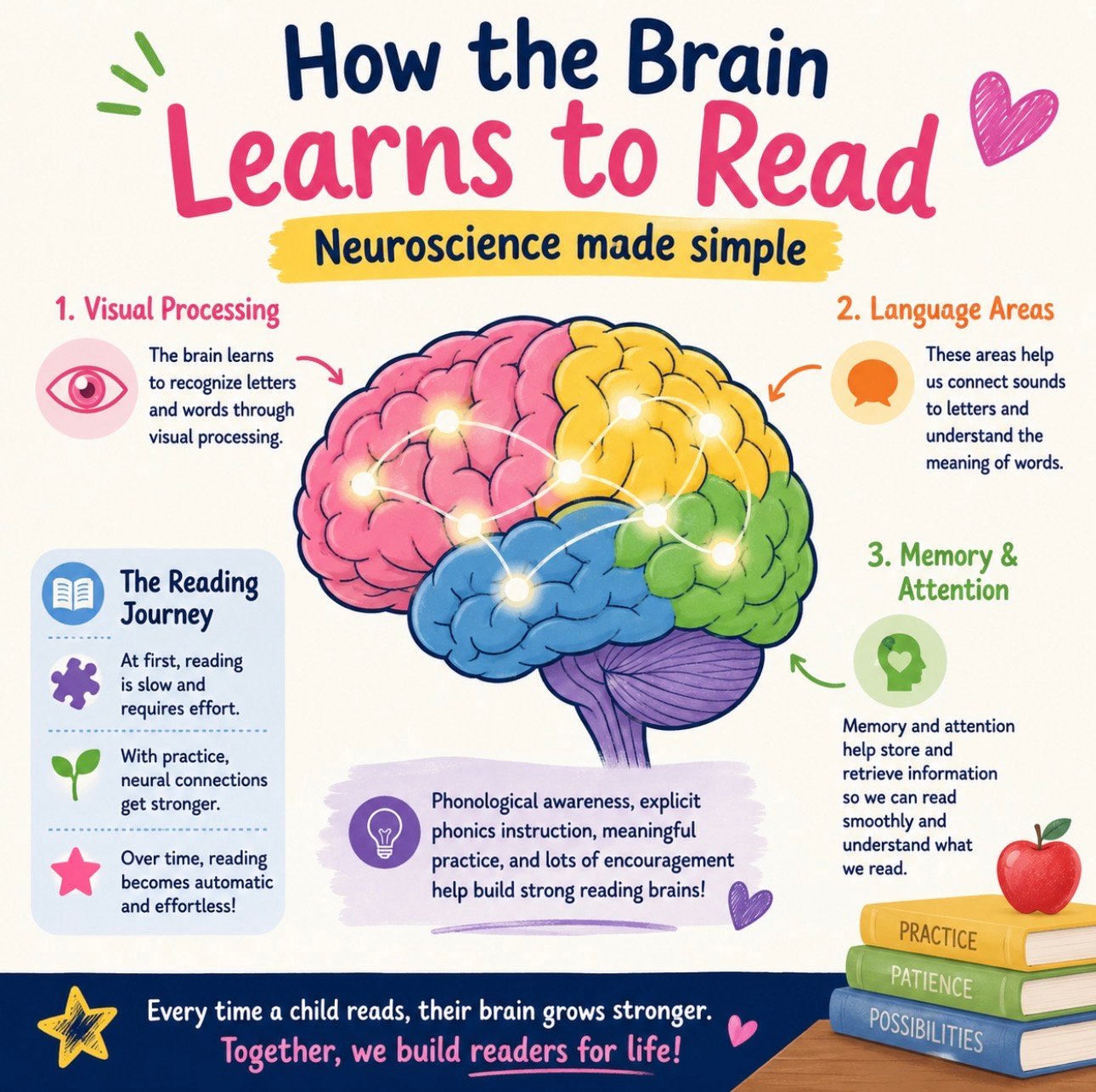
When children learn to read, the brain links together three key areas:
- Visual processing areas that recognize letters and words
- Language areas that process sounds and meanings
- Memory and attention systems that help store and retrieve information
Through repeated practice, these areas begin working together efficiently, allowing reading to become more automatic over time.
The Importance of Phonological Awareness
One of the most important discoveries from reading research is the role of phonological awareness—the ability to hear and manipulate sounds in spoken words.
Before children can successfully connect letters to sounds, they need to understand that words are made up of smaller sound units. Skills such as identifying rhymes, counting syllables, and blending sounds prepare the brain for reading instruction.
For example, when a child recognizes that the word cat consists of the sounds /c/ /a/ /t/, they are developing the foundation needed for decoding.
Research consistently shows that strong phonological awareness is one of the best predictors of future reading success.
Building the Reading Pathway
As children learn letter-sound relationships, the brain begins forming what scientists sometimes call a "reading pathway."
At first, reading is slow and effortful. A child may need to consciously sound out each letter:
c-a-t... cat
With practice, neural connections strengthen. Eventually, the brain can recognize familiar words almost instantly. This process is known as orthographic mapping, where words become stored in long-term memory for rapid retrieval.
The more successful reading experiences children have, the stronger and more efficient these pathways become.
Why Repetition Matters
Neuroscience tells us that the brain changes through repetition. Every time students practice reading accurately, they strengthen neural connections associated with reading.
This does not mean endless worksheets or drills. Meaningful repetition can occur through:
- Repeated reading of familiar texts
- Guided reading practice
- Decodable texts aligned with phonics instruction
- Reading and discussing engaging books
- Word study activities
Consistent, structured practice helps transform reading from a laborious task into an automatic skill.
Reading Difficulties and the Brain
Brain research has also helped us better understand reading difficulties such as dyslexia.
Children with dyslexia are not less intelligent or less capable of learning. Their brains simply process language differently. They often require more explicit, systematic instruction and additional practice to develop reading pathways.
The encouraging news is that the brain remains adaptable. With evidence-based instruction, many struggling readers can make significant progress.
What This Means for Teachers
Understanding the neuroscience of reading reinforces several important classroom practices:
- Teach phonological awareness explicitly.
- Provide systematic phonics instruction.
- Offer frequent opportunities for reading practice.
- Build vocabulary and language comprehension.
- Use assessment to identify and address difficulties early.
- Foster confidence and motivation alongside skill development.
When instruction aligns with how the brain learns, students are more likely to develop strong reading foundations.
Final Thoughts
The science of reading is not about replacing the joy of literature with drills and data. Rather, it helps us understand how children acquire the skills needed to access the rich world of reading.
Every time we teach a child to connect sounds to letters, decode a new word, or comprehend a meaningful text, we are helping build and strengthen neural pathways that can last a lifetime.
As educators, that is a remarkable opportunity. By understanding how the brain learns to read, we can better support every learner on their journey toward becoming a confident, capable reader.