

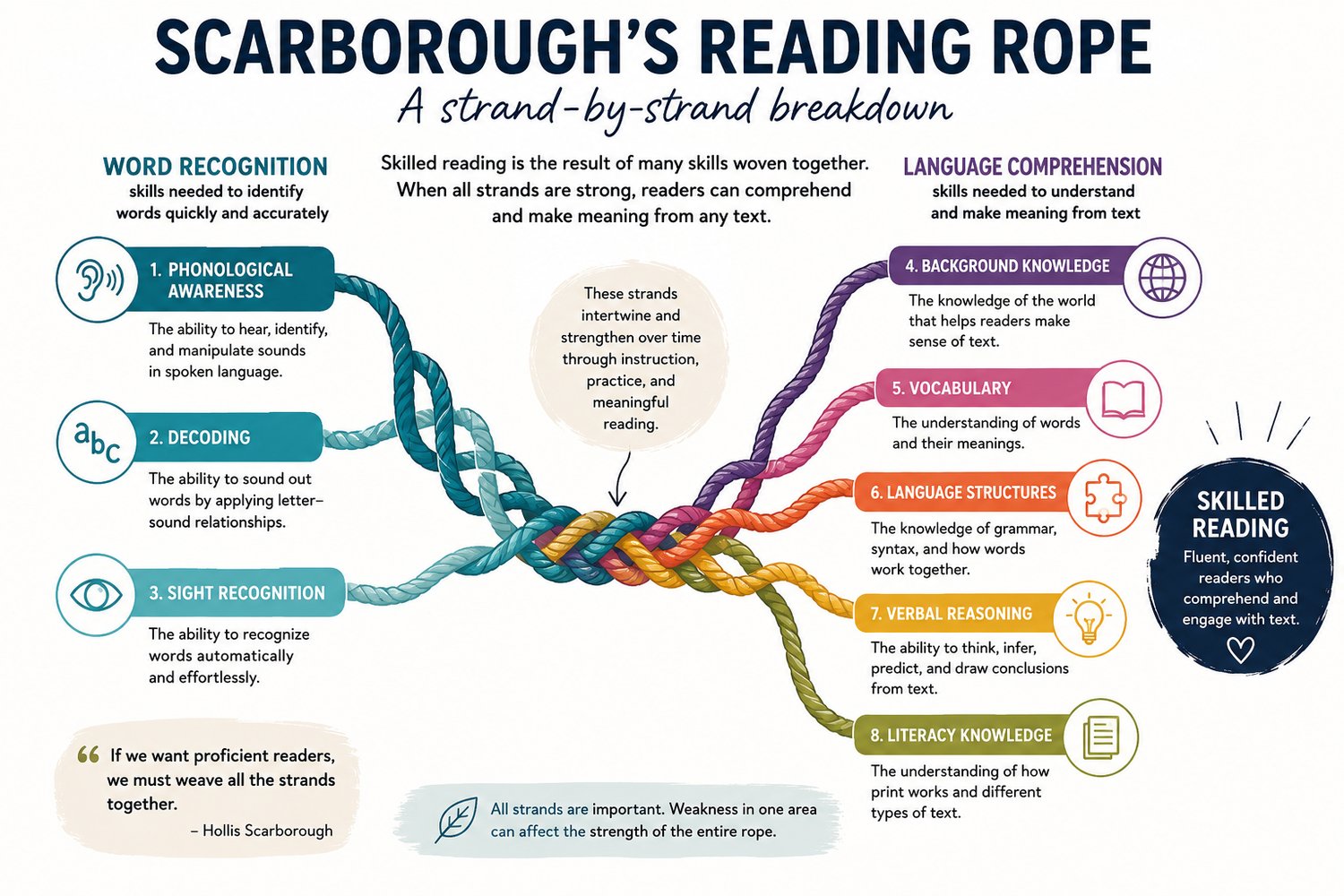
Reading is one of the most complex skills we teach, yet for years it was often treated as a single process. In reality, skilled reading develops through the interaction of multiple language and literacy skills working together. One of the most influential models for understanding this process is Scarborough’s Reading Rope.
Developed by literacy researcher Dr. Hollis Scarborough in 2001, the Reading Rope provides a visual representation of how different reading skills intertwine and strengthen over time to create proficient readers. The model has become a cornerstone of the Science of Reading because it helps educators understand exactly what students need to become successful readers.
Let’s take a closer look at each strand of the rope and explore what it means for classroom instruction.
What Is Scarborough’s Reading Rope?
Scarborough’s Reading Rope consists of two major sections:
- Word Recognition
- Language Comprehension
Each section contains several smaller strands that gradually become more automatic and interconnected as students develop reading proficiency. Just as individual strands are woven together to create a strong rope, these literacy skills combine to support skilled reading.
When one or more strands are weak, reading becomes more difficult. When all strands are developed and integrated, students can read fluently and comprehend complex texts.
The Word Recognition Strands
Word recognition focuses on the skills students use to identify written words accurately and efficiently.
1. Phonological Awareness
Phonological awareness is the ability to hear, identify, and manipulate sounds in spoken language. This includes:
- Recognizing rhymes
- Segmenting words into syllables
- Identifying individual phonemes
- Blending and manipulating sounds
Strong phonological awareness forms the foundation for decoding. Before students can connect letters to sounds, they must first be able to hear and work with those sounds.
Classroom strategies:
- Rhyming games
- Sound matching activities
- Phoneme segmentation practice
- Oral language activities
2. Decoding
Decoding is the process of translating written symbols into spoken language using knowledge of letter-sound relationships.
Students learn to:
- Recognize graphemes
- Apply phonics rules
- Blend sounds into words
- Read unfamiliar words
Systematic, explicit phonics instruction is essential for developing strong decoding skills.
Classroom strategies:
- Explicit phonics lessons
- Word building activities
- Decodable texts
- Sound-spelling mapping
3. Sight Recognition
Sight recognition refers to the ability to recognize words automatically and effortlessly.
Contrary to popular belief, sight words are not memorized as visual shapes. Through repeated successful decoding, words become stored in long-term memory and can be recognized instantly.
Automatic word recognition allows students to focus their cognitive energy on understanding what they read rather than figuring out individual words.
Classroom strategies:
- Repeated reading
- Decodable text practice
- High-frequency word instruction
- Fluency-building activities
The Language Comprehension Strands
Language comprehension includes the skills students use to make meaning from text.
4. Background Knowledge
Background knowledge encompasses what students already know about the world.
The more knowledge students possess about a topic, the easier it is for them to understand related texts. Knowledge acts as a framework that helps readers connect new information to existing understanding.
Classroom strategies:
- Knowledge-rich curricula
- Read-alouds across content areas
- Multimedia resources
- Discussion and inquiry-based learning
5. Vocabulary
Vocabulary knowledge includes both the words students understand and the words they use.
A robust vocabulary supports reading comprehension because students cannot understand texts that contain too many unfamiliar words.
Vocabulary grows through:
- Direct instruction
- Wide reading
- Conversations
- Exposure to rich language
Classroom strategies:
- Explicit vocabulary teaching
- Morphology instruction
- Context clue practice
- Academic language development
6. Language Structures
Language structures refer to the grammar, syntax, and sentence structures used in spoken and written language. Students must understand how words work together within sentences to construct meaning.
For example, complex sentence structures in academic texts often present comprehension challenges even when individual words are familiar.
Classroom strategies:
- Sentence combining
- Mentor text analysis
- Oral language practice
- Grammar instruction within authentic contexts
7. Verbal Reasoning
Verbal reasoning involves thinking beyond the literal meaning of text.
Students use verbal reasoning when they:
- Make inferences
- Predict outcomes
- Interpret figurative language
- Understand implied meanings
These skills help readers engage deeply with texts and draw meaningful conclusions.
Classroom strategies:
- Think-alouds
- Guided discussions
- Questioning techniques
- Inferencing activities
8. Literacy Knowledge
Literacy knowledge includes understanding how print works and familiarity with different types of texts.
Students develop awareness of:
- Print concepts
- Text features
- Genres
- Author’s purpose
- Text organization
These understandings help students navigate increasingly complex reading materials.
Classroom strategies:
- Exposure to diverse genres
- Shared reading
- Text feature exploration
- Writing across genres
Why the Reading Rope Matters
One of the most important messages from Scarborough’s Reading Rope is that reading difficulties can stem from different strands.
A student who struggles with decoding may need targeted phonics support. Another student may read fluently but struggle with comprehension due to limited vocabulary or background knowledge.
The model reminds us that effective literacy instruction must address both word recognition and language comprehension. Focusing exclusively on one area leaves important strands undeveloped.
What This Means for Teachers
Scarborough’s Reading Rope encourages educators to take a comprehensive approach to literacy instruction. Effective reading programs should:
- Include systematic phonics instruction
- Build oral language skills
- Expand vocabulary and knowledge
- Develop comprehension strategies
- Provide opportunities for meaningful reading and discussion
When we intentionally strengthen each strand, we help students build the strong, flexible rope needed for lifelong reading success.
Final Thoughts
Scarborough’s Reading Rope offers more than a framework—it provides a roadmap for literacy instruction. By understanding each strand and how they work together, teachers can better identify student needs, plan targeted instruction, and support all learners on their journey toward skilled reading.
As educators, our goal is not simply to teach students to read words on a page. It is to help them become confident readers who can understand, analyze, and learn from what they read. Scarborough’s Reading Rope reminds us that achieving this goal requires careful attention to every strand.