

The 5 Pillars of Reading: What Every Teacher Needs to Know
If you've spent any time in literacy circles, you've heard the phrase "the five pillars of reading." But what does it actually mean for your classroom on a Tuesday morning, when you've got twenty-six readers in front of you working at twelve different levels?
The five pillars come from the 2000 National Reading Panel report, which synthesized decades of research to identify the core components of skilled reading instruction. They aren't a curriculum or a program—they're the foundational areas that effective reading instruction has to address. When one pillar is weak or missing, the whole structure wobbles. Here's a practical look at each one.
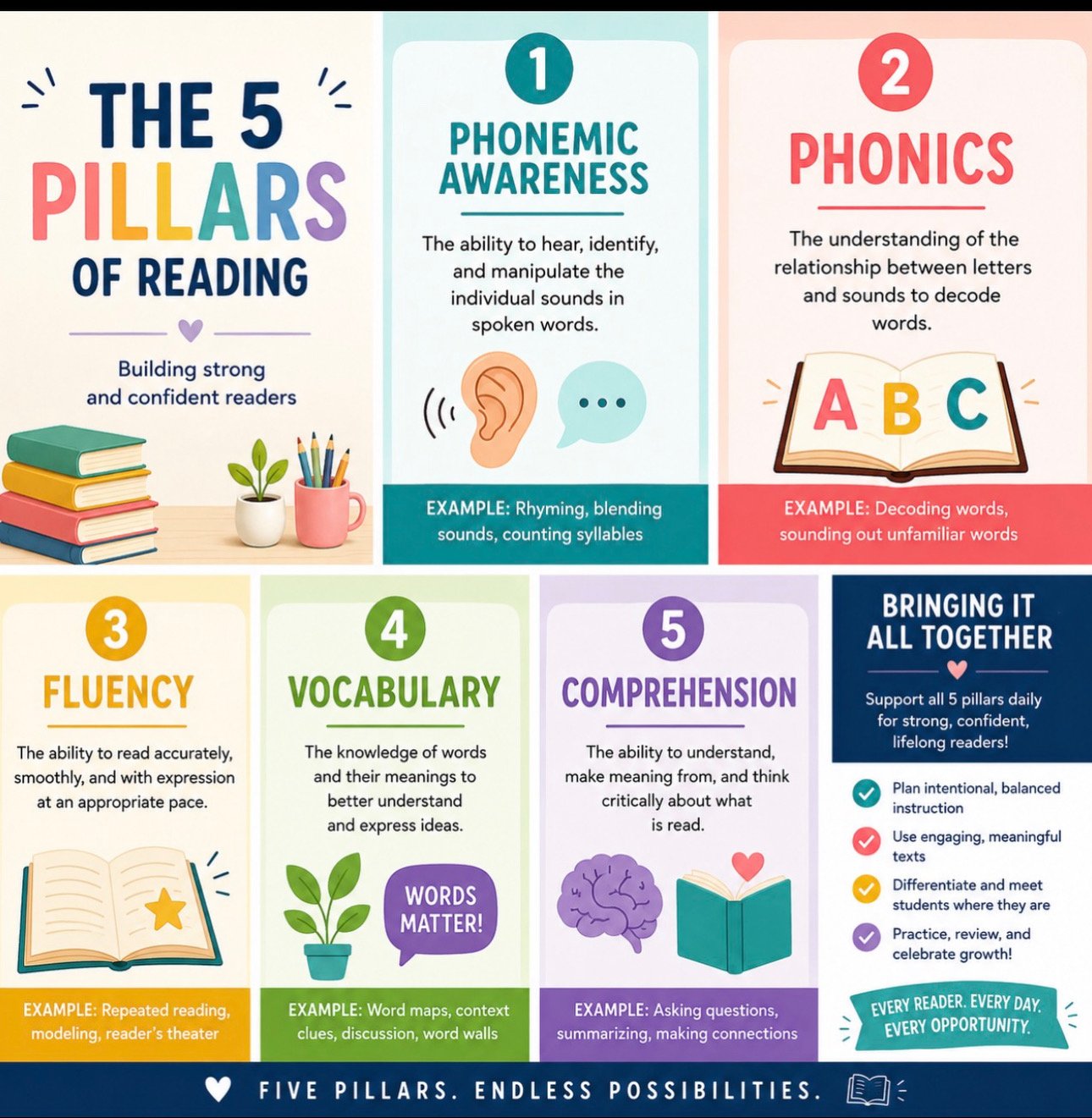
1. Phonemic Awareness
Phonemic awareness is the ability to hear, identify, and manipulate the individual sounds (phonemes) in spoken words. Notice that this is entirely an oral skill—no letters required. A student who can tell you that "cat" starts with /k/, or who can blend /s/ /u/ /n/ into "sun," is demonstrating phonemic awareness.
This pillar lives in the early grades but shows up again whenever an older student struggles to decode. If a sixth grader can't segment the sounds in a multisyllabic word, no amount of vocabulary instruction will fix the underlying problem. Quick oral warm-ups—blending, segmenting, deleting and substituting sounds—keep this skill sharp.
2. Phonics
Phonics connects those sounds to print. It's the understanding that letters and letter combinations represent specific sounds, and that we can use those relationships to decode unfamiliar words. This is where systematic, explicit instruction pays off enormously: teaching letter-sound correspondences in a deliberate sequence rather than hoping students absorb them through exposure.
Strong phonics instruction is cumulative and direct. Students learn a pattern, practice it in isolation and in connected text, and then build on it. The goal is automaticity—getting decoding to the point where it no longer hogs all of a reader's mental energy, freeing them up to think about meaning.
3. Fluency
Fluency is the bridge between decoding and comprehension. A fluent reader reads accurately, at an appropriate pace, and with expression (what we call prosody). When reading is labored and word-by-word, comprehension suffers because the reader is spending everything they've got just getting the words off the page.
The most effective fluency-builder is still the simplest: repeated, supported oral reading. Think partner reading, echo reading, reader's theater, and timed re-reads of the same passage. Round-robin reading, by contrast, does very little—most students are tuned out waiting for their turn. Build in real, repeated practice with feedback instead.
4. Vocabulary
You can't comprehend words you don't know. Vocabulary knowledge has one of the strongest correlations with reading comprehension, and the gap between word-rich and word-poor students tends to widen over time without intervention.
Effective vocabulary instruction goes beyond looking up definitions. It means teaching words in context, returning to them repeatedly across days, connecting new words to ones students already know, and giving students reasons to actually use the words in speaking and writing. Prioritize the high-utility academic words that show up across texts and content areas—these give you the most instructional bang for your buck.
5. Comprehension
Comprehension is the whole point—the reason the other four pillars exist. It's the active process of constructing meaning from text, and it draws on everything else: decoding, fluency, vocabulary, plus background knowledge and intentional strategy use.
Skilled readers do things almost automatically that we can teach directly: asking questions, making inferences, summarizing, monitoring whether the text is making sense, and repairing comprehension when it breaks down. Background knowledge matters enormously here too. A reader can decode every word in a passage about photosynthesis and still understand none of it without the relevant knowledge to hang it on, which is why a content-rich curriculum is itself a comprehension strategy.
Bringing the Pillars Together
It's tempting to treat these as a checklist or a strict sequence—master phonemic awareness, then move to phonics, and so on. In reality, the pillars work together and overlap throughout a reader's development. A strong literacy block weaves several of them into the same lesson, and skilled readers draw on all five at once, every time they read.
The takeaway isn't to teach the pillars in lockstep, but to make sure none of them is being neglected. When a student struggles, the pillars give you a diagnostic lens: Is this a decoding problem? A fluency bottleneck? A vocabulary or knowledge gap? Knowing which pillar is shaky tells you where to aim your instruction—and that's what turns the research into real results for the readers in front of you.
What does this look like in your classroom? I'd love to hear how you balance the five pillars in your own literacy block.