

If you’ve ever had a student who reads every word on the page perfectly but can’t tell you what the passage was about, you’ve already met the problem the Simple View of Reading was built to explain. It’s one of the most useful frameworks in the Science of Reading, and the best part is that you can hold the whole thing in your head while standing at the copier.
The Whole Theory in One Line
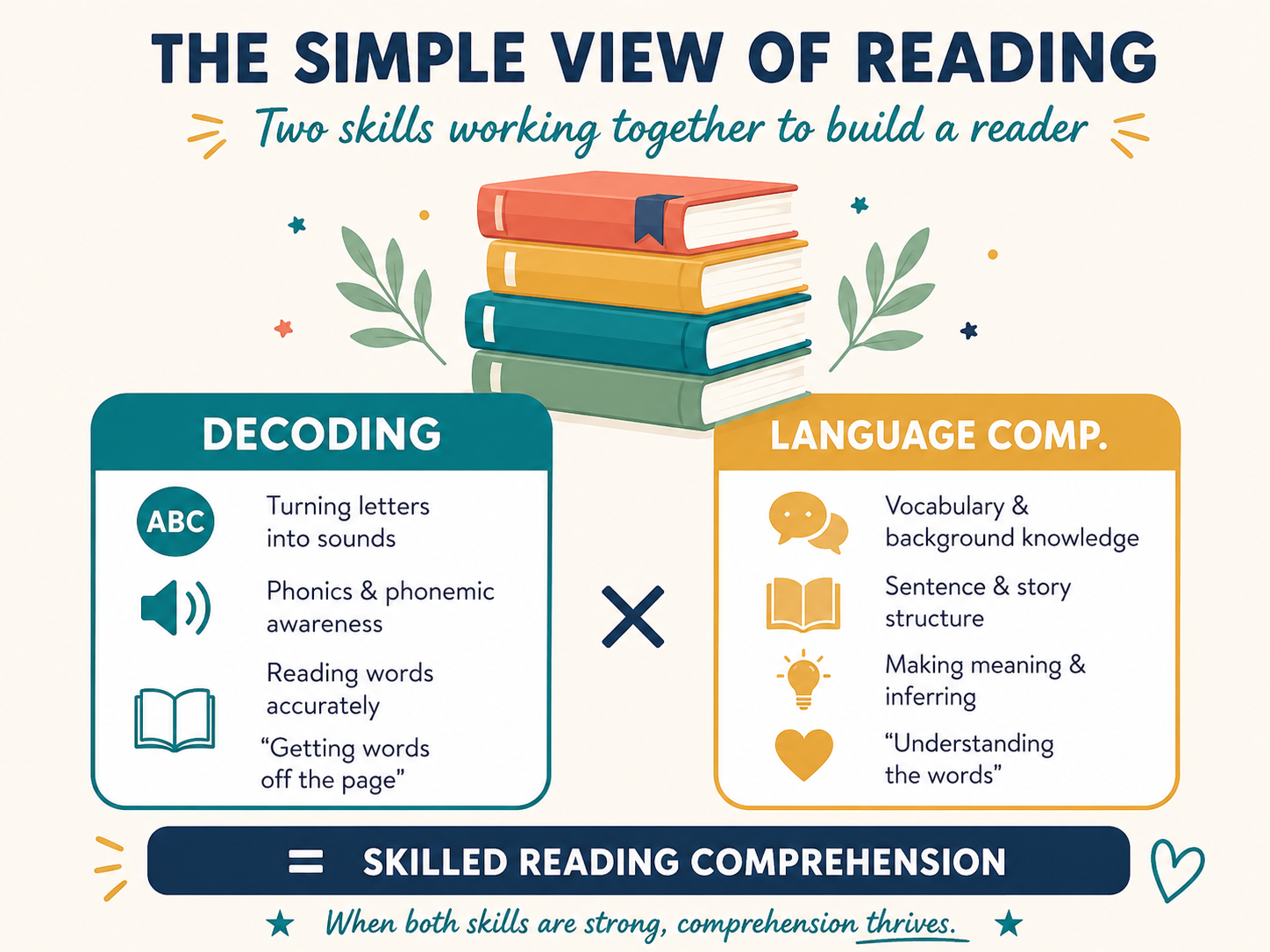
Reading comprehension is the product of two things: how well a student can decode words and how well they understand language. Researchers Gough and Tunmer put it as a formula back in 1986:
Decoding × Language Comprehension = Reading Comprehension
Notice it’s multiplication, not addition. That matters. If either factor is near zero, comprehension collapses no matter how strong the other side is. A student who decodes flawlessly but has weak language comprehension still won’t understand what they read. A student with rich vocabulary and background knowledge who can’t decode the words on the page is just as stuck.
What Each Side Actually Means
Decoding is the ability to translate print into speech: matching letters and letter patterns to sounds, blending them, and reading words accurately and fluently. This is the territory of phonics, phonemic awareness, and word recognition.
Language comprehension is everything a student would need to understand a text *if you read it aloud to them: vocabulary, background knowledge, sentence structure, inferencing, and understanding how stories and arguments are organized.
A quick way to think about it: decoding is getting the words off the page, and language comprehension is making meaning from them
Why This Saves You Time
The framework is powerful because it turns a vague problem (“this kid struggles with reading”) into a diagnostic question with only a few possible answers. When a student isn’t comprehending, the cause almost always falls into one of these profiles:
*Strong decoding, weak language comprehension. These students read aloud smoothly, so their struggles are easy to miss. They need work on vocabulary, background knowledge, and comprehension strategies—not more phonics.
*Weak decoding, strong language comprehension. These students understand a text fine when you read it to them but stumble over the words themselves. This is the classic dyslexia profile. They need targeted decoding and fluency instruction.
*Weak in both. These students need support on both sides, often starting with decoding so they can access text independently.
Instead of throwing every intervention at the wall, you figure out which side of the equation is breaking down and target that.
Simple Way to Spot the Profile
You don’t need a formal assessment to start forming a hypothesis. Try this: have the student read a grade-level passage aloud, then read a different passage of similar difficulty aloud *to them*. Ask comprehension questions about both.
- Struggles to read the words but understands the read-aloud → likely a decoding issue.
- Reads the words fine but can’t answer questions either way → likely a language comprehension issue.
- Struggles with both → support on both fronts.
It’s not diagnostic in a clinical sense, but it points you in the right direction in about ten minutes.
The Catch Worth Knowing
The Simple View is intentionally simple, and that’s its strength and its limit. It doesn’t fully capture fluency, motivation, or the way background knowledge interacts with specific texts. Many researchers now pair it with Scarborough’s Reading Rope, which “unbraids” each strand into more detail. Think of the Simple View as the quick mental model you use on the fly, and the Rope as the zoomed-in map when you need more nuance.
The Takeaway
When a student isn’t comprehending, resist the urge to guess. Ask yourself: is this a decoding problem, a language comprehension problem, or both? That single question, drawn from one short formula, will route your time and energy where they’ll actually move the needle—which is exactly what you need when you’ve got thirty kids and not enough hours.