

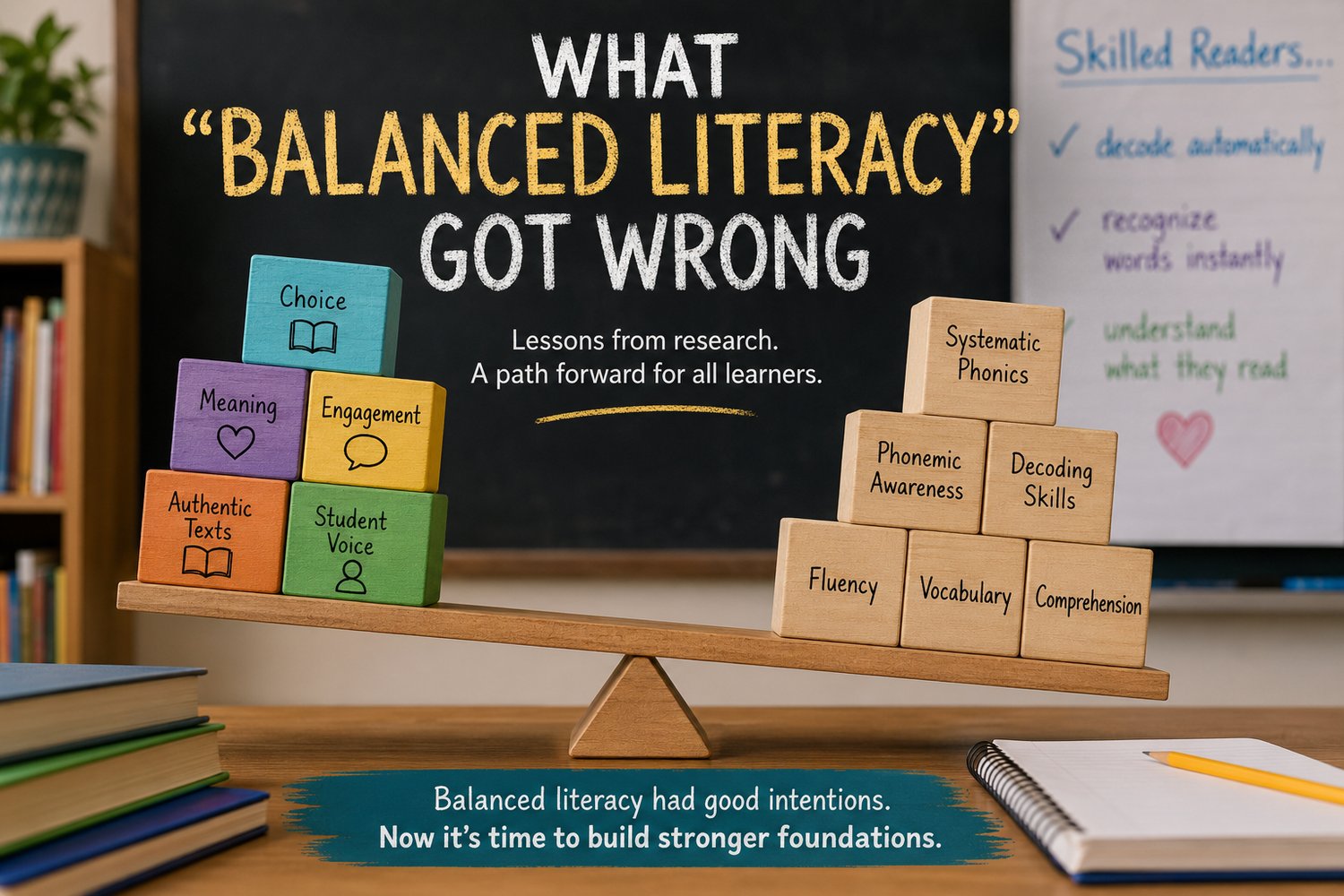
What “Balanced Literacy” Got Wrong
For years, balanced literacy was presented as the reasonable middle ground in reading instruction. The name itself sounded reassuring: not too rigid, not too skills-focused, not too worksheet-heavy. Just a balanced approach that combined authentic reading and writing experiences with some phonics instruction.
Many teachers embraced it in good faith. I did too.
But as more evidence emerged about how children learn to read, it became increasingly clear that balanced literacy had a fundamental problem: it often treated reading as a natural process that children would largely figure out through exposure, practice, and strategies. For many students, that assumption proved costly.
The Problem Was Never Teacher Commitment
Before discussing what balanced literacy got wrong, it's important to acknowledge what it got right.
Balanced literacy encouraged rich classroom libraries, meaningful conversations about books, student choice, writing across the curriculum, and a love of reading. Teachers worked incredibly hard to create literacy-rich environments where children saw themselves as readers and writers.
The issue was not a lack of dedication from educators.
The issue was that the instructional model was built on several assumptions about reading that research has not supported.
Reading Is Not a Natural Process
One of the biggest misconceptions behind balanced literacy was the idea that reading develops similarly to speaking.
Children acquire spoken language naturally when surrounded by language. Reading is different. The human brain is not wired to read automatically. Reading requires explicit instruction that helps students connect letters and letter patterns to speech sounds.
When schools assume that reading will emerge primarily through exposure to books, many students succeed anyway—often because they receive support elsewhere or have strengths that compensate for instructional gaps.
But many others do not.
Cueing Systems Encouraged Guessing
Perhaps the most criticized aspect of balanced literacy is its emphasis on cueing strategies.
Students were often taught to figure out unknown words by asking questions such as:
- Does it make sense?
- What would sound right?
- Look at the picture.
- Think about what word might fit.
While meaning and context certainly matter for comprehension, struggling readers often learned to rely on these cues instead of actually decoding the word.
A child looking at the sentence “The horse ran across the field” might say “pony” because it fits the meaning and matches the picture. Under some balanced literacy approaches, this response was treated as evidence of strategic reading.
But skilled readers do not primarily guess words from context. They rapidly recognize words because they can decode them.
When instruction encourages guessing, students may appear successful in predictable texts while developing weak foundational skills.
Phonics Was Often Present—but Not Systematic
Defenders of balanced literacy sometimes point out that phonics was included in many programs.
That is true.
The problem was not necessarily the absence of phonics. It was often the lack of systematic, explicit phonics instruction.
In many classrooms, phonics lessons were brief, inconsistent, or introduced according to a program's pacing rather than a carefully sequenced progression of skills. Students might encounter letter-sound relationships, but not receive enough practice to achieve automaticity.
Research increasingly shows that many students benefit from structured instruction that builds decoding skills in a logical sequence.
Assessment Sometimes Focused on the Wrong Things
Balanced literacy classrooms often relied heavily on running records and observations of reading behaviors.
These assessments provided useful information, but they sometimes encouraged teachers to analyze how students were using reading strategies rather than whether students possessed the underlying decoding skills needed for fluent reading.
A child who appeared engaged, used picture clues, and self-corrected occasionally might seem to be progressing. Yet that same child could still lack the phonics knowledge necessary to read increasingly complex text independently.
The Biggest Cost Fell on Vulnerable Students
Students who learn to read easily can succeed under many instructional approaches.
The real test of a reading program is how it serves students who struggle.
Children with dyslexia, language-processing challenges, limited exposure to print, or other risk factors often need direct, systematic instruction. When that instruction is delayed or inconsistent, achievement gaps widen.
Balanced literacy tended to work best for students who needed it least and least well for students who needed the strongest instructional support.
What Should Replace It?
The answer is not to eliminate authentic reading, classroom libraries, or meaningful discussions about books.
The goal is not to replace one extreme with another.
Instead, schools should build literacy instruction around what research tells us about reading development:
- Explicit and systematic phonics instruction
- Strong phonemic awareness instruction
- Vocabulary and language development
- Background knowledge building
- Reading fluency practice
- High-quality comprehension instruction
- Ample opportunities to read and discuss real books
In other words, students need both foundational skills and rich literacy experiences.
The difference is that foundational skills cannot be left to chance.
Moving Forward
The conversation about balanced literacy is often framed as a battle between philosophies. But for most teachers, it is something more practical.
We want approaches that help all children become successful readers.
Many educators implemented balanced literacy because they were trained to do so and because respected experts recommended it. As the evidence evolved, our understanding evolved too.
That is not failure. That is professional growth.
The most important lesson from the balanced literacy debate is not that teachers got it wrong. It is that literacy instruction should remain grounded in the best available evidence, even when that evidence challenges long-held beliefs.
Our students deserve nothing less.