

A teacher's take on the most important thing the Science of Reading teaches us
Every fall, I watch the same thing happen.
A child sits in front of a book and struggles. Maybe they reverse letters. Maybe they sound out a word perfectly and then can't remember it two lines later. Maybe they shut down entirely, convinced that something is wrong with them.
And somewhere nearby, a well-meaning adult says the thing that breaks my heart a little every time: "Just keep reading. It'll click."
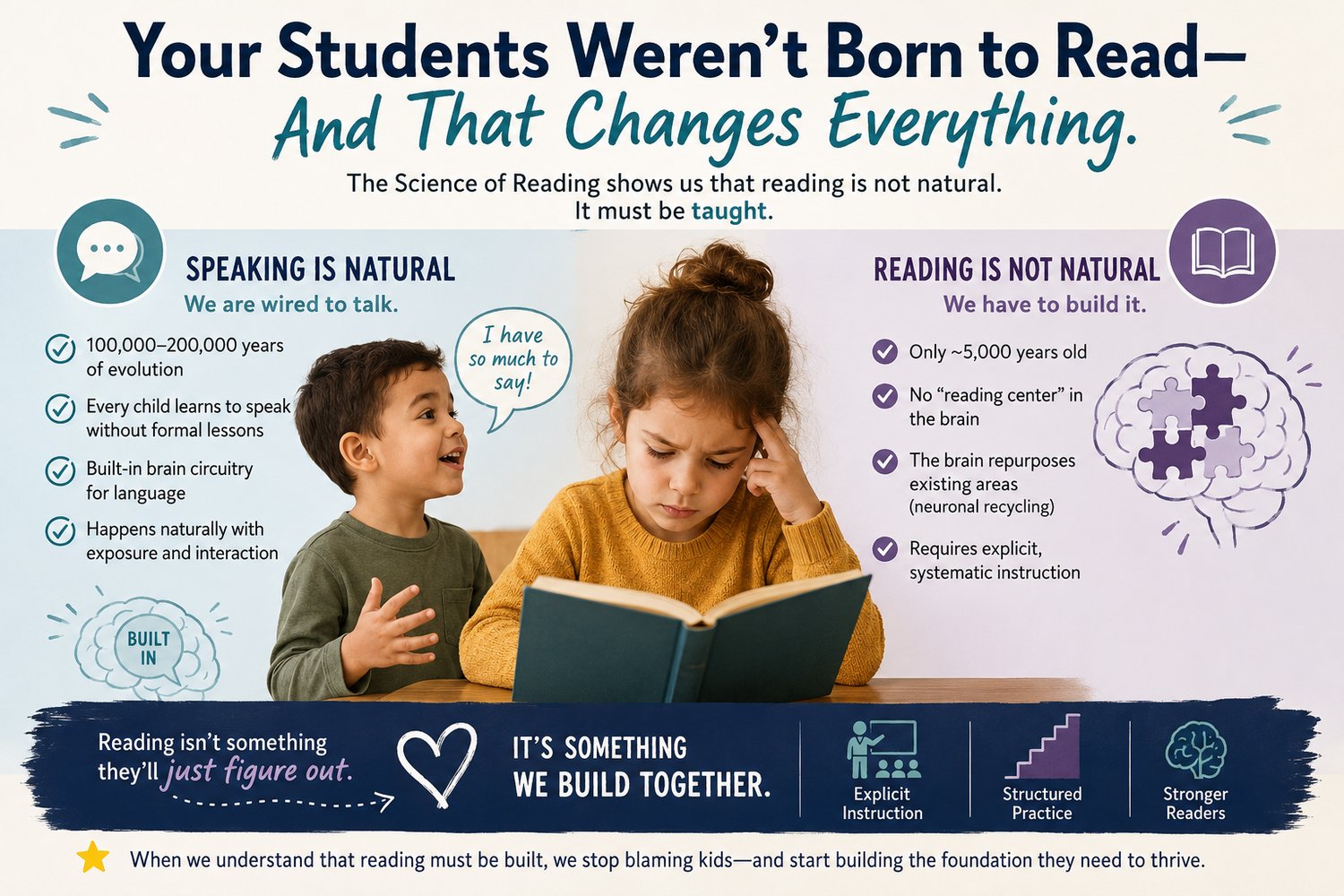
Here's what I want every teacher, parent, and caregiver to understand — something the Science of Reading has made crystal clear: reading is not natural. Speaking is. And that distinction matters more than almost anything else we know about literacy.
We Are Wired to Talk. We Are Not Wired to Read.
Human beings have been speaking for somewhere between 100,000 and 200,000 years. Every neurotypical child on earth, raised in a language-rich environment, will learn to speak their home language without a single lesson. No phonics. No decoding. No curriculum. Just exposure, immersion, and the astonishing human brain doing what evolution built it to do.
Reading? Reading is approximately 5,000 years old. That is nothing on an evolutionary timescale. There is no "reading center" in the brain the way there is circuitry dedicated to language acquisition. Instead, when a child learns to read, the brain has to perform a remarkable act of repurposing — borrowing and rewiring regions originally built for object recognition, oral language, and memory to create a system that simply does not exist by default.
Dr. Stanislas Dehaene, a leading cognitive neuroscientist, calls this process neuronal recycling. We are literally teaching the brain to do something it was never designed to do.
That is not a flaw in our students. That is just biology.
What "Natural" Actually Looks Like
Think about what a child does not need in order to learn to speak:
- Explicit instruction in how to form sounds
- A scope and sequence for grammar
- Practice worksheets
- A teacher
They hear language. They attempt language. Adults around them respond. Over time — sometimes very quickly — fluency emerges. Children in bilingual homes often pick up two languages simultaneously, sorting out completely different grammar systems, and no one formally teaches them to do it.
This happens because the brain has a language acquisition device (as Chomsky famously theorized) or, more precisely, because oral language development taps into neural architecture that is ready and waiting from birth.
Reading taps into no such thing.
The Implications for Our Classrooms
If reading were natural, struggling readers would just need more time. More exposure. More books put in front of them.
But reading is not natural — which means struggling readers often need something very different: explicit, systematic, structured instruction in how the written code works.
This is the foundational insight of the Science of Reading. Children do not intuit that letters represent sounds. They do not automatically notice that English spelling, while messy, follows patterns. They do not naturally develop phonemic awareness just because we read aloud to them (though read-alouds matter enormously for other reasons).
They need to be taught these things. Directly. Sequentially. With enough repetition that the brain builds the neural pathways reading requires.
When a student is "stuck," it's often not a motivation problem or an attention problem. It's frequently a code-knowledge problem — a gap in the explicit instruction that should have built the foundation underneath them.
This Should Change How We See Struggling Readers
One of the most powerful shifts I've made in my own teaching is this: I stopped asking "Why isn't this child trying harder?" and started asking "What hasn't been made explicit for this child yet?"
That reframe is everything.
A child who can't decode multisyllabic words isn't lazy. They may never have been taught how syllable types work. A student who reads word-by-word with no fluency may have working memory gaps in phonics automaticity — gaps that drill-and-kill won't fix but structured cumulative practice might.
When we understand that reading must be built, we stop blaming children for not arriving with something they were never born with. We start taking responsibility for building it with them.
What This Means for Every Teacher (Not Just Reading Specialists)
You don't have to be a reading interventionist to internalize this. You just have to carry it with you.
When a student struggles with a text in your science class or your social studies class, the barrier isn't always comprehension — it's sometimes still decoding. When a child avoids reading, they may have learned that reading is unpredictable and humiliating, because the foundational code was never made clear.
Every teacher is a literacy teacher. And every teacher deserves to know: your students aren't failing at something natural. They're attempting something that requires instruction — real, thoughtful, expert instruction.
That's our job. And understanding why makes us so much better at it.