
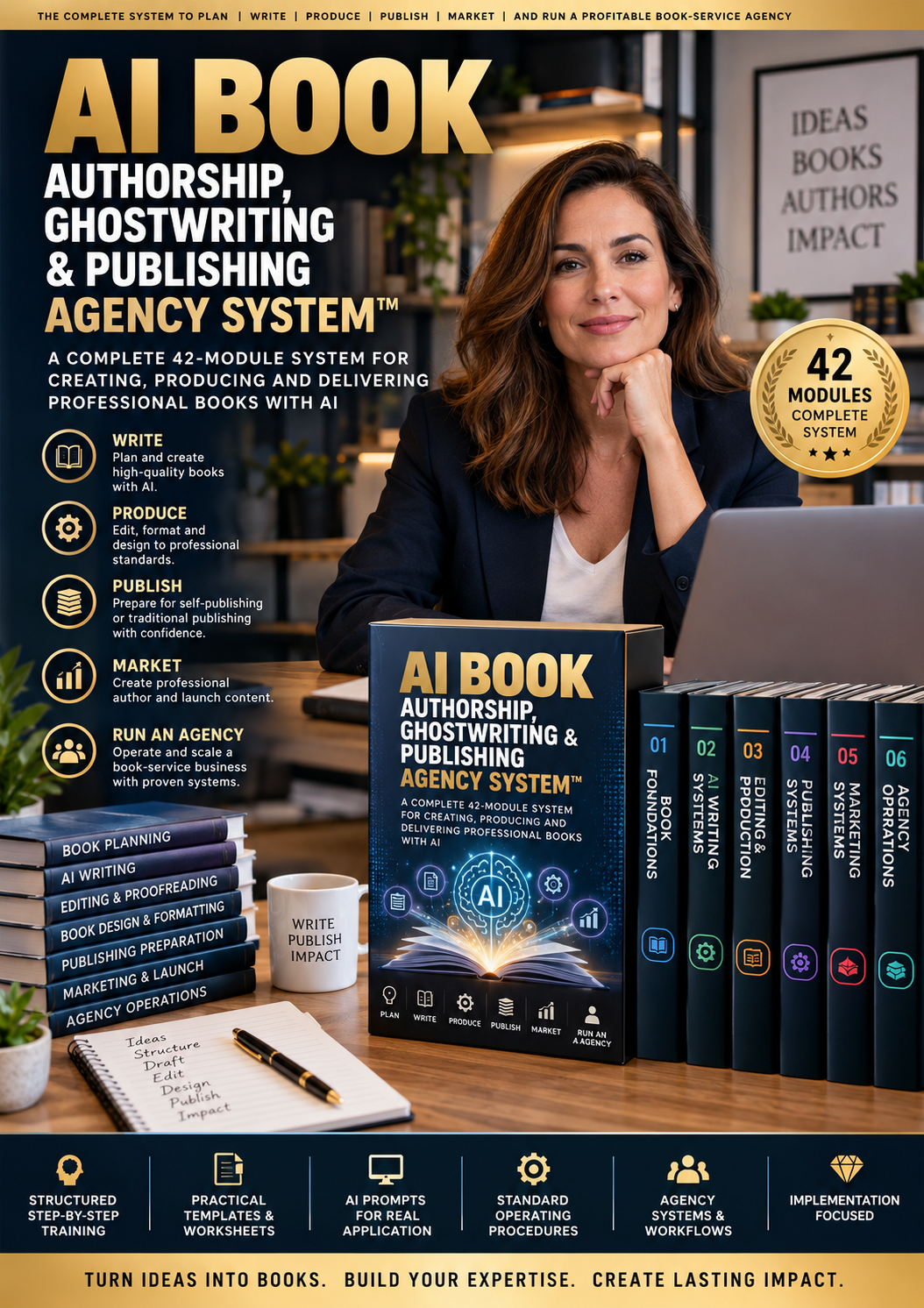
Build a Complete AI-Assisted Book-Service Workflow — From Client Discovery to Manuscript, Publishing Preparation, Delivery & Agency Operations
What if you could stop treating book creation as a collection of disconnected tasks and instead operate from one structured 42-module system?
The AI BOOK AUTHORSHIP, GHOSTWRITING & PUBLISHING AGENCY SYSTEM™ is a premium implementation-focused training and workflow system designed for freelancers, ghostwriters, editors, book-service providers, aspiring agencies and entrepreneurs who want a structured way to manage the many stages involved in professional book projects.
From the first client conversation to final delivery, the system brings together book discovery, research, architecture, drafting, editing, proofreading, formatting, cover development, metadata, publishing preparation, client communication, project management, quality control, marketing content, agency operations and AI-assisted workflows.
📚 ONE SYSTEM. 42 CONNECTED MODULES.
Book-service work can involve dozens of separate activities.
Research.
Planning.
Writing.
Editing.
Proofreading.
Formatting.
Cover development.
Metadata.
Publishing preparation.
Client approvals.
Project management.
Delivery.
Agency operations.
Automation.
The problem is not simply knowing what these activities are.
The challenge is knowing how they connect.
This system is designed around that connection.
The workflow:
CLIENT / AUTHOR
↓
DISCOVERY
↓
PROJECT DEFINITION
↓
BOOK CONCEPT
↓
RESEARCH
↓
BOOK ARCHITECTURE
↓
VOICE & DRAFTING
↓
DEVELOPMENTAL EDITING
↓
COPY & LINE EDITING
↓
PROOFREADING
↓
FORMATTING
↓
COVER & VISUAL IDENTITY
↓
DESCRIPTION & SALES COPY
↓
METADATA
↓
PUBLISHING PREPARATION
↓
DELIVERY
↓
MARKETING CONTENT
↓
AGENCY OPERATIONS
↓
AUTOMATION
↓
MASTER QUALITY CONTROL
TO GET INSTANT ACCESS CLICK HERE
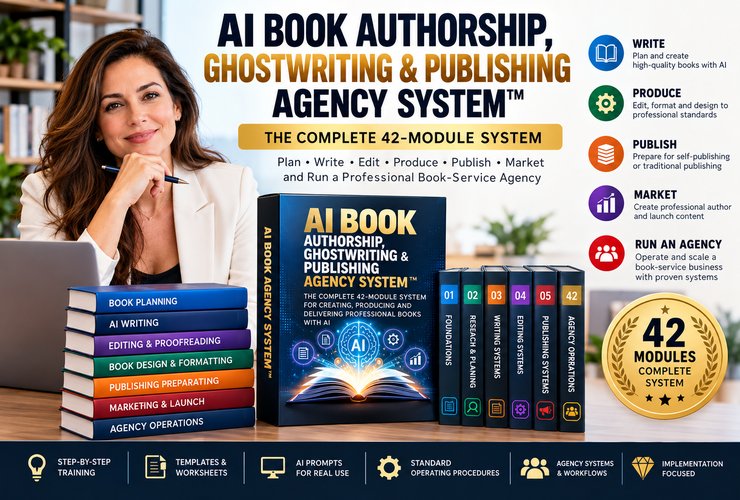
🚀 WHAT YOU GET
The system contains 42 connected modules, each addressing a specific part of the book-service workflow.
Modules 01–10 — Book Creation Foundation
Build the foundations for structured book production, including:
- Book project foundations
- Research workflows
- AI-assisted research
- Author knowledge extraction
- Book concept development
- Audience definition
- Book architecture
- Chapter planning
- Voice development
- AI-assisted drafting
Modules 11–20 — Manuscript Development
Move from draft to professionally reviewed manuscript:
- Drafting systems
- Chapter development
- Manuscript analysis
- Developmental editing
- Copy-editing
- Line-editing
- Proofreading
- Final manuscript QA
- Book formatting
- Interior design
Modules 21–30 — Production & Client Workflow
Build the production and client-facing infrastructure:
- Book interior design
- Book cover and visual identity
- Book description and sales copy
- Metadata
- Publishing preparation
- Self-publishing workflow
- Audiobook production
- Translation and multilingual workflows
- Rights, copyright and confidentiality
- Client onboarding and book discovery
Modules 31–42 — Agency & Business Operations
Turn individual book-production tasks into an organised service operation:
- Book project management
- Client communication
- Master quality control
- Client delivery and approval
- Book marketing content
- Author platform and personal brand
- Book launch content
- Book-service proposals
- Lead-generation systems
- Agency operations
- AI agency automation
- Master operating system
🤖 AI-POWERED — HUMAN-CONTROLLED
This is not a system telling you to let AI produce everything automatically.
Instead, AI is positioned as an assistant.
Use AI to help with:
✓ Research organisation
✓ Information extraction
✓ Brainstorming
✓ Outlining
✓ Draft analysis
✓ Editorial assistance
✓ Content organisation
✓ Quality-control checks
✓ Workflow documentation
✓ Client communication drafts
✓ Project management
✓ Repetitive administrative work
But important decisions remain subject to human review and approval.
That includes:
- Facts
- Sources
- Originality
- Copyright
- Client confidentiality
- Author voice
- Editorial judgement
- Legal matters
- Publishing requirements
- Final deliverables
🧠 THE 1,050-PROMPT AI PROMPT VAULT
One of the major components of the system is its structured prompt library.
Across 42 modules, the system provides:
25 prompts × 42 modules = 1,050 prompts
The prompts are designed around specific production tasks rather than generic "write a book" instructions.
Each prompt includes:
PROMPT NUMBER
PROMPT NAME
USE CASE
COPY-PASTE PROMPT
EXPECTED OUTPUT
OPTIONAL VARIABLES
This gives you a structured prompt framework that can be adapted to different book projects and workflows.
🛠️ WORK WITH THE AI TOOLS YOU ALREADY KNOW
The system incorporates relevant AI and productivity applications where appropriate, including tools such as:
ChatGPT — ideation, analysis, drafting assistance and workflow support.
Claude — long-form analysis, manuscript assistance and structured editorial workflows.
Gemini — AI-assisted research, analysis and content workflows where appropriate.
NotebookLM — source-grounded analysis of supplied reference material.
Perplexity — research-oriented discovery workflows where appropriate.
Canva — visual assets, book-cover concepts and promotional materials.
Google Workspace — documents, spreadsheets, forms and collaborative project management.
Microsoft 365 — Word, Excel and related document workflows.
Notion — knowledge management, project organisation and SOP systems.
Airtable — structured records and operational databases.
Make, Zapier and n8n — automation workflows where appropriate.
Current features, integrations, pricing, limits, privacy policies and licensing terms should always be verified before implementation.
📋 PRACTICAL TEMPLATES & WORKSHEETS
This isn't designed as a theory-only course.
Throughout the system, you'll work with practical structures such as:
Client & Discovery
- Client Intake Form
- Book Discovery Questionnaire
- Project Brief
- Scope Worksheet
- Source Material Checklist
Editorial
- Developmental Edit Assessment
- Chapter Evaluation Matrix
- Style Sheet
- Copy-Edit Checklist
- Proofreading Checklist
Production
- Interior Design Checklist
- Cover Brief
- Visual Identity Worksheet
- Metadata Master Sheet
- Publishing Readiness Checklist
Project Management
- Project Plan
- Milestone Tracker
- Task Register
- Revision Tracker
- Change Log
- Issue Log
- Approval Tracker
Agency Operations
- Role Matrix
- SOP Index
- Production Board
- QA Board
- Capacity Planner
- Operations Dashboard Structure
Final Delivery
- Deliverables Tracker
- Client Approval Form
- Handoff Checklist
- Archive Checklist
- Project Closeout
- Lessons-Learned Review
🏗️ THREE IMPLEMENTATION LEVELS
You don't have to build everything at once.
BEGINNER
Start with a straightforward book-service workflow.
Focus on:
Client → Discovery → Brief → Research → Draft → Edit → Proof → Deliver
Build familiarity with the tools and templates before adding complexity.
INTERMEDIATE
Add:
- Structured project management
- Multiple review stages
- Client approval gates
- Metadata
- Publishing preparation
- Content systems
- Documentation
- Quality-control dashboards
ADVANCED
Build a more sophisticated agency operating environment incorporating:
- Multiple roles
- Production workflows
- SOP libraries
- Automation opportunities
- Human approval gates
- Error handling
- Operational dashboards
- Capacity planning
- Master QA
- Continuous improvement
🔐 BUILT WITH QUALITY CONTROL IN MIND
A professional book workflow needs more than generation.
The system incorporates quality gates covering areas such as:
Research QA
Are the sources identifiable and appropriate?
Architecture QA
Does the structure serve the intended book purpose?
Draft QA
Does the manuscript follow the approved brief?
Editorial QA
Have structural and sentence-level issues been addressed?
Proofreading QA
Have final errors and inconsistencies been identified?
Production QA
Are the interior, cover and supporting files ready for review?
Publishing QA
Have current requirements been checked?
Delivery QA
Are the correct final files being delivered?
Completion QA
Has the project been formally closed and documented?
💼 DESIGNED FOR MULTIPLE BOOK-SERVICE MODELS
The system can be adapted to workflows involving:
Ghostwriting
Structure client knowledge into an organised book-production process.
Book Writing Services
Create a repeatable workflow from concept through manuscript delivery.
Editing Services
Organise developmental, copy, line and proofreading workflows.
Publishing Preparation
Coordinate manuscript, cover, metadata and submission preparation.
Author Support
Help authors organise their book projects and supporting assets.
Book-Service Agencies
Create documented processes for team members, contractors and vendors.
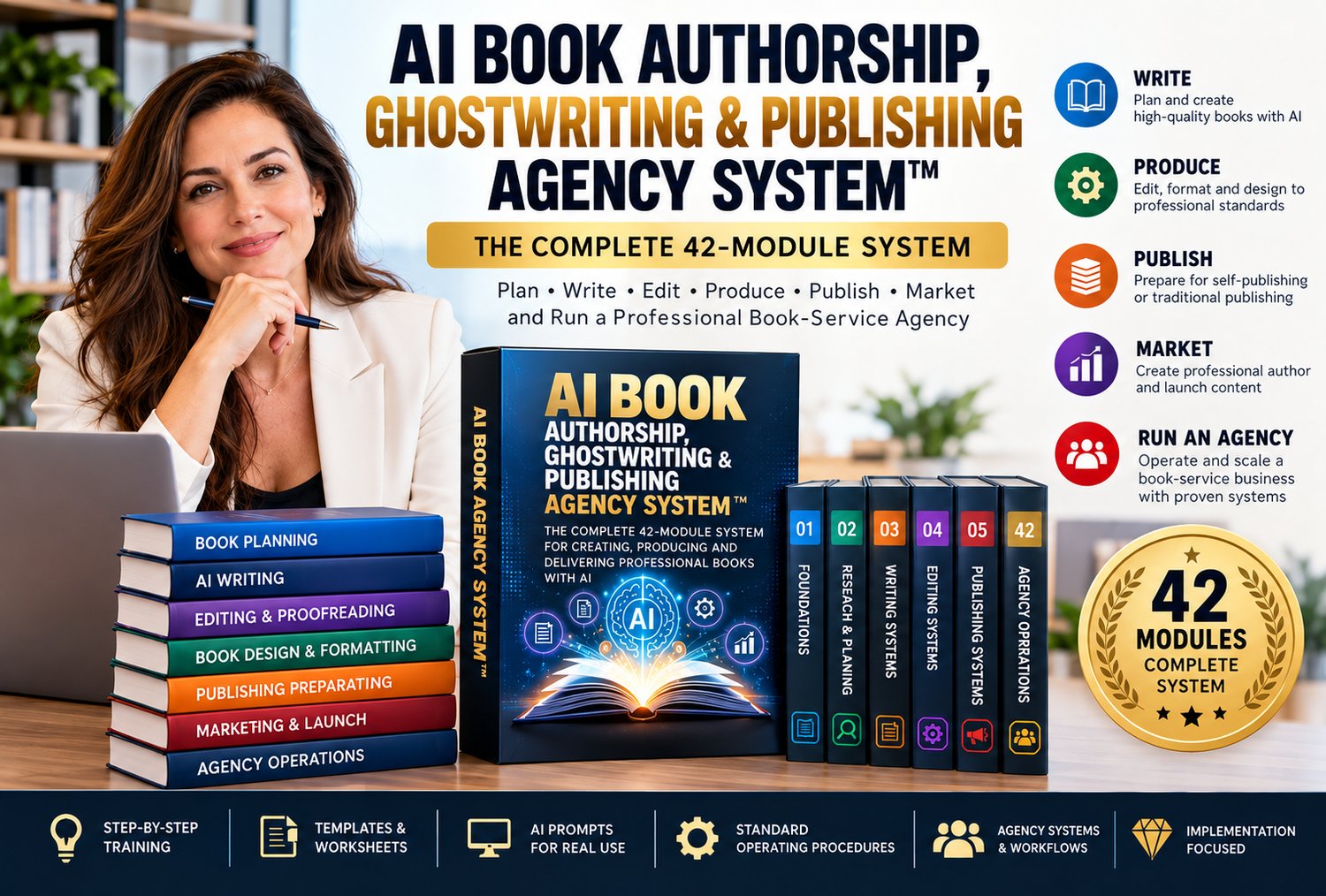
🎯 WHO IS THIS FOR?
This system is particularly relevant for:
Aspiring ghostwriters
People who want a structured starting point for developing book-service workflows.
Freelance writers and editors
Professionals who want to organise their existing services into a more systematic process.
Book-service providers
Those handling multiple stages of book production.
AI-assisted content professionals
People looking to incorporate AI into appropriate parts of their workflow while retaining human editorial control.
Publishing-support businesses
Teams providing preparation, formatting, metadata or related services.
Book agencies
Businesses that need documented workflows, roles, quality gates and operational systems.
⚠️ THIS IS NOT A "PUSH ONE BUTTON AND WRITE A BOOK" SYSTEM
Professional book production requires judgement.
AI can assist.
It cannot replace responsibility for:
accuracy, originality, copyright, confidentiality, editorial judgement, author voice, legal review or final approval.
The system therefore treats AI as a workflow assistant, not an autonomous publishing authority.
🔥 WHY THE MASTER SYSTEM MATTERS
The individual modules are useful on their own.
But the real value of the complete system is the connection between them.
A client doesn't simply need a manuscript.
A professional workflow may require:
Discovery → Research → Architecture → Draft → Editing → Proof → Design → Metadata → Publishing Preparation → Approval → Delivery
And an agency may additionally need:
Project Management → Communication → QA → Documentation → Operations → Automation
Module 42 brings the entire architecture together into a Master Operating System, showing how the individual workflows can connect without requiring every process to be rebuilt from scratch.
📦 WHAT YOU RECEIVE
THE AI BOOK AUTHORSHIP, GHOSTWRITING & PUBLISHING AGENCY SYSTEM™
42-module implementation system
PLUS:
1,050 structured AI prompts
25 prompts × 42 modules
PLUS:
Practical worksheets
For discovery, research, writing, editing, production, publishing preparation, delivery and agency operations.
PLUS:
SOP frameworks
For recurring book-service workflows.
PLUS:
AI application guidance
Showing where different AI and productivity tools may fit.
PLUS:
Quality-control frameworks
Designed to keep human review inside critical stages.
PLUS:
Client workflow systems
From onboarding through approval and final delivery.
PLUS:
Agency operations frameworks
For roles, responsibilities, documentation, capacity and process management.
🚀 STOP BUILDING YOUR BOOK-SERVICE WORKFLOW FROM SCRATCH
Instead of searching separately for:
"How do I structure a book?"
"How do I research it?"
"How do I edit it?"
"How do I prepare the manuscript?"
"How do I organise the client?"
"How do I handle revisions?"
"How do I prepare publishing information?"
"How do I manage all the files?"
"How do I document the process?"
You have a single structured system designed to connect these stages together.
YOUR NEXT BOOK PROJECT CAN START WITH A SYSTEM
Whether you're working on one author project or developing a broader book-service operation, the goal is simple:
Bring structure to the workflow.
Use AI where it genuinely helps.
Keep humans responsible for important decisions.
Document the process.
Control quality.
Deliver professionally.
TO GET INSTANT ACCESS CLICK HERE
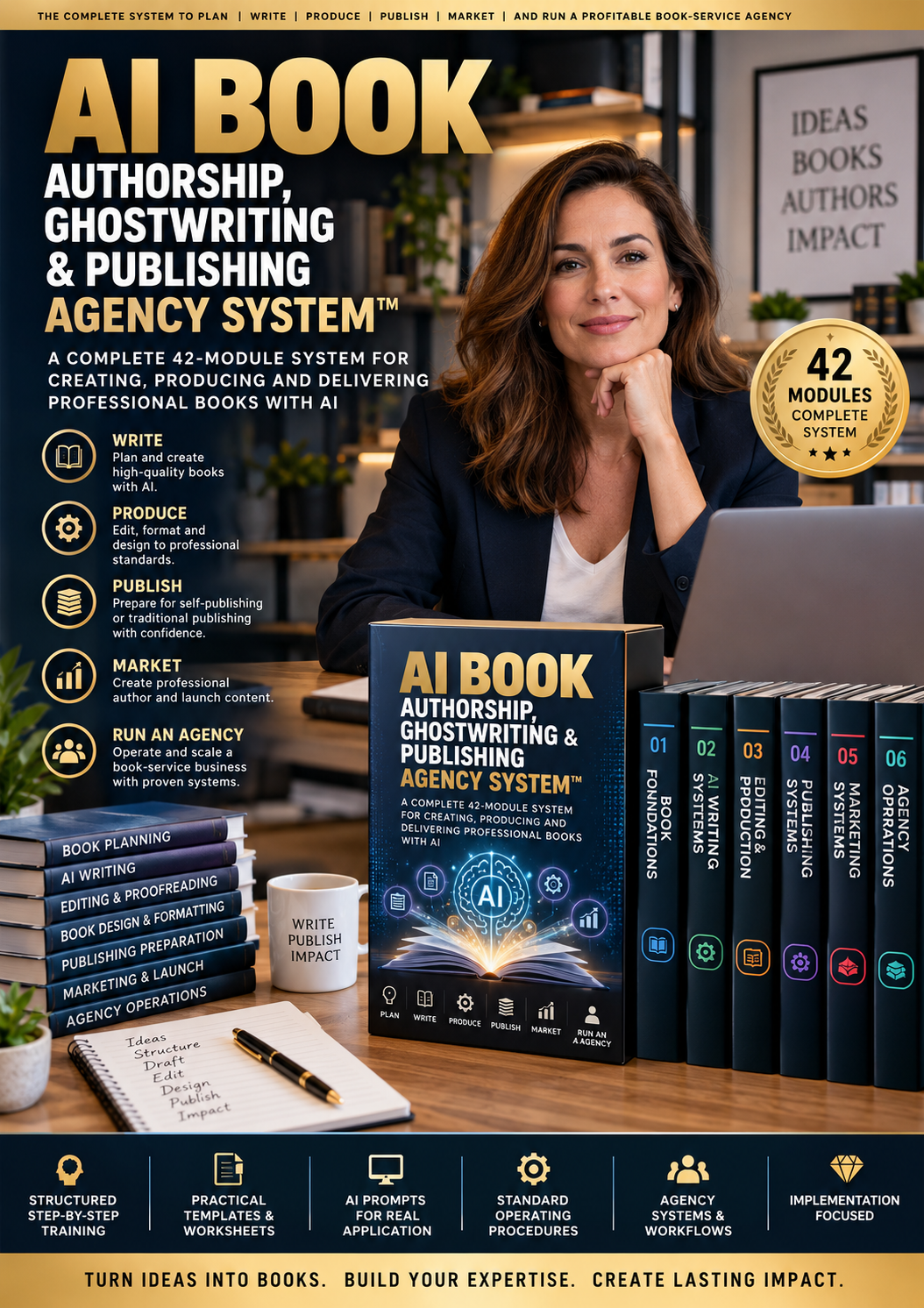
Frequently Asked Questions
1. What is the AI BOOK AUTHORSHIP, GHOSTWRITING & PUBLISHING AGENCY SYSTEM™?
It is a comprehensive 42-module education and implementation system covering the major stages of book creation and book-service operations — from client discovery and research through drafting, editing, proofreading, formatting, cover development, metadata, publishing preparation, delivery, marketing content, agency operations and AI-assisted workflows.
2. How many modules are included?
The complete system contains 42 modules, designed to work together as a connected book-production and agency workflow.
3. How many AI prompts are included?
The system is structured around 25 prompts per module, providing 1,050 AI prompts in total.
4. Are the prompts copy-and-paste ready?
Yes. Each structured prompt is designed to include a prompt number, name, use case, copy-paste instructions, expected output and optional variables.
5. Do I need previous ghostwriting experience?
No. The system includes Beginner, Intermediate and Advanced implementation approaches where appropriate, allowing newcomers to start with fundamental workflows and experienced professionals to build more sophisticated processes.
6. Is this only for professional ghostwriters?
No. It can also be relevant to freelance writers, editors, book-service providers, publishing-support professionals, author-service businesses and agencies.
7. Does the system teach me how to write an entire book using AI?
It covers AI-assisted book workflows, including research, architecture, drafting and editorial processes. However, AI output should always be reviewed and refined by a human rather than being accepted automatically.
8. Does AI replace a professional editor or proofreader?
No. AI can assist with analysis and identification of potential issues, but human editorial judgement remains important for accuracy, style, voice, context and final approval.
9. Which AI applications can be used with the system?
Depending on the workflow, the system discusses tools such as ChatGPT, Claude, Gemini, Perplexity and NotebookLM, alongside productivity and production tools such as Canva, Google Workspace, Microsoft 365, Notion and Airtable.
10. Do I need to subscribe to every AI tool mentioned?
No. The system is designed around choosing tools according to the workflow. You do not necessarily need every application.
11. Are software features and integrations guaranteed?
No. AI platforms and software change frequently. Current features, integrations, pricing, limits, privacy policies and licensing terms should be verified before implementation.
12. Does the system include book editing?
Yes. Dedicated workflows cover developmental editing, copy-editing, line-editing and proofreading, with each stage treated as a distinct editorial activity.
13. Does it include book formatting?
Yes. The system includes a dedicated book formatting and interior-design workflow covering typography, hierarchy, page structure, visual consistency and export review.
14. Does it include book-cover development?
Yes. The cover system addresses cover strategy, visual identity, typography, colour direction, imagery, series consistency, human review and cover QA.
15. Does it include book metadata?
Yes. The metadata workflow covers titles, subtitles, descriptions, keywords, categories, author information, series information, contributors and metadata consistency.
16. Does it include publishing instructions for every platform?
The system teaches publishing-preparation workflows, but platform requirements can change and differ between providers. Verify current information before implementation.
17. Does it guarantee publishing approval?
No. Publishing approval depends on the applicable provider, requirements and review processes.
18. Can this system be used for client ghostwriting projects?
Yes. It includes client discovery, onboarding, project management, communication, approval, revision, delivery and confidentiality workflows.
19. Does it include client communication templates?
Yes. The system includes practical structures for project updates, clarification requests, feedback, revision communication, approvals, delays, handoffs and final delivery.
20. Does it include project-management tools?
Yes. The system provides frameworks for project plans, milestones, tasks, dependencies, responsibilities, revisions, change requests, issues and delivery.
21. Does it include agency operations?
Yes. Dedicated modules address roles, SOPs, production workflows, quality gates, file management, team collaboration, vendor coordination, capacity planning and operational documentation.
22. Does it include automation?
Yes. The automation module covers opportunities for connecting workflows using tools such as Make, Zapier and n8n where appropriate. Current integrations, triggers, actions, pricing and plan limitations must be verified before implementation.
23. Can I use AI with confidential client material?
Confidential material requires careful handling. Before submitting client information to any AI service, review the provider's current privacy, data-handling and applicable contractual terms, and follow your own confidentiality obligations.
24. Does the system provide legal advice about copyright or publishing?
No. The rights and confidentiality material provides operational education and workflow guidance, not legal advice. Copyright, contracts, privacy, licensing and publishing laws vary by jurisdiction. Qualified local legal advice should be obtained when appropriate.
25. Does the system guarantee clients, sales or income?
No. The system does not guarantee clients, revenue, sales, publishing approval, rankings, bestseller status or business success. Results depend on many factors outside the system.
26. Can I use the system to build my own book-service agency?
The system provides operational frameworks, workflows, SOPs, templates and AI-assisted processes that can be adapted to a book-service business. Actual business decisions, positioning, pricing and service delivery remain your responsibility.
27. Does the system include templates?
Yes. Templates and worksheets cover areas such as client intake, book discovery, research, editing, proofreading, formatting, metadata, publishing preparation, project management, QA, delivery and agency operations.
28. Is the system suitable for beginners?
Yes. Beginner pathways are included so that someone new to book-service workflows can build understanding progressively rather than attempting to implement the entire system at once.
29. Can experienced professionals use it?
Yes. Intermediate and advanced workflows address areas such as multi-stage production, quality gates, agency operations, automation, documentation and process improvement.
30. How should I implement the system?
A practical approach is to begin with the modules directly relevant to your current service, build the associated templates and SOPs, test the workflow on a controlled project, introduce quality gates, and then expand into additional modules as your operation develops.
31. Is everything automated?
No. The system deliberately incorporates human approval points. AI can assist with repetitive or analytical tasks, but important decisions involving accuracy, originality, confidentiality, editorial judgement, rights and final deliverables require human oversight.
32. What makes the system different from a collection of AI prompts?
The system is structured as a connected operating framework, not simply a prompt library. The prompts sit inside workflows containing templates, checklists, SOPs, quality gates, handoffs and human-review stages.
33. Can I customise the workflows?
Yes. The frameworks are intended to be adapted to your service model, client requirements, tools, team structure and project type.
34. Will the system stay permanently up to date with software and publishing platforms?
Software features, integrations, platform policies and publishing requirements can change. Always verify current information before implementation rather than relying on historical specifications.
35. What is the main purpose of the 42-module system?
The central purpose is to provide a structured framework for managing the book-production lifecycle
and the supporting agency operations around it, helping users organise the work rather than approaching every project from scratch.
AI BOOK AUTHORSHIP, GHOSTWRITING & PUBLISHING AGENCY SYSTEM™
42 Modules • 1,050 AI Prompts • Practical Templates • SOPs • QA Systems • AI Workflows • Agency Operations
Build the workflow.
Organise the process.
Control the quality.
Deliver the book.
Verify current software, platform, legal, licensing and publishing requirements before implementation.