
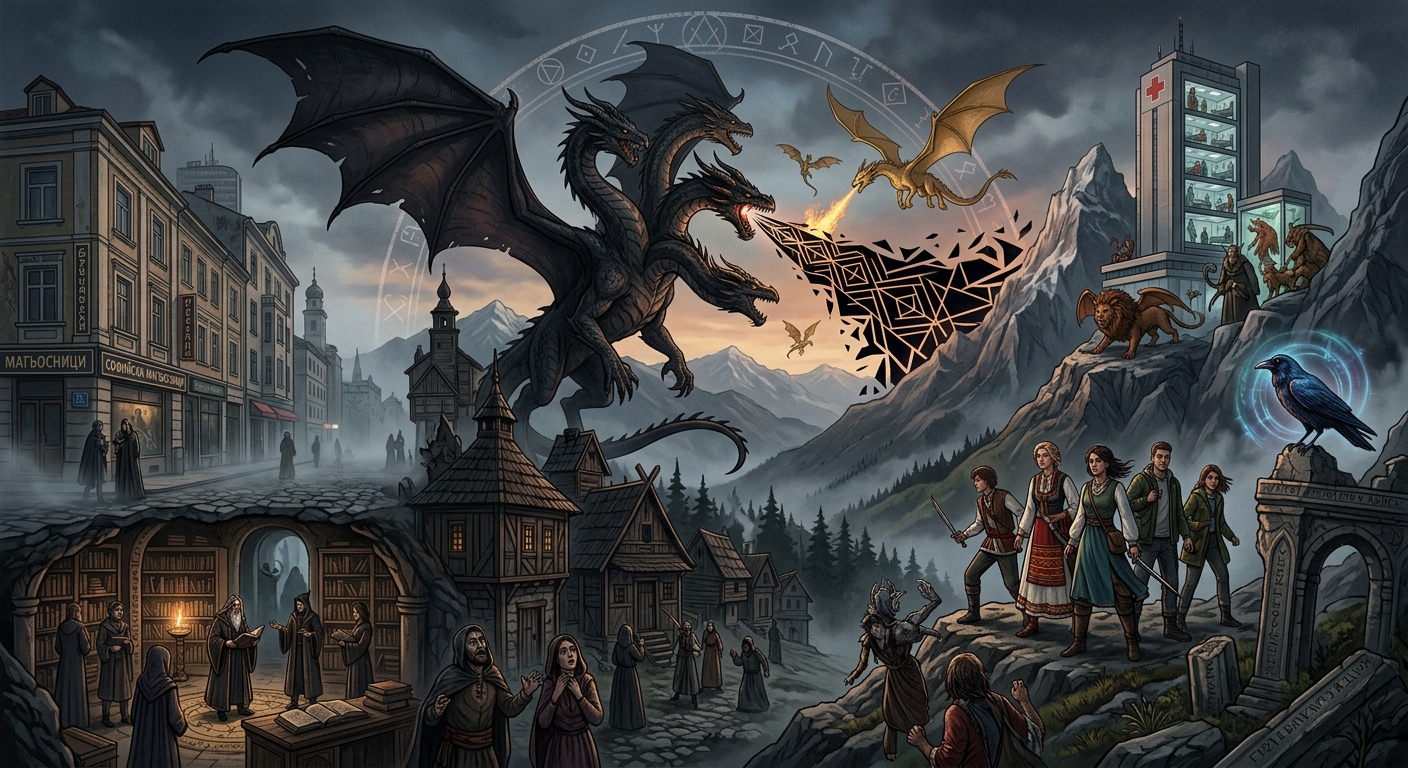
If your familiarity with Slavic fantasy begins and ends with The Witcher, you are barely scratching the surface of a deep, vibrant literary scene. Across the Balkans and Eastern Europe, modern authors are tapping into regional folklore, forgotten pantheons, and centuries-old mythologies to deliver stories that challenge standard Western fantasy tropes.
From claustrophobic folk horror to epic dragon sagas and secret urban societies, these ten standalone works and series prove that Slavic speculative fiction is one of the most exciting corners of modern genre literature.
1. Mamnik by Vasil Popov
Genre: Folk Horror / Dark Mystery
Core Setting: A remote, superstitious village in the Balkan mountains.
A breakout success in Balkan genre fiction, Mamnik takes place in the isolated village of Vrukola, where ancient terrors refuse to stay buried. When grisly incidents and sudden disappearances rock the local community, border police officers uncover a terrifying truth: the whispered creature legends of old were never fairy tales—they were warnings.
Popov crafts a claustrophobic, paranoid atmosphere driven by genuine folklore entities like the mamnik demon and the plutenik. It is an essential read for fans of atmospheric monster hunting and slow-burn supernatural thrillers.
2. The Fifth God Saga by Dalibor Kovačec
Genre: Slavic Dark Epic Fantasy
Core Setting: The fractured continent of L'ven.
Spanning multi-volume entries like Black Dragons (Crni zmajevi) and Magic of the Soul (Magija duše), Dalibor Kovačec’s saga revolves around the devastating return of Hagala: an ancient sorceress returning from a thousand-year exile with a flight of black dragons to awaken a primordial cosmic entity.
Kovačec sets his series apart by embedding authentic South Slavic mythology directly into the geopolitical fabric of his world. Mythic entities like the drekavac and moguts shape the history and warfare of L'ven, while a dual magic system pits geometric sorcery against dark witchcraft. Readers who enjoy moral grayness, multi-POV war sagas, and dragon lore will find a compelling world here.
3. Sofia Magicians (Софийски магьосници) by Martin Kolev
Genre: Urban Fantasy
Core Setting: Modern-day Sofia, Bulgaria.
Martin Kolev re-imagines Bulgaria's capital city by layering a secret, bustling arcane society directly beneath its everyday streets. Hidden behind historic landmarks lies a complex network of rival spellcasters, guild politics, and urban magic.
Rather than mirroring traditional Western urban fantasy aesthetics, Kolev builds his setting around local culture, quick wit, and regional myth. The city itself becomes a central character in a fast-paced adventure that gives a fresh spin to secret-magic tropes.
4. Hospital for Immortal Creatures by Alexandrina Krusharska
Genre: Medical Fantasy / Mythic Romantasy
Core Setting: A high-tech hidden hospital in the mountains above Sofia.
Trading battlefields for medical wards, Krusharska explores what happens when ancient beings and mythic beasts begin to suffer from mysterious, fatal ailments. High in the mountains, a secret twenty-story facility operates to treat legendary entities whose lifespans are unexpectedly unraveling.
Following a human medical resident thrust into a world of manticores and ancient guardians, the novel balances character-driven drama with supernatural mystery. It provides an original look at immortality, medicine, and mythic biology.
5. Heralds (Вестители) by Tsvetelina Vladimirova
Genre: Romantic High Fantasy
Core Setting: The kingdom of Voronina.
As the opening book of The Curse of Voronina series, Heralds delivers high-stakes court intrigue and ancient prophecy. As long-dormant dark forces begin to stir, a group of young protagonists finds themselves caught between royal power struggles and ancient supernatural curses.
Vladimirova blends classic epic fantasy scope with character relationships and political scheming. The story expands from personal stakes into a multi-faction struggle where modern characters must face the consequences of historical sins.
6. The Raven Who Could Stop Time by Samuil Petkanov
Genre: Philosophical Fable / Magical Realism
Core Setting: A mythic, timeless landscape.
Centering on an extraordinary raven gifted with the ability to pause and manipulate time, Petkanov’s novel steps away from traditional quest narratives to deliver an introspective fable on human nature.
The book weaves dry humor with quiet existential themes, exploring memory, regret, and the weight of passing moments. It appeals directly to readers who appreciate speculative fiction focused on lyrical prose and philosophical depth.
7. The Fox (Лисицата) by Galin Nikiforov
Genre: Rural Magical Realism / Folk Tale
Core Setting: The spiritual, isolated landscapes of rural Bulgaria.
The Fox sits at the intersection of literary prose and old-world magic, treating nature as an active, breathing presence that shapes human destiny. Nikiforov replaces explosive spellcasting with subtle symbolism and sensory-rich storytelling.
Through quiet encounters and deep-rooted spiritual traditions, folklore manifests organically in everyday life. It offers an immersive experience for readers who prefer atmospheric, slow-burn narratives over action-heavy magic systems.
8. The Child of the Prophecy by Milen Halyov
Genre: Contemporary Mythic Fantasy
Core Setting: A modern world where humans and monsters share a fragile truce.
The third installment in the Dormitory for Monsters series explores a universe where supernatural beings live alongside humanity under a delicate peace. When a new threat emerges to shatter the balance, a young cast must uncover the secrets of an ancient prophecy.
Halyov crafts an accessible narrative packed with creatures inspired by authentic regional myths. While approachable for younger audiences, its themes of loyalty, sacrifice, and moral compromise give it strong crossover appeal for adult fantasy readers.
9. Awaken a Little Dragon (Да пробудиш драконче) by Nikolay Tellalov
Genre: High Fantasy Classic
Core Setting: A hidden realm of ancient dragon civilizations.
First published in the late 1990s, Tellalov’s foundational novel helped shape modern Bulgarian speculative fiction. The story begins when a young protagonist accidentally discovers a hidden world of intelligent dragons, pulling him into ancient histories and lost magic.
Tellalov rejects the trope of dragons as mindless fire-breathing beasts, depicting them instead as philosophical, highly intelligent guardians of the earth's deepest secrets. It remains a landmark coming-of-age journey in regional fantasy literature.
10. Fire and Gold: The Prophecy by Gabriela Plocheva
Genre: Epic High Fantasy
Core Setting: A continent on the verge of political collapse.
Gabriela Plocheva launches her series with a continent fracturing under political unrest and arcane instability. When an uncompromising prophecy comes to light, royal houses and magic factions scramble to secure their survival at any cost.
The book delivers classic high-fantasy elements, rigorous training arcs, sharp court politics, and high stakes, built upon a unique mythological framework.
These ten titles demonstrate the evolution and diversity of contemporary Slavic fantasy. By drawing on underutilized mythologies, regional geography, and authentic folklore, these authors offer a refreshing alternative to standard fantasy settings—making any of these books an excellent addition to your reading list.