
There is a sanctuary you are trying to build. You can feel the shape of it in your quietest moments—a place of unshakable peace, a heart that feels entirely safe, a belonging that does not fray at the edges. You have been building it for a lifetime, stacking stone upon stone, raising walls against the winds of the world. You have believed, with every fiber of your being, that security is a fortress. That to be safe is to be strong, and to be strong is to stand unwavering, to hold your ground, to win.
But the cosmos has other plans. The tides are shifting, pulling not at the shore, but at the very bedrock of your soul. And the cards you have drawn are not a map for building higher. They are an invitation to a great and necessary undoing.
I. The Hanged Man: The Invitation to the Gallows of Grace
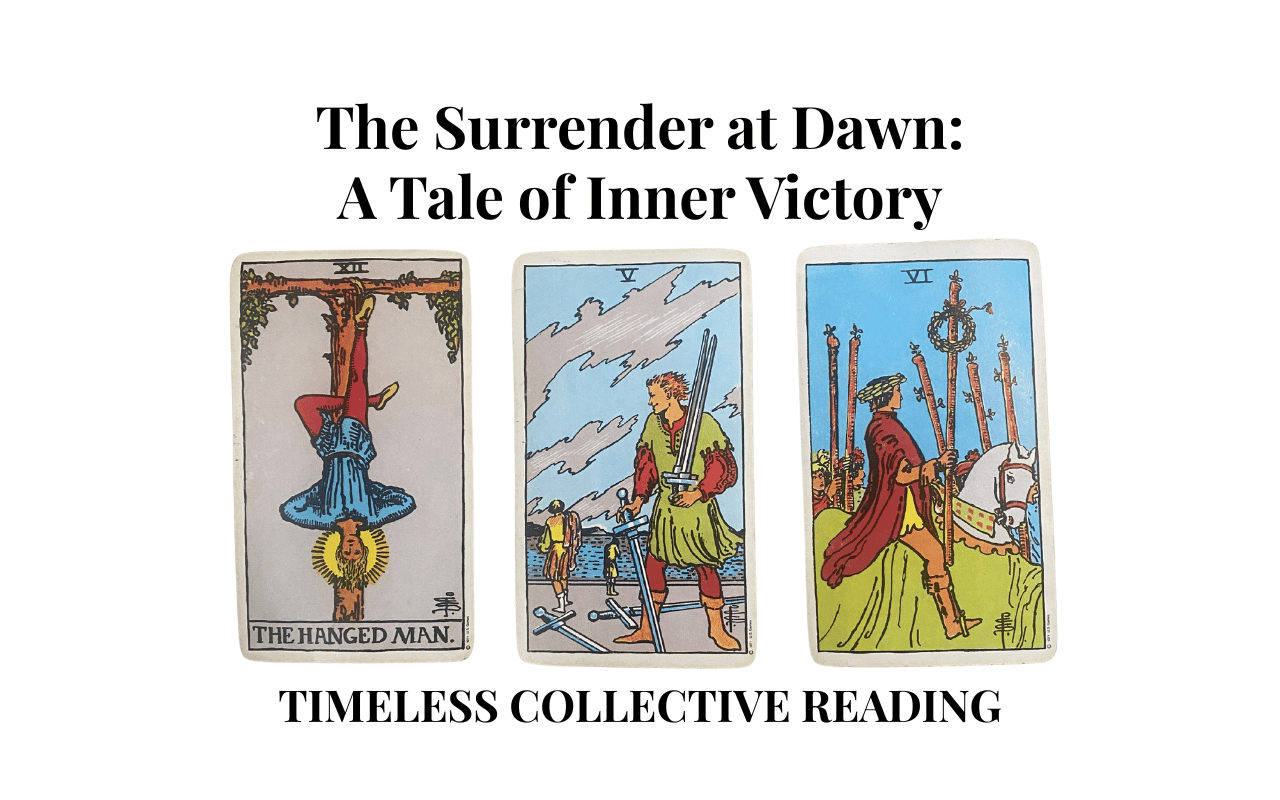
The first card reveals the flaw in your foundation. It is not that the stones are weak, but that the ground upon which you built is an illusion. The Hanged Man appears, not as a sentence, but as a sacred invitation. He asks you the most terrifying question you will ever hear: What if everything you believe about safety is wrong?
You have built your inner world on the principle of action. To be secure is to be in control. To be in control is to have a plan, a defense, a counter-argument. You have believed that your vigilance is your strength. But the Hanged Man reveals that this vigilance is your cage. Your need to control the narrative, to manage outcomes, to preemptively strike against potential pain—this is the very thing that is starving your soul of true peace.
He asks you to do the one thing that feels like death: to surrender.
This is not the surrender of defeat. This is not giving up. This is the strategic, conscious, and breathtakingly courageous surrender of the warrior who finally drops his weapons, not because he is beaten, but because he has realized he is fighting the wrong war. The Hanged Man is your gallows of grace. He is the divine pause. He is the moment you are cut loose from the frantic struggle of the world and left hanging, upside down, forced to watch as your entire reality inverts.
The security you crave will not be found in the next battle you win or the next wall you build. It will be found here, in this suspended animation. It is in this space of voluntary powerlessness that a new truth will dawn—a luminous, quiet knowing that what you are truly part of is so much larger than your individual struggles. The foundation that needs healing is your addiction to the fight itself. The strength that needs cultivating is the strength to be still, to listen, and to trust that the universe is holding you, even—especially—when you have let go of the branch.
II. The Five of Swords: The Ghost of Victories Past
And what of the world you have built with this old, combative energy? The second card holds up a mirror to your external reality, and it shows you the cost of your victories. The Five of Swords presents a battlefield at dawn, the fog lifting to reveal the hollow truth. You stand amidst the aftermath, three swords in your hand, two at your feet. You have won. By any measure, you have won the argument, proven your point, defended your territory.
So why do you feel so utterly alone?
This card is the ghost of every relationship dynamic born from an ancient, festering wound—the childhood belief that you had to fight to be seen, that love was conditional, that your worth was a prize to be won in conflict. You learned to sharpen your tongue into a sword. You learned to see disagreement as a threat and conversation as a duel. You have carried this wound into your adult life, and it has shaped everything. It has created a world where you are perpetually braced for impact, where every conversation has a subtext of battle, where you leave a trail of pyrrhic victories in your wake.
This is the external structure that must be reformed: the pattern of relating to the world as an adversary.
The Five of Swords does not judge you for this. It simply shows you the emptiness of the spoils. The cold comfort of being right. The chilling silence that follows a fight you technically won. This pattern is ready to be released because your soul can no longer bear the taste of ashes in its mouth. You are being called to lay down your weapons. To walk away from battles that, even in winning, tear pieces from your heart. This is not surrender to another person; it is a surrender of an old identity. It is the conscious choice to stop being a warrior and to start becoming a sovereign. A true ruler does not fight in every skirmish; they command the field from a place of unassailable inner authority, which is built on peace, not conflict.
III. The Six of Wands: The Triumphant Return to Self
So, where does this leave you? If you surrender the fight and lay down your weapons, who are you? The third card reveals the glorious, forgotten emotional truth that has been waiting patiently beneath the struggle. The Six of Wands is your triumphant return.
For so long, you have believed that your value was something to be earned in the arena. That acclaim was the reward for a battle well-fought. You have suppressed the most simple and profound truth of your being: You are worthy of victory simply because you exist.
This card shows you on horseback, riding through a cheering crowd, a wreath of victory upon your head. But the crowd is not who you think it is. They are not your adversaries, finally acknowledging your superiority. They are the reconciled parts of your own soul—the warrior, the child, the skeptic, the dreamer—all finally united and celebrating the end of the civil war within you.
The forgotten truth is that you do not need to cross a finish line you cannot see. You have already arrived. The victory parade is not for a battle you are about to fight; it is for the journey you have already completed. Every hardship, every moment of pain, every time you got back up—that was the journey. This moment, right now, is the celebration. You have been so focused on the next fight, the next defense, that you have failed to acknowledge the profound victory of your own resilience.
The Six of Wands calls you to step out of the shadows of your own doubt and into the brilliant light of self-acceptance. Acknowledge this truth: your worth is not contingent. Your security is not fragile. It is inherent, unassailable, and born from the same stardust as the constellations. The love and belonging you seek is not a prize to be won from others; it is your birthright, waiting to be claimed from within.
Integrate this, and the world shifts. You no longer seek battles to prove your strength, because you feel your strength as a constant, humming truth inside you. You no longer build fortresses for safety, because you have found that the only true sanctuary was never a place at all—it was a state of being. It was the courage to surrender, the wisdom to lay down your arms, and the final, glorious return to the victorious self you were always meant to be.
Your sanctuary was never in the stones. It was in the surrender. Your victory was never in the fight. It was in the homecoming.
Comments ()