

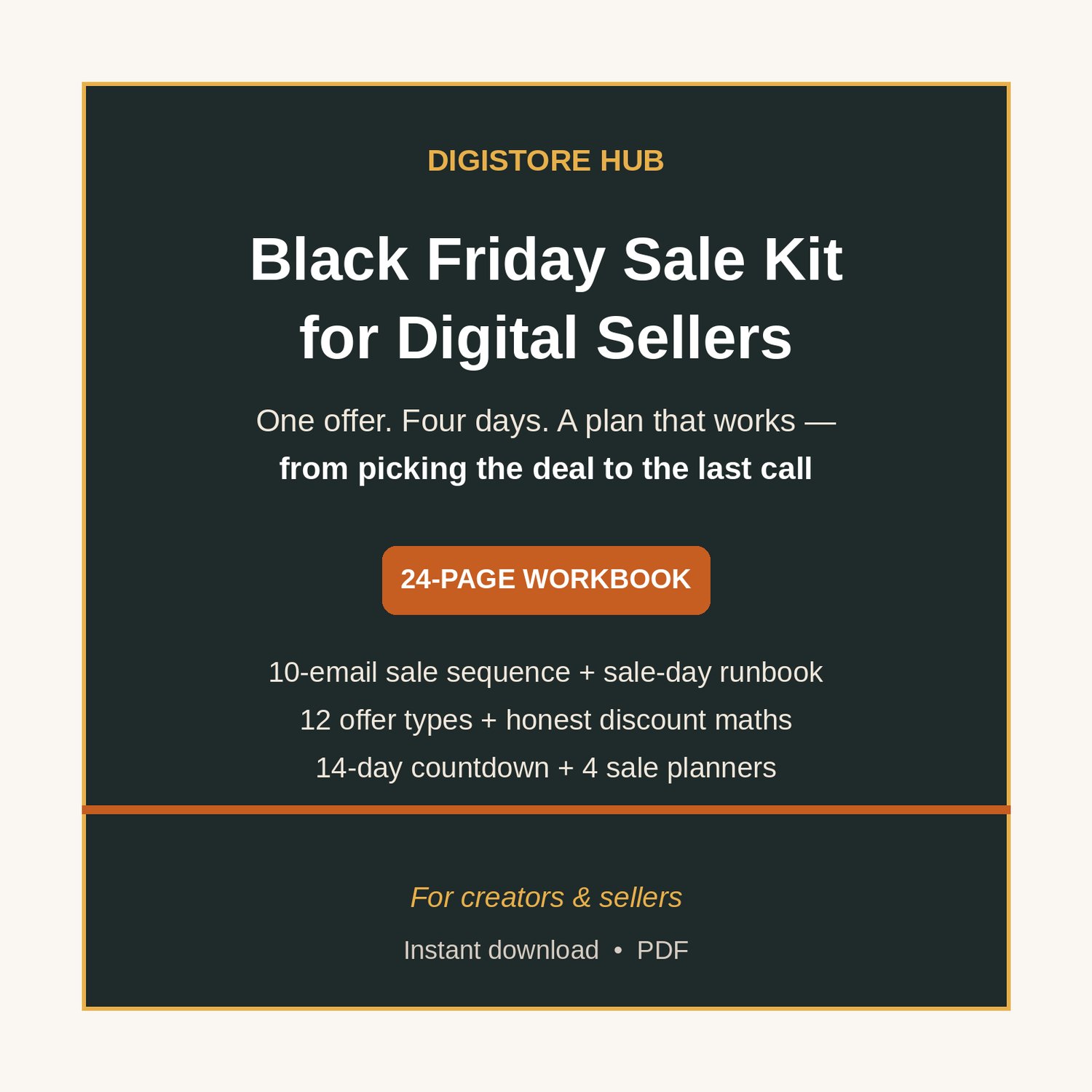
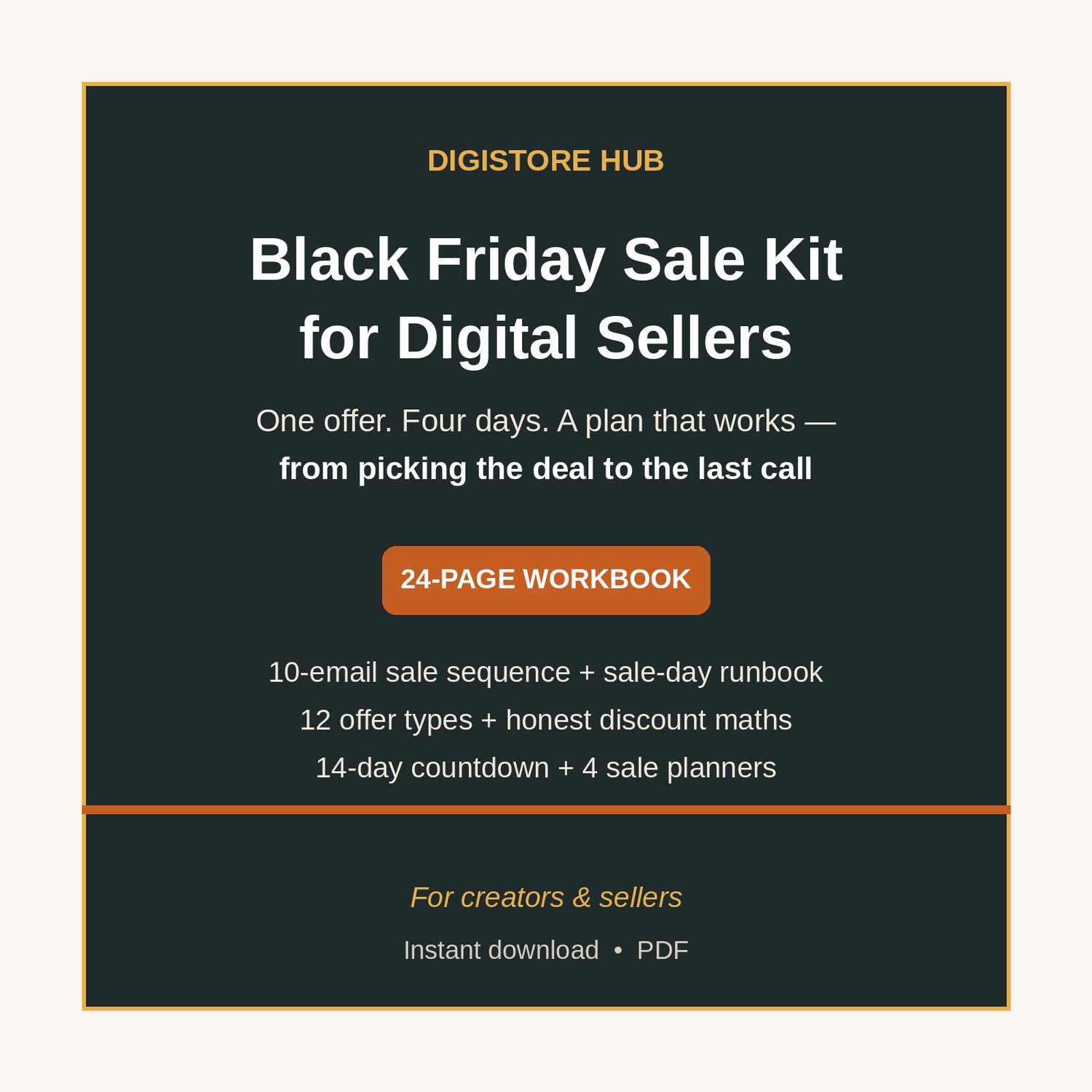
If you are wondering how to plan a Black Friday sale for your digital products, here is the honest answer: pick one offer, price it honestly, warm up your list for two weeks, and run four days on a calendar you wrote in advance. Black Friday is Friday 27 November 2026, and the sale is won or lost before it opens. A sale decided on Friday morning is a sale that breaks. A sale planned in the next fourteen days is a sale you can actually enjoy.
This is the method our Black Friday Sale Kit is built on. Below is the plan itself — the kit holds the worksheets for every step.
Step 1: Pick ONE offer — not five
The first mistake is discounting everything. A shop with five discounts has no offer at all; a shop with one offer gives buyers a decision they can make in ten seconds. So the first job is to pick one.
Work through it in seven steps: list your products, score the top three, pick one offer, do the discount maths, name the bonus, set the dates, and write the one sentence that describes the sale. The scoring matters — the product you discount should be the one buyers already look at, not the one you are tired of. And the dates matter more than the discount: a sale with a real end date (Monday 30 November, midnight) sells; a sale that "might" end does not.
If you are stuck choosing, there are twelve offer types to pick from: one product at one discount, a bundle, buy one get one free, an early-bird price, a bonus file, a free sample plus a discount, a limited-edition seasonal product, pay what you want with a floor, a tiered discount, a coupon for returning buyers, or a 24-hour flash deal. Pick one, then stop picking — the rest of the plan depends on this decision staying still.
Step 2: Price it honestly — do the discount maths
A discount is only a deal if the "was" price was real. Before you announce anything, write down today's price, the discount, the price buyers will pay — and what you keep after the platform fee. The maths is simple: $19.99 at 30% off is $13.99. Three $9.99 products bundled at $19.99 is 33% off. And at 30% off, you need 1.43 times as many sales to match full-price revenue — so a bigger discount is not automatically a better sale.
The kit's seven discount rules cover honest "was" pricing and platform fees (Payhip 5%, Gumroad 10%, Etsy $0.20 plus 6.5% — check each platform's current fee page). Do the maths once, and your sale page can state the price with a straight face.
Step 3: Warm the list — the 10-email sequence
Here is the rule most sellers miss: the list sells the sale. A sale announced to a cold list on Friday morning is a post, not a launch. The list needs two weeks of warming — that is what the kit's 14-day countdown is for. It started Friday 13 November — and if you begin today, Friday 20 November, you still have a full week before the doors open. Start today.
The sequence is ten emails: a tease, early access, sale opens, what you get, a Small Business Saturday story, the top objection answered, a Cyber Monday last-day reminder, a "most buyers pick this" note, a closing-tonight email, and a thank-you — each with a subject line and first line in the kit, ready to write in your own voice. Spread over four days, that is two or three a day — never three in one morning.
Step 4: Run the four days on a calendar, not on hope
Black Friday is not one day. For a digital product seller it is four: Friday 27 November, Small Business Saturday 28 November, Sunday 29 November, and Cyber Monday 30 November. Each day has a job, an email and a post.
Saturday matters more than sellers expect. Small Business Saturday is the day buyers deliberately look for small shops, and a short story about your shop sells better on Saturday than another discount code. Sunday is the quiet day: answer the top objection and let the list breathe. Monday is the close: the last-day email, the closing-tonight email, and prices back up on Tuesday. A sale with a real end is one buyers trust next year too.
Step 5: Test the checkout before the doors open
Nothing kills a sale faster than a checkout that does not work. Before Friday, run the ten pre-sale checks: the offer, the page, the checkout, the discount code, the download, the price and date, the scheduled emails, buyer exclusions, the written posts, and the support email on the page. Ten checks, one evening, no surprises on Friday morning.
Then run each sale day from the runbook — hour by hour from 06:00 to 21:00, ready to print and tick off.
Step 6: After the sale — the twelve follow-ups
The sale ends Monday night; the work does not. The kit's twelve post-sale follow-ups start with thanking buyers within 24 hours and restoring prices on Tuesday — and they end with writing the numbers down and setting next year's date. Track list size, open rate, clicks, checkouts, sales, revenue, and the one conversion rate to watch. A sale you measured is a sale you can improve; a sale you forgot by December is one you will repeat blindly next November.
Your 14-day checklist
• Today: pick your one offer and do the discount maths.
• This week: write the ten emails and fifteen social posts; schedule what you can.
• Thursday 26 November: run the ten pre-sale checks and test the checkout yourself, as a buyer.
• Friday 27 November: sale opens. Follow the runbook, not your inbox. Saturday: tell your Small Business Saturday story.
• Monday 30 November: close the sale, thank the buyers, restore prices on Tuesday.
Want the whole plan as worksheets — the offer picker, discount maths, ten email outlines, fifteen post ideas, four-day calendar, runbook, ten pre-sale checks and results tracker? Get the Black Friday Sale Kit: 24 pages, $9.99, built for this exact sale.
Frequently asked questions
When should I start planning a Black Friday sale? Two weeks is enough if you start today: pick the offer and do the maths in week one, write the emails and posts, then test the checkout on Thursday 26 November. Starting on Friday morning does not work.
How much discount should I offer on digital products? Enough that the deal is real, small enough that the maths still works: at 30% off you need 1.43 times as many sales to match full-price revenue. Start from the price you keep after the platform fee, not from the discount percentage.
Do I need an email list to run a Black Friday sale? No — but the list is what makes it a launch instead of a post. Without one, lean on the fifteen social post ideas and the Small Business Saturday story, and start the list with this sale's buyers.
What if I have no products yet? Then do not run a sale. Finish one product first, and use the 14-day countdown to build the list — a sale with nothing to sell is a post, not a launch.
What to read next
If your holiday content is not planned yet, the Holiday Content & Sales Planner covers the season's content and sales campaigns, so your posts and your sale tell the same story. And once the sale is done, our post on planning Christmas gifts without overspending walks through a six-week plan that starts with one total budget.
Questions about the kit or your download? Email mdarifshekh20@gmail.com — we reply to every message.
— Digistore Hub