
Published by Digital Wealth Series | Markets & Macro Strategy | 8 min read
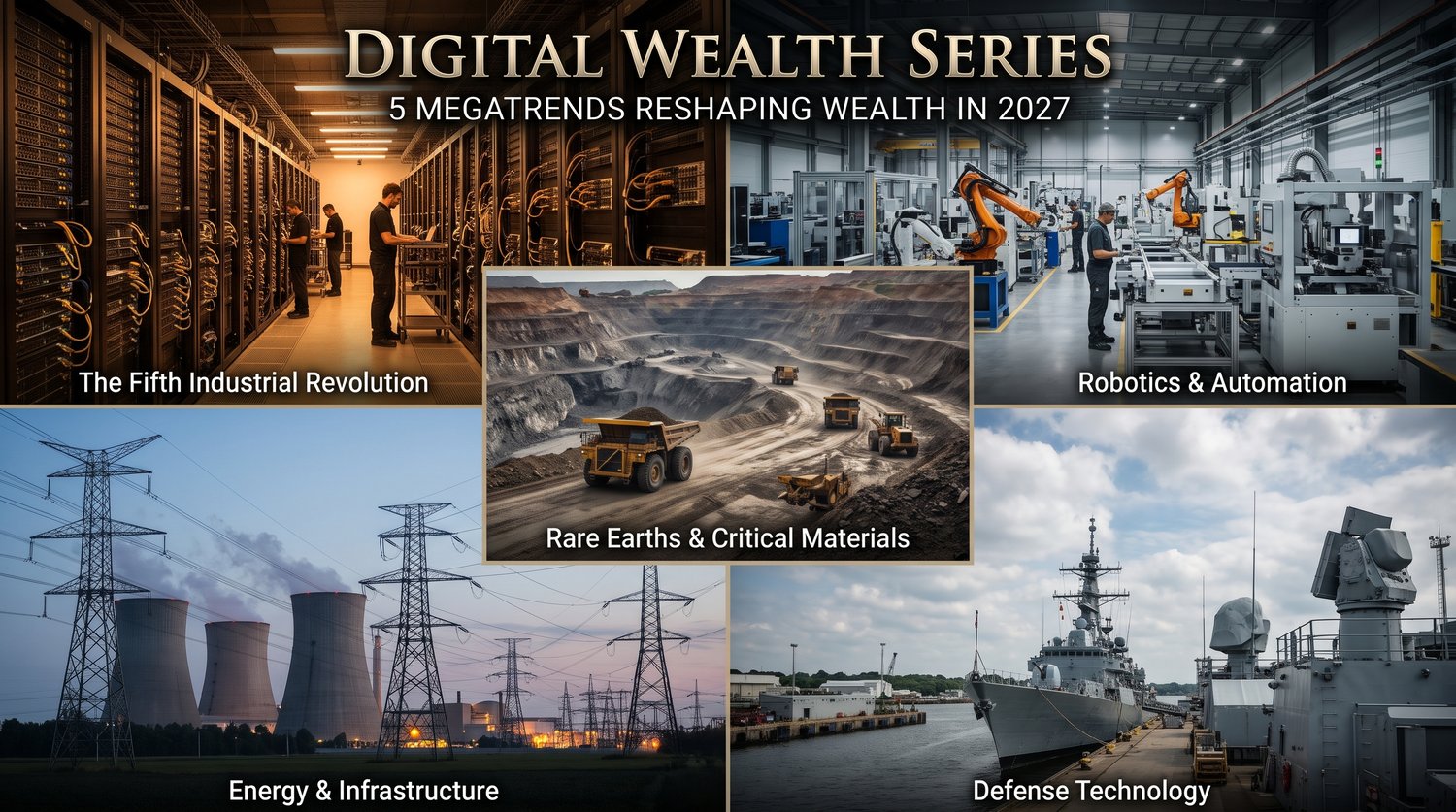
Most people treat breaking economic headlines as entertainment. Financially savvy investors treat them as a map. Right now, two of the largest capital allocators on earth—Big Tech and the United States government—are pouring trillions of dollars into the exact same five sectors. Private enterprises are on pace to deploy roughly $1 trillion annually into artificial intelligence, hyperscalers are financing their own nuclear power plants, and Washington is actively restructuring global supply chains with taxpayer capital.
Yet a lot has changed even since late October 2026, when this thesis first gained traction—most notably the November 3, 2026 US Midterm Elections, which handed both chambers of Congress to Democrats and ushered in a divided government for 2027.
Below is the complete, updated Digital Wealth Series breakdown of the five structural market shifts driving global capital right now, the 16 ETFs positioned across them, how the post-midterm political landscape alters the math, and how to integrate thematic bets into a disciplined portfolio without blowing up your risk profile.
The Foundation First: Wealth Building vs. Wealth Acceleration
Before chasing any megatrend, you need a clear separation between how you build wealth and how you accelerate it.
- The Core Engine — ABB (Always Be Buying): Automated, recurring investments into broad market index funds (like the S&P 500 or a global equity ETF) remain the most reliable, proven wealth builder.
- Accelerator #1 — Buying Market Panics: Deploying cash during severe drawdowns (such as 2008 or 2020) lets you acquire quality assets at steep discounts. The catch is that you cannot schedule a crash.
- Accelerator #2 — Riding Structural Market Shifts: Allocating a deliberate slice of capital toward multi-year capital flows—where corporate CapEx and government spending intersect. This carries higher volatility and higher risk, but it offers asymmetric upside without requiring you to work extra decades.
Digital Wealth Series Rule of Thumb: Treat thematic ETFs as satellites, not your core. A Core-Satellite portfolio—keeping 80%–90% in low-cost, broad-market index funds and reserving 10%–20% for high-conviction market shifts—captures upside while protecting your long-term financial floor.
Shift 1: The Fifth Industrial Revolution & The "AI Onion"
Every industrial revolution has compressed the timeline of wealth creation. Factories took a century; electricity took decades; the internet took years; mobile platforms took months. Today, we are inside the Fifth Industrial Revolution—the convergence of human capability and autonomous intelligence.
Most retail investors stop at the surface: household names like Nvidia, Microsoft, or Meta. Think of AI instead like an onion. The real structural opportunities often sit in the layers underneath:
- Layer 1: Frontier AI & Software — The platforms monetizing enterprise and consumer AI.
- Layer 2: Semiconductors — Both fabless chip designers (high-margin IP creators) and integrated chipmakers.
- Layer 3: Physical Data Centers — "The cloud" is not in the sky; it lives in massive, power-hungry industrial real estate facilities.
- Layer 4: Thermal Management & Cooling — High-density AI server racks generate immense heat; liquid cooling and thermal engineering are mandatory infrastructure.
- Layer 5: Critical Metals & Energy — The copper, rare earths, and electricity required to keep the entire stack online.
Is AI a bubble? Almost certainly in pockets. Just like the dot-com bust of 2000 wiped out weak companies while leaving the internet stronger than ever, overvalued AI startups will fail—while the physical picks-and-shovels infrastructure compounds over the next decade.
ETFs to Research:
- AIQ (Global X Artificial Intelligence & Technology ETF): Broad exposure across AI software, cloud, and hardware leaders.
- SMHX (VanEck Fabless Semiconductor ETF): Focused exposure to 23 capital-efficient chip designers that own the IP without the heavy overhead of running fabrication plants.
- XSD (SPDR S&P Semiconductor ETF): Broader, equal-weighted exposure across roughly 40–47 US semiconductor companies.
- DTCR (Global X Data Center & Digital Infrastructure ETF): Direct exposure to the REITs and operators building physical data centers.
Shift 2: Robotics & "Physical AI"
In 1961, a single robotic arm joined a General Motors assembly line. Today, more than 5 million industrial robots operate worldwide—and AI is giving them eyes, spatial reasoning, and the ability to learn in simulated environments.
Nvidia CEO Jensen Huang has called this the "ChatGPT moment for robotics," pointing to "Physical AI" as a once-in-a-generation shift. The demand isn't just sci-fi speculation; it is backed by hard demographics and labor math:
- Severe Labor Gaps: The US faces an estimated 1.9 million unfilled manufacturing jobs over the coming decade.
- Corporate Automation: Amazon has projected it can avoid hiring up to 600,000 human workers over time through warehouse automation, while Tesla is actively pivoting legacy vehicle lines toward humanoid robot manufacturing.
- The Geopolitical Catch-Up: China currently deploys roughly nine times more industrial robots than the United States. Morgan Stanley estimates the global humanoid market alone could scale to $5 trillion in annual revenue by 2050, turning Western industrial automation into an economic imperative.
ETFs to Research:
- IBOT (VanEck Robotics ETF): Invests in companies building deployed factory robots alongside the chips and software powering them.
- KOID (KraneShares Global Humanoid Robotics and Physical AI Index ETF): A dedicated pure-play on the humanoid ecosystem—including the "brain" (chips), "body" (actuators and sensors), and global integrators across the US, China, and Japan . (Note: High China exposure makes this sensitive to US-China trade policy.)
- ROBO (ROBO Global Robotics and Automation Index ETF): Broad global diversification across ~80 companies spanning sensors, machine vision, and industrial automation.
Shift 3: Rare Earths & Critical Materials Reshoring
Rare earth elements are the invisible backbone of modern life—essential for smartphones, EVs, wind turbines, data center components, and missile guidance systems. For decades, China dominated global processing. When 2025 tariff escalations triggered Chinese export restrictions, the vulnerability became undeniable—even forcing temporary US auto production halts.
In response, Washington has become the investor, rulemaker, and customer all at once:
- Direct Backing & Stockpiling: The US government has backed domestic producers like MP Materials and launched Project Vault in February 2026—a $12 billion strategic critical minerals reserve combining $10 billion in US Export-Import Bank financing with nearly $2 billion in private capital.
- The January 1, 2027 Hard Deadline: Starting January 1, 2027, US defense contractors are legally barred from using rare earth magnets mined, processed, or manufactured in China, Russia, Iran, or North Korea. That creates guaranteed, non-negotiable demand for ex-China supply chains.
ETFs to Research:
- REMX (VanEck Rare Earth and Strategic Metals ETF): Broad global exposure to rare earth miners and processors across the US, Australia, and China.
- REXC (Sprott Rare Earths Ex-China ETF): Launched in April 2026, this pure-play fund holds 41 rare earth companies strictly outside of China, directly targeting the Western supply chain rebuild.
- SETM (Sprott Critical Materials ETF): The widest net—holding over 150 companies across copper, uranium, lithium, silver, nickel, and rare earths.
Shift 4: Energy — The True Bottleneck of AI
If AI is the engine of the next decade, electricity is the fuel—and the grid is running on empty. As Microsoft’s leadership has publicly admitted, the biggest constraint on AI expansion is no longer a shortage of chips; it is a shortage of power and "warm shells" to plug those chips into.
A single complex AI query consumes multiples more electricity than a standard web search. Multiply that by billions of daily prompts, add aging Western power grids, and layer on geopolitical oil volatility from Middle East conflict, and energy transforms from a sleepy utility sector into a high-priority growth theme.
ETFs to Research:
- XLE (Energy Select Sector SPDR Fund): Concentrated exposure to the largest US oil, gas, and traditional energy majors.
- GRID (First Trust NASDAQ Clean Edge Smart Grid Infrastructure Index Fund): The picks-and-shovels play on power lines, transformers, smart meters, and grid modernization.
- NLR (VanEck Uranium and Nuclear ETF): Full-stack nuclear exposure—spanning uranium miners, reactor component makers, and utilities—positioned for Big Tech’s push into 24/7 carbon-free baseload power.
Shift 5: Defense & Modern Security
Geopolitical friction—spanning the Middle East, Eastern Europe, and Indo-Pacific tensions—has pushed global military restocking and defense budgets to historic highs heading into 2027. Modern warfare is also shifting rapidly from legacy hardware alone toward autonomous drones, missile interceptors, satellite networks, and AI-driven cybersecurity.
The "Three Senses" Filter: Before considering defense stocks, apply a simple three-part filter: an investment should make financial sense (strong return potential), legal sense (compliant), and moral sense (aligned with your personal values). You are never obligated to profit from an industry that conflicts with your principles.
ETFs to Research:
- ITA (iShares U.S. Aerospace & Defense ETF): Market-cap weighted exposure to major US defense primes (heavy concentration in the largest contractors).
- XAR (SPDR S&P Aerospace & Defense ETF): Equal-weighted exposure across ~40–50 defense companies, giving mid-cap innovators the same voice as legacy giants.
- SHLD (Global X Defense Tech ETF): Targets the next generation of defense—cybersecurity, AI battlefield software, and autonomous systems.
The Late-2026 Reality Check: What the Midterm Elections Changed
The November 3, 2026 US Midterm Elections, it warned that a shift in Congress could alter these trends. That shift has now happened: Democrats won both the House and the Senate, guaranteeing a divided government starting in January 2027.
Here is how to update your thesis accordingly:
- Defense & Oil Cooled Off Immediately: Following the election, oil dropped more than 8% on hopes of de-escalation in the Iran conflict, and defense shares lagged as markets priced in tighter congressional oversight and potential budget friction . Don't chase defense at peak panic—watch appropriations battles closely.
- Data Center Permitting Scrutiny: With voter frustration centered on utility bills and affordability, both federal lawmakers and newly elected state governors are scrutinizing local electricity costs and data center approvals. This could slow smaller data center developers while favoring cash-rich incumbents and grid-upgrade plays (GRID, NLR).
- Bipartisan Floors Remain Intact: National security supply chains—like the January 1, 2027 rare earth magnet ban and grid modernization—enjoy broad bipartisan support and are far less likely to be reversed than partisan executive orders.
- The Historical Silver Lining: Markets generally appreciate divided government because it limits sweeping legislative surprises. Historically, since 1938, the S&P 500 has finished positive in roughly 95% of 12-month periods following a midterm election.
How to Research These ETFs Like a Pro (4-Point Due Diligence Checklist)
Never buy a ticker because it sounded compelling in a video or article. Before putting real money to work—whether you are using AI tools like Gemini, ChatGPT, or Claude to speed up your analysis, or reading fund fact sheets directly—run every thematic ETF through these four checks:
- Fee Drag (Expense Ratio): Broad S&P 500 ETFs cost ~0.03% per year. Specialized thematic ETFs often charge 0.50% to 0.79% (for example, SETM and REXC charge 0.65%, while KOID has a 0.69% net expense ratio). Make sure the growth thesis justifies paying 20x more in annual fees.
- Hidden Overlap: If you already own an S&P 500 or Nasdaq-100 ETF, you already own heavy weights in Nvidia, Microsoft, and Amazon. Buying AIQ or SMHX increases your concentration in those exact same names—know your total portfolio exposure before adding more.
- Volatility & Drawdown Tolerance: Thematic funds move violently. REXC, for instance, has experienced steep double-digit swings since its April 2026 launch. Size your positions small enough that a 30% drawdown won't force you to panic-sell.
- Global Investor Access & Tax Friction: If you are investing from outside the United States, check whether your broker supports US-domiciled ETFs or if an Irish-domiciled UCITS equivalent (such as the UCITS version of KOID or iShares Automation & Robotics) is more tax-efficient for estate duty and dividend withholding purposes.
Capital always leaves footprints. By pairing a boring, automated core portfolio with disciplined, well-researched exposure to the physical infrastructure of the next decade—chips, robots, power grids, and critical minerals—you stop reacting to the news and start positioning ahead of it.
Disclaimer: This article is published by Digital Wealth Series for educational and informational purposes only and does not constitute personalized financial, tax, or investment advice. Investing involves risk, including the possible loss of principal. Always conduct your own due diligence or consult a qualified financial professional before making investment decisions.