
Estimated Read Time: 9 minutes
The 5-Layer Investment Strategy for South Africans: How to Build Resilient Wealth in 2026 and Beyond
If you have spent any time reading South African personal finance advice, you already know the standard checklist: open a Tax-Free Savings Account (TFSA), contribute to a Retirement Annuity (RA), buy a few Exchange-Traded Funds (ETFs), and maybe save for a rental property.
That advice is not wrong—but following it out of order builds something fragile. A collection of good financial products arranged in the wrong sequence can quietly cost you tens of thousands of rands in unnecessary interest, missed tax breaks, and currency erosion.
This Digital Wealth Series guide maps out the exact sequence for building wealth in South Africa—updated with the 2026/27 SARS tax changes, the November 2026 interest rate environment, and critical structuring rules (like the Two-Pot Retirement System and offshore estate taxes) that complete the picture.
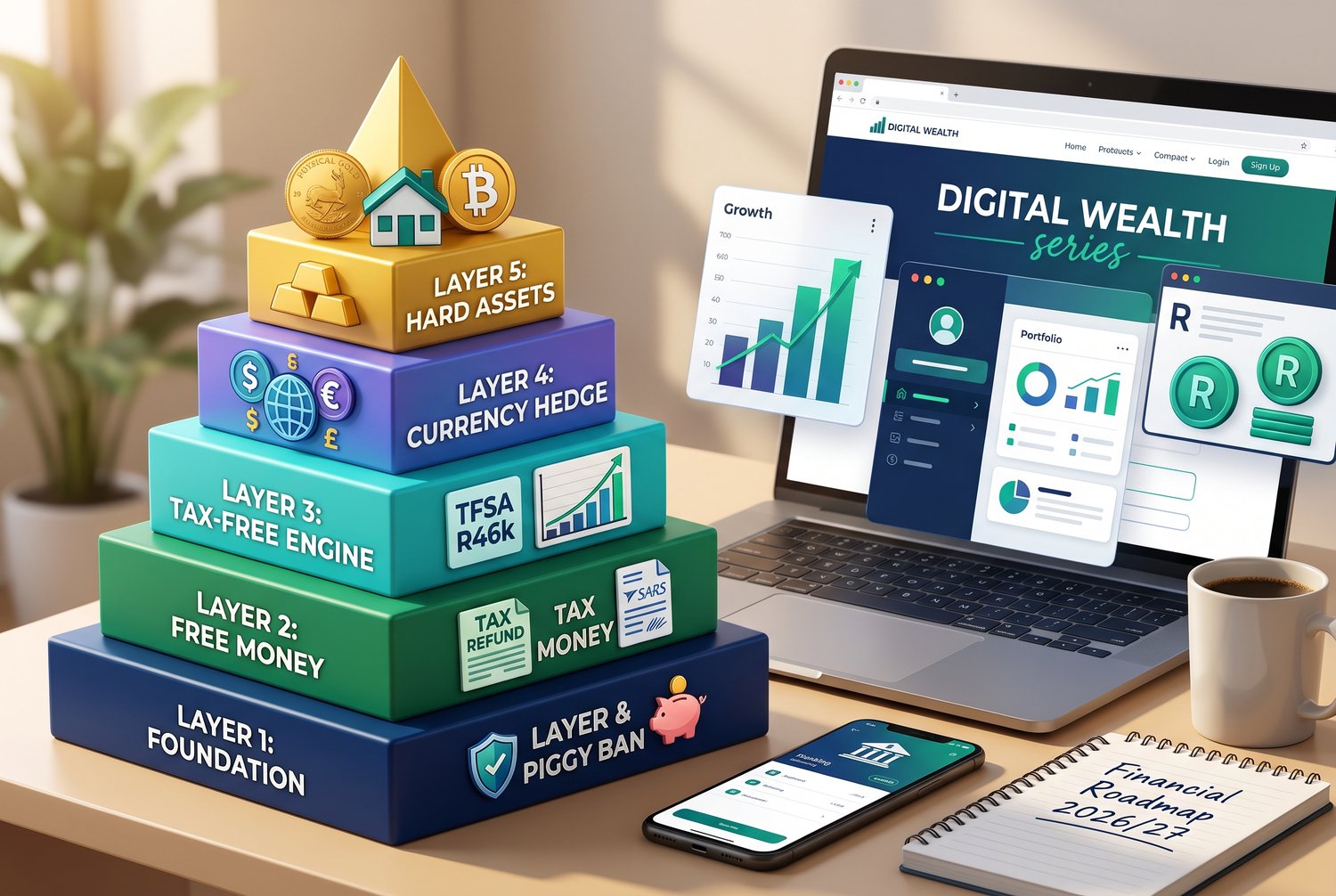
Layer 1: The Foundation (Emergency Fund + Eliminating Bad Debt)
Layer 1 is the least exciting step in the stack—there is no impressive ETF chart to show off at a braai—which is precisely why most investors skip it. Yet without it, every rand you invest above it is built on sand. The first retrenchment, car breakdown, or unexpected medical bill forces you to liquidate long-term investments at the worst possible time, often locking in market losses and triggering taxes.
Two pillars make up this layer:
- A 3-to-6-Month Emergency Fund: Hold enough cash to cover essential living expenses in a separate, high-yield savings or money market account accessible within 24 hours. With the South African Reserve Bank (SARB) holding the repo rate at 7.25% and the prime lending rate at 10.75% as of November 2026, cash sitting in a competitive money market fund can still earn a solid yield while keeping you liquid.
- Eliminating High-Interest ("Bad") Debt: Prioritize clearing any debt whose interest rate exceeds what you can realistically earn in the market—namely credit cards (18%–22%), retail clothing accounts, and personal loans (up to 29%).
The Math in Action: Consider a South African earner holding R12,000 in savings (earning ~R1,000/year in interest) while carrying R8,500 on a credit card at 21% and R4,000 on a store account. That debt bleeds roughly R2,500 a year in interest. Paying off a 22% credit card is mathematically identical to earning a guaranteed, tax-free, risk-free 22% annual return—something no ETF or property deal can promise.
- Action Step: List every short-term debt, its interest rate, and its annual rand interest cost. Pause aggressive investing if necessary until high-interest consumer debt is cleared and your emergency buffer is ring-fenced.
Layer 2: The "Free Money" Layer (Employer Match & Retirement Funds)
Once your foundation is stable, Layer 2 unlocks guaranteed upfront returns that beat the stock market before a single cent is even invested: employer retirement matching and SARS tax deductions.
- Capture 100% of Your Employer Match: If your company offers a pension or provident fund match (commonly 5% to 7.5% of gross salary), contributing enough to capture the full match delivers an instant 100% return on the matched portion. Leaving it unclaimed is effectively taking a voluntary pay cut.
- Maximize the Updated 2026/27 SARS Deduction: Effective 1 March 2026, SARS raised the annual tax-deductible retirement contribution ceiling from R350,000 to R430,000 per year (still capped at 27.5% of your taxable income or remuneration, whichever is greater). If you are in the 31% marginal tax bracket, every R1,000 contributed saves you R310 in income tax; in the top 45% bracket, it saves you R450.
The Compounding Impact: On a R58,000 monthly gross salary (31% tax bracket), contributing 7.5% (R4,350/month) triggers a 5% employer match (R2,900/month) and roughly R1,350/month in tax savings. That turns an out-of-pocket cost of R3,000/month into R7,250/month invested—an immediate 142% return in year one. Compounded at 10% annually over 30 years, that single layer grows to over R16.4 million nominally (roughly R5.4 million in today's purchasing power).
What You Need to Know About Structure & Liquidity (2026 Update)
- Estate & Creditor Protection: Retirement funds sit outside your deceased estate (avoiding estate duty and executor fees) and are legally protected from creditors.
- The Two-Pot Retirement System: Under South Africa's Two-Pot framework, one-third of your new contributions goes into a Savings Pot (accessible once per tax year in emergencies, taxed at your marginal rate), while two-thirds goes into your Retirement Pot, which stays locked until age 55. Treat the Savings Pot as a last resort—withdrawing from it destroys decades of compounding and triggers a steep tax bill.
- Watch Regulation 28 & Fees: Retirement funds are governed by Regulation 28 (capping offshore exposure at 45% and equities at 75%). Because fees compound against you over decades, compare your Effective Annual Cost (EAC) across low-cost platforms like EasyEquities, Sygnia, or 10X.
Layer 3: The Tax-Free Engine (Using Your TFSA Correctly)
A Tax-Free Savings Account is one of the most generous tools available to South Africans: every rand of interest, dividends, and capital gains earned inside it is 100% exempt from SARS forever.
The 2026/27 Limit Upgrade: From 1 March 2026, the annual TFSA contribution limit jumped from R36,000 to R46,000 per tax year (R3,833/month), while the lifetime contribution limit remained at R500,000. That means disciplined investors can now max out their lifetime allowance in under 11 years instead of nearly 14. (Tip: Your existing bank or broker debit order will not automatically adjust to R3,833/month—you must update it manually.)
The Most Expensive TFSA Mistake
The word "Savings" in Tax-Free Savings Account has cost South Africans millions. Holding cash inside a TFSA at 7% wastes your limited lifetime allowance on low-growth returns.
- Cash TFSA (7% return): R2,500/month over 15 years (starting from R65,000) grows to roughly R800,000 nominally (~R550,000 in today's buying power).
- Equity ETF TFSA (10%–15% return): Moving that exact same R2,500/month into a low-cost growth ETF (such as a Satrix Top 40 or global equity ETF) can grow to roughly R1.7 million nominally (~R1.1 million in today's buying power)—double the outcome with zero extra monthly effort.
Non-Negotiable TFSA Rules
- Never over-contribute: Exceeding R46,000 in a tax year (across all your TFSAs combined) triggers a brutal 40% SARS tax penalty on the excess.
- Never withdraw early: Withdrawn amounts do not restore your R500,000 lifetime cap.
- Transfer—don't withdraw: If your TFSA is currently stuck in a bank cash account, request a formal Section 12T transfer through a low-cost broker (like EasyEquities, Sygnia, or Satrix) so you don't burn your lifetime allowance.
Layer 4: The Currency Hedge (Protecting Against Rand Erosion)
You can own a South African bank account, a local RA, local unit trusts, and a local property—and still have 100% of your net worth bet on a single currency.
Even if you plan to live in South Africa forever, your real cost of living is tied to hard currencies: fuel, vehicles, electronics, imported food, and software are all priced globally. Historically, the rand has depreciated against the US dollar by an average of 4% to 6% per year over the long term. If your local portfolio earns 8% while the rand slides 5% against the dollar, your global purchasing power barely treads water. Wealthy South African families routinely keep 30% to 70% of their investable assets exposed to hard currencies.
Three Legal Ways to Build Offshore Exposure in 2026
- JSE-Listed Rand Feeder ETFs (Simplest & Most Tax-Efficient): Funds like Satrix MSCI World, Sygnia Itrix S&P 500, 1nvest S&P 500 Info Tech, and 10X Total World are bought in rands on the JSE, yet hold global companies underneath. Even better, you can hold these directly inside your Layer 3 TFSA to combine offshore currency protection with tax-free compounding.
- Direct USD Brokerage Accounts (e.g., EasyEquities USD): Converts rands into dollars to buy US-listed shares and ETFs. As of April 2026 (SARB Exchange Control Circular 6/2026), your Single Discretionary Allowance (SDA) doubled from R1 million to R2 million per calendar year with no SARS tax clearance required.
- International Offshore Brokers (e.g., Interactive Brokers): Ideal for larger portfolios needing multi-currency custody and direct access to international exchanges.
Crucial Estate Planning Update (US Situs Tax): If you hold US-domiciled ETFs or stocks directly in a USD account (such as VOO or Apple) and pass away with more than $60,000 in US assets, your estate may be hit with US Estate Tax (situs tax) of up to 40%—even as a South African resident. To avoid this trap, stick to JSE-listed rand feeder ETFs for smaller portfolios, or use Irish-domiciled UCITS ETFs (like CSPX or VWRA) via an offshore broker once your direct foreign portfolio grows.
Layer 5: Hard Assets (Generational Wealth & Systemic Protection)
Layers 1 through 4 handle liquidity, tax efficiency, and currency diversification. Layer 5 is where long-term investors build generational resilience using hard assets—assets that are physically or mathematically scarce and cannot be printed at will.
Wealthy families rarely bet on just one hard asset; they combine three because each defends against a different risk:
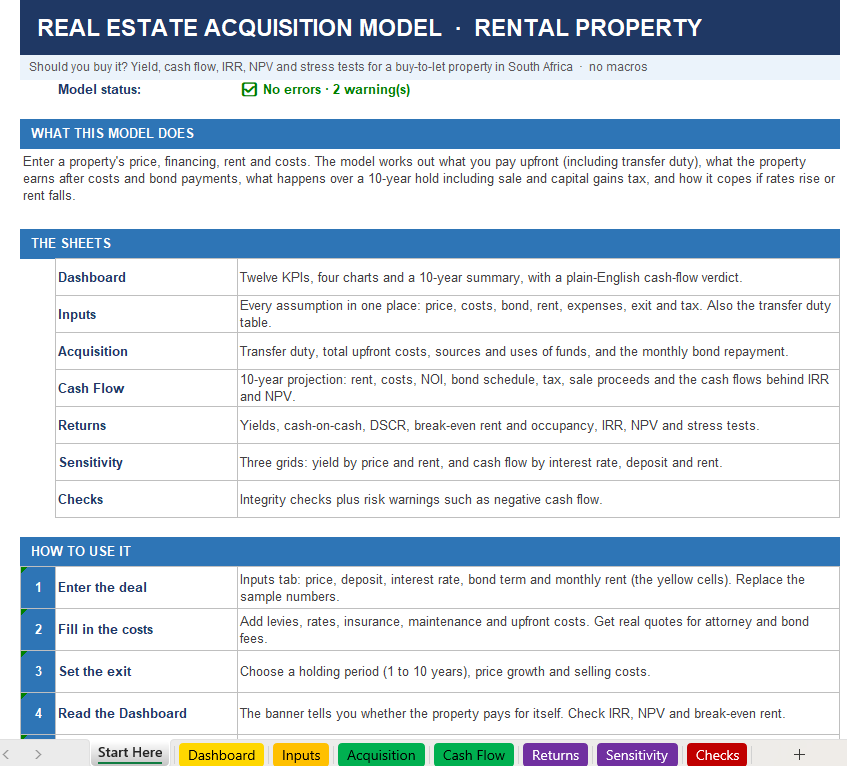
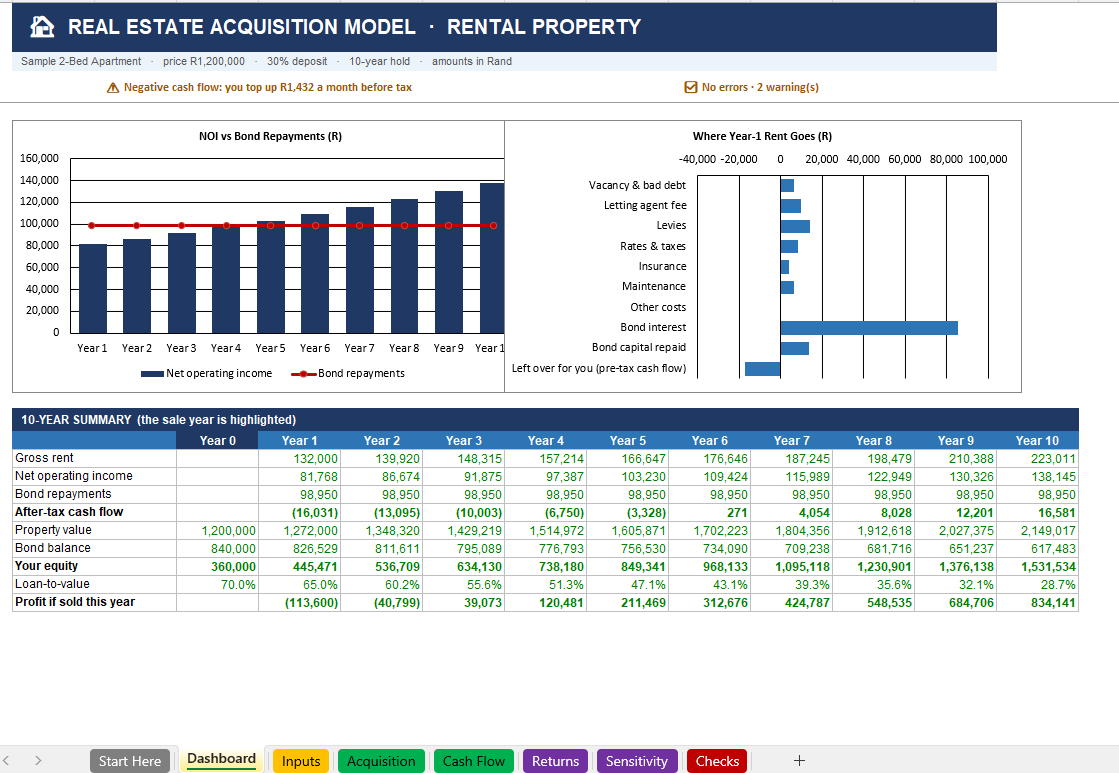
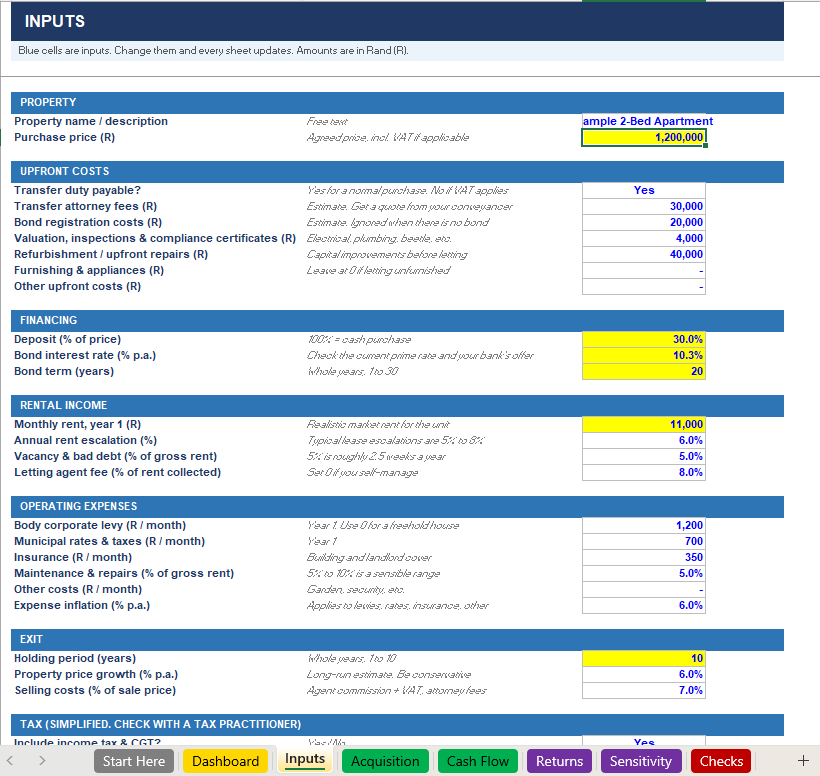
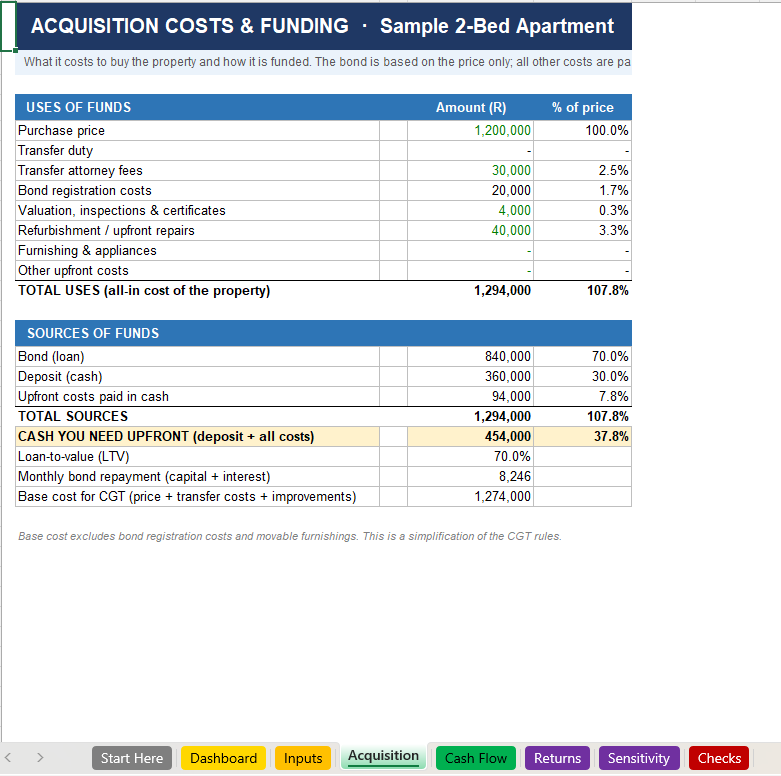
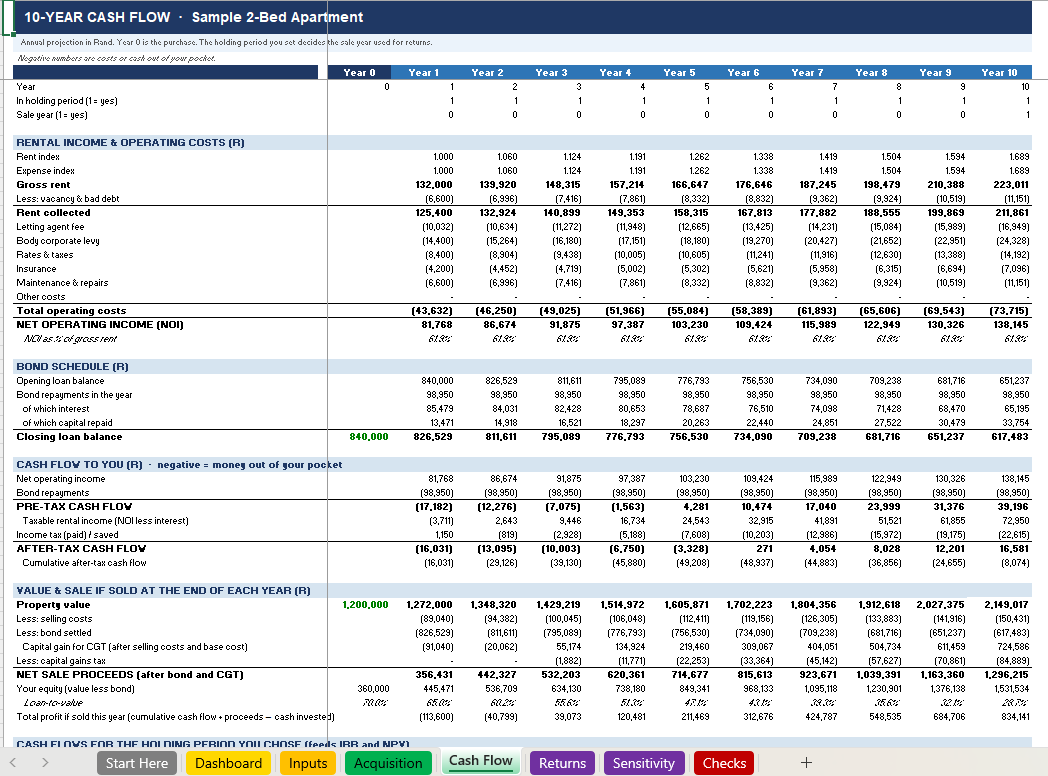
- Income-Producing Property: Generates inflation-linked rental cash flow, offers leverage via bank financing, and provides tax-deductible expense structures—though it is illiquid, concentrated in South Africa, and requires active management.
- Physical Gold: A multi-millennia store of value priced in US dollars that protects against severe currency or financial crises, though it produces no yield. Favour standard bullion coins like Krugerrands (including 1/10 oz fractional coins) over high-markup "collector" coins.
- Bitcoin: Capped at a mathematically fixed supply of 21 million coins and priced in USD, Bitcoin hedges against long-term fiat currency debasement, though it carries high short-term volatility.
The Golden Rule of Layer 5: Paper vs. Real Custody
Buying a property REIT, gold ETF, or leaving Bitcoin on an exchange gives you paper exposure—meaning you remain exposed to counterparty, platform, or seizure risk. True hard-asset resilience comes from direct ownership and self-custody: physical property deeds, bullion stored securely in your possession, and Bitcoin bought via FSCA-licensed South African exchanges (such as Luno or VALR) and transferred to personal cold storage (hardware wallet).
(Compliance Note: Remember that SARS classifies crypto assets as financial instruments—selling, swapping, or spending Bitcoin triggers Capital Gains Tax or income tax depending on your holding intent. Keep clean transaction records from day one.)
Your Late-2026 Action Plan Before Tax Year-End
With the 2026/27 South African tax year closing on 28 February 2027, you have a tight window to put this 5-layer stack into motion:
- Audit Layer 1 tonight: Tally your high-interest debt and verify your emergency fund covers 3–6 months of essentials.
- Check HR before December: Confirm you are capturing 100% of your employer's retirement match and calculate whether an RA top-up before 28 February makes sense under the new R430,000 cap.
- Fix & Top Up Layer 3: Log into your TFSA—if it is sitting in cash, initiate a formal transfer into low-cost global equity ETFs, and aim to use your updated R46,000 annual allowance before the February deadline.
- Calculate Your Offshore Percentage: Check how much of your net worth is tied to the rand, and start automating even R500/month into a global feeder ETF.
- Educate Before Buying Layer 5: Never buy property deals, altcoins, or collectible gold coins from commission-driven salespeople—study the mechanics and tax rules first.
Disclaimer: This article is published by Digital Wealth Series for educational and informational purposes only and does not constitute registered financial or tax advice. Consult a FSCA-registered financial planner or tax practitioner before making major portfolio changes.