

Published by Digital Wealth Series
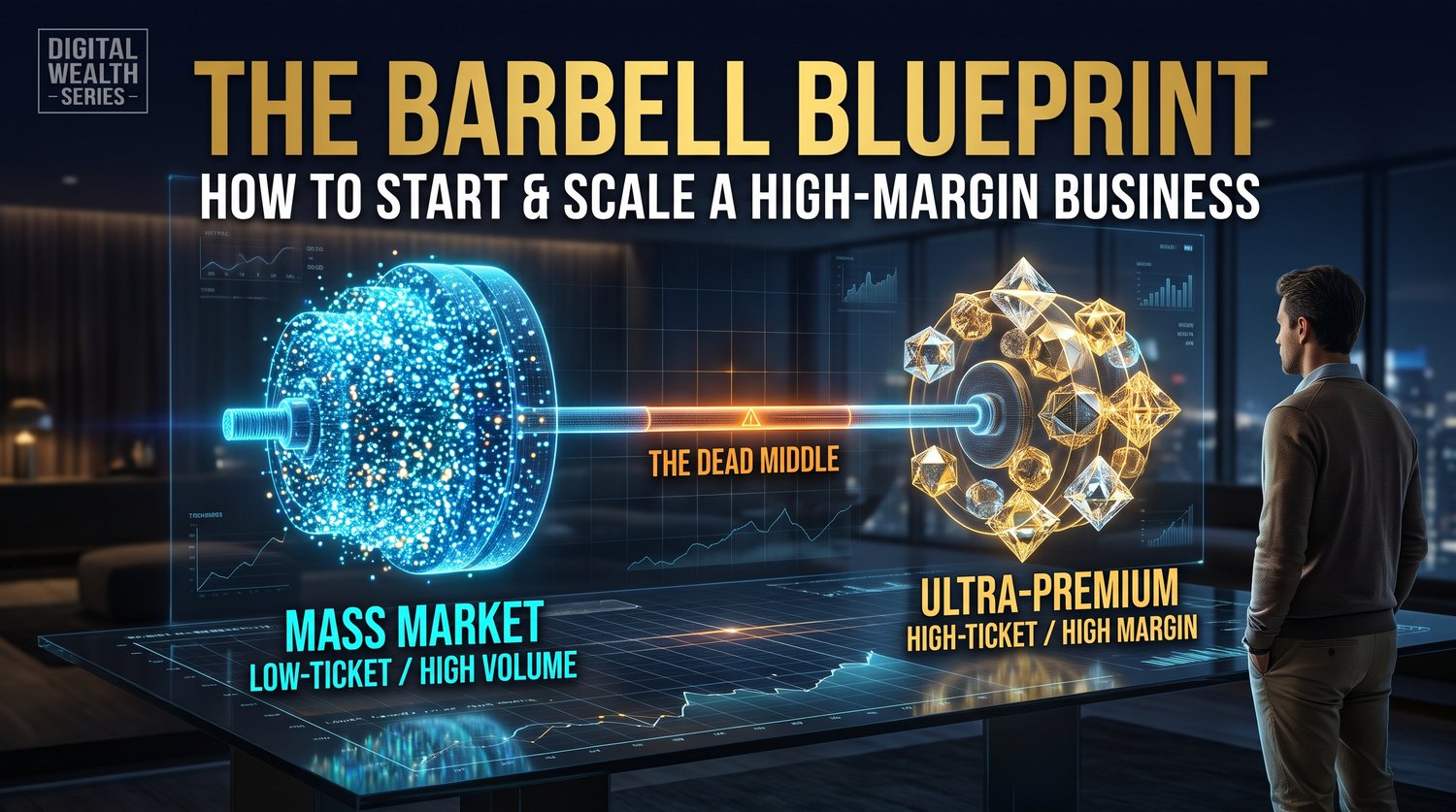
Most new founders fail for the exact same reason: they build a mediocre offer priced right in the middle of the market. They charge too much to attract mass-market volume, yet too little to afford the customer acquisition costs or deliver an unforgettable result.
In an economy where AI has driven the cost of generic information and average execution to near zero, the middle is where businesses go to die.
If you are building a business from scratch—or trying to break a stagnant revenue plateau—the smartest move isn't chasing viral scale on day one. It is embracing a counterintuitive strategy popularized by investor and entrepreneur Alex Hormozi: start unscalable, charge a premium, and use high-margin cash flow to fund your scale.
Here is the complete, updated playbook for turning high-ticket economics into lasting digital wealth.
1. The Barbell Strategy: Go Ultra-Premium or Ultra-Cheap
At its core, every business is simple economic arbitrage: the gap between what it costs to acquire a customer and the lifetime value that customer generates.
When you look at the market, sustainable businesses cluster at two extremes:
- The Mass-Market End: Selling something inexpensive to millions of people (requires massive capital, distribution, and razor-sharp systems).
- The High-Ticket End: Selling something expensive to a select few (requires minimal upfront capital and generates immediate cash flow).
Starting at the mass-market end without capital is a brutal uphill climb. Starting at the top is far easier—and it is the exact blueprint used by some of the world’s largest companies.
Consider Tesla. They didn't start by trying to manufacture an affordable mass-market sedan. They launched with the $250,000 Roadster—essentially a beta-test vehicle sold to a tiny group of wealthy early adopters. The margins and proof of concept from those few buyers funded the Model S, which eventually funded the mass-market Model 3.
The 2026/2027 Reality Check: AI has accelerated the collapse of the middle. Consumers will no longer pay mid-tier prices ($200–$500) for generic courses, basic templates, or standard consulting that an AI tool can replicate in seconds. What buyers will pay a premium for today is bespoke judgment, direct accountability, speed, and done-for-you execution.
2. Why "Unscalable" 1-on-1 Work Is Your Ultimate Bootstrapping Weapon
Modern entrepreneurship culture is obsessed with passive income and scale. As a result, many builders dismiss 1-on-1 services as a trap. That mindset often leaves them broke while they spend months building a "scalable" product nobody buys.
When Hormozi launched his first gym, his core model was group training. Yet he took on a single 1-on-1 private client who trained 90 minutes a day, five days a week. That one client generated roughly $180 a day—about $4,000 a month in pure cash flow—which covered his personal living expenses and allowed him to reinvest 100% of his gym's profits back into growth.
Here is why starting with a capped, unscalable 1-on-1 offer beats trying to scale prematurely:
- Nearly 100% Profit Margins: When you sell your direct expertise, you don't need ad spend, complex software stacks, or a large payroll. Almost every dollar goes straight to the bottom line.
- Rapid Iteration Without Breaking Systems: With five private clients, you can pivot your delivery on the fly, test new frameworks, and spot recurring bottlenecks in real time—without recoding a platform or retraining staff.
- Accelerated Market Education: Working closely with high-paying clients rewires your beliefs about money. Landing one $15,000 client requires the same revenue as making 300 sales at $50—and teaches you far more about what sophisticated buyers actually value.
- Built-In Case Studies and Authority: Your private clients become your strongest proof points, giving you real-world lessons and stories that fuel your content and marketing.
Busting the "Don't Trade Time for Money" Myth
A common objection is that "wealthy people don't sell their time." In reality, everyone has an effective hourly rate—just divide your annual income by 2,000 working hours. Even legendary investors like Warren Buffett trade time for money when you account for the thousands of hours spent reading financial reports and conducting due diligence on deals he passes on.
The goal isn't to avoid trading time for money on day one; the goal is to trade a capped portion of your time at a dramatically higher rate so you can buy back your freedom later.
3. The 10x Profit Math (and the Power of Price Anchoring)
Adding a high-ticket tier doesn't just bring in extra cash—it transforms your unit economics and lifts the perceived value of everything else you sell.
Imagine you have 100 customers. Compare selling only a $100 scalable product (at a 40% profit margin) versus introducing a $1,000 premium tier (at a 100% margin). Just 10% of your customers more than double your revenue and generate nearly 74% of your total profit.
How to Use the Anchor Effect Properly
Even when prospects decline your premium tier, its existence makes your scalable offer look like a bargain. You gain a natural, high-authority narrative: "Most people can't justify $10,000 to work with me privately, so I distilled the exact same system into this $100 program."
One critical rule: You must confront the high price directly. Don't mumble it or rush past it. Present the premium offer clearly, state the price, and stay silent. Give the prospect space to seriously consider it. Some will surprise you and say yes. If they hesitate, then smoothly down-sell to your scalable option.
4. Three Mental Models to Build a 10x Offer
If you aren't sure what you could possibly include to justify adding a zero to your price tag, run your business through these three filters:
- The 10x–100x Brainstorm: Ask yourself: If someone paid me 10x or 100x my current price, what absurd level of service would I provide? Write down everything—custom audits, direct phone access, weekly strategy calls, personal setup. Next, cross out the items with heavy hard costs. You will be shocked at how many high-value perks cost you almost nothing to deliver.
- The Word-of-Mouth Mandate: Imagine you are forbidden from running ads or posting content. You have one client, and your business only survives if that client is so blown away that they recruit their friends for you. What would that onboarding, communication, and result look like? Build that.
- The Scalable Value Test: Strip away every unscalable element from your offer and ask: How could I still make this 10x more valuable? This forces you to invent better tools, sharper frameworks, and clearer assets—which immediately upgrade your core product too.
5. Tactical Value Deconstruction: Engineering an Offer People Can't Refuse
A high price tag without disproportionate value is just wishful thinking. To command premium rates, engineer your offer around five concrete levers:
1. Choose the Right Avatar
Stop asking what your $100 customer would pay $1,000 for. Usually, the person who buys your high-ticket offer is a completely different buyer. Target an avatar who already has the purchasing power, feels an urgent pain, and is easy to reach.
2. Articulate Their Pain Better Than They Can
Persuasion lives in the specific, never the vague. If you can describe a prospect's exact frustration more accurately than they can describe it themselves, they will instinctively trust that you hold the solution.
- Modern AI Workflow: Use AI to scrape and analyze 3-star and 4-star book reviews, Reddit threads, and forum discussions in your niche. Extract the exact phrases, complaints, and failed solutions your target market uses, and mirror that language in your positioning.
3. Maximize Perceived Likelihood of Success
People don't buy your hours—they buy certainty. A $29 PDF meal plan promises the same weight-loss outcome as a private coach who checks in with you daily, yet the private coach commands 50x the price because the likelihood of actually achieving the result skyrockets. Competence plus visible commitment acts as an implied guarantee.
4. Sell Speed, Not Savings
"Latency beats magnitude seven days a week."
You rarely sell wealthy buyers by promising to save them money; you sell them by saving them time. Audit your current delivery timeline and ask how you can cut it in half. Offer priority response times, first-in-line access, or emergency turnaround. If your business relies on third-party vendors or contractors, your higher margins let you pay those vendors more to prioritize your VIP clients, creating a "priority ring" competitors can't match.
5. Systematically Delete Friction
Map out every single action a client currently has to take to get their desired result. Then, delete those steps one by one. The higher the price point, the more "done-for-you" and turnkey the experience should be.
- AI-Augmented White-Glove Delivery: Today, you can combine high-touch human strategy with AI-driven backend workflows—automating onboarding forms, research briefs, custom dashboards, and draft deliverables—so your clients feel like royalty without burning out your calendar.
6. Avoiding the "Golden Handcuffs": Your Exit Ramp to Digital Wealth
Starting with high-ticket 1-on-1 work is a launchpad, not a permanent prison. To make sure you actually build wealth rather than just a high-paying job, pair this strategy with three guardrails:
- Cap Your Capacity: Strictly limit private client delivery to 10%–20% of your working week (for example, 3 to 5 clients maximum). When demand exceeds your cap, don't add more hours—raise your price.
- Productize Everything You Repeat: Every time you solve a problem for a private client, turn that solution into a template, SOP, calculator, or mini-course. Your VIP clients effectively pay you to do R&D for your scalable digital products.
- Route Cash Flow Into Assets: Treat your high-margin service revenue as venture capital for your own portfolio. Keep your personal overhead lean and funnel those 100%-margin profits into scalable digital assets, audience growth, or long-term investments.
Your 48-Hour Action Plan
You don't need a massive following or a redesigned website to test this today:
- Draft one 10x offer using the brainstorm frameworks above—focus on speed, direct access, and removing friction.
- Put it in front of the market by listing it on your site, mentioning it in your newsletter, or pitching it directly on your next sales conversation.
- Confront the price with confidence, stay quiet, and let the market respond.
Even if only a tiny fraction of your audience says yes, the math—and the momentum—will permanently change how you build your business.
Disclaimer: This article is published by Digital Wealth Series for educational and informational purposes only and does not constitute registered financial or tax advice. Consult a FSCA-registered financial planner or tax practitioner before making major portfolio changes.