
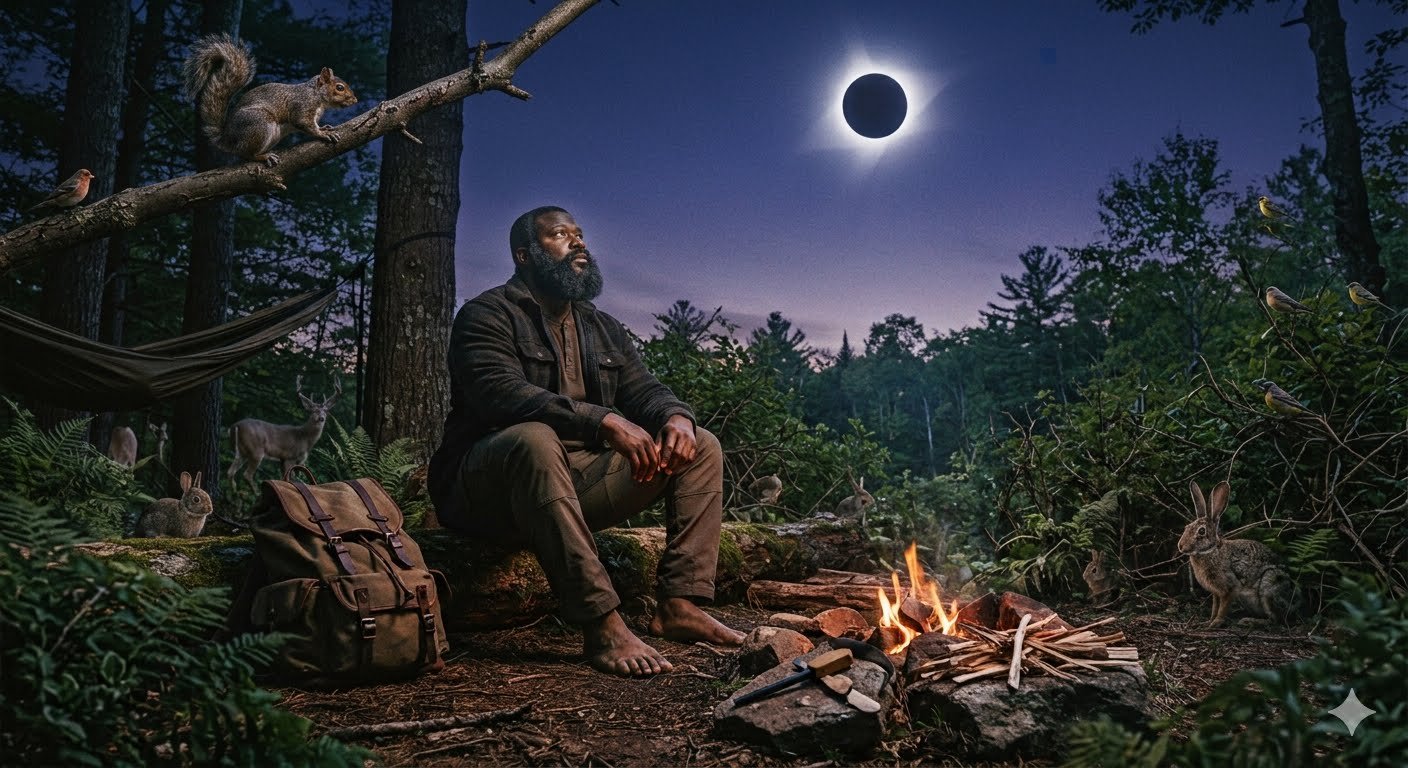
To step into the wilderness is to step out of human time. When a man shoulder-straps his burdens, leaves the paved world behind, and marches upward into the ancient woods beneath the cosmic shadow of an eclipse, a profound and quiet alchemy begins. He enters the forest as a seeker; he returns as something formidable.
Throughout history, the prophets, the warriors, and the psalmists—from Moses on the thundering peaks of Sinai to David singing to the stars in the rugged fields of Judea—knew a singular truth: the divine state cannot be achieved in the noise of the crowd. It requires the isolation of the elements. It demands a confrontation with the raw, unyielding skin of creation.
The Physical Rebirth
The transformation begins in the flesh. As he hauls the heavy rucksack uphill, hacks away deadwood with a machete, and drives his bare feet deep into the living soil, his body awakens. His chest expands, his posture locks into place, and his muscles swell from the sheer, primitive exertion of survival. By the time he conquers the dark—striking sparks from flint and steel until a fire roars to life—he has shed his modern softness. He returns to civilization taking up more physical space, radiating a primal, athletic authority that causes onlookers to instinctively step aside. He does not seek dominance; his body simply carries the unmistakable weight of a man who has mastered his environment.
The Psychological Reset
Psychologically, the wilderness strips away the artificial structure of the clock. Seconds, minutes, and days dissolve until Wednesday and Friday bleed into one seamless present. The mind stops reacting to the constant digital noise of the world and drops into a deep, meditative focus. In this quietude, the creative subconscious is unlocked. Blocked stories begin to flow, and the answers to deep narrative and life puzzles surface effortlessly through dreams. The mind is no longer frantic; it becomes sharp, strategic, and profoundly still.
The Emotional Integration
Emotionally, the journey forces a beautiful, paradoxical union of absolute strength and deep humbleness. There is an immense humility in kneeling before the earth, gathering tiny twigs, dry tinder, and heavy stones to construct a simple hearth. In that dirt, the traveler confronts his own vulnerability. He feels the ancient, terrifying weight of the supernatural in the deep dark—the sudden, visceral awareness of things greater than himself. Yet, by anchoring his emotions in absolute faith, he pushes through the fear. He emerges from the woods emotionally ironclad, possessing a soft heart for the vulnerable but an unshakeable armor against judgment and shame.
The Spiritual Countenance
Spiritually, the man is illuminated. By sitting still under the synchronized dance of the sun, moon, and the eclipse, his spirit aligns directly with the frequency of God. He has passed through a rite of initiation, and he returns carrying ancestral blessings and a renewed promise for his legacy. This spiritual alignment alters his very countenance. Much like Moses descending the mountain with a face that shone so brightly people could not look away, the modern woodsman returns with a magnetic, spiritual weight (Kabod). People on the sidewalk stop and stare, not merely at his physical size, but at the rare, quiet light of a soul that has walked with the Divine in the deep woods and returned made whole.