
Fourth of July 2026
This year's Fourth of July (July 4, 2026) is much more than a typical Independence Day—it's the United States' 250th birthday, officially called the Semiquincentennial (a 250th anniversary). It marks 250 years since the adoption of the United States Declaration of Independence on July 4, 1776.
 .
.
Some reasons it's considered especially significant:
- A once-in-a-generation milestone. The last major milestone was the U.S. Bicentennial (200th anniversary) in 1976. Most Americans alive today have never experienced a quarter-millennium national anniversary.
- Nationwide celebrations. Federal, state, and local organizations have been planning commemorations for years under the "America250" initiative, with special events, exhibits, concerts, parades, historical programs, and fireworks across the country.
- Special commemorative items. The U.S. government has authorized redesigned circulating coins and other commemorative items tied to the 250th anniversary.
- Major historical and cultural events. Cities such as Philadelphia, Washington, and Boston are hosting especially large celebrations because of their connection to the nation's founding.
A fun fact: the word "semiquincentennial" is so awkward that most organizations simply call it "America 250."
The biggest difference this year is that the Fourth of July is the centerpiece of the nationwide America 250 celebration, marking 250 years since the Declaration of Independence. The federal government, states, cities, museums, and civic groups have been planning special events for years.
Some of the major national plans include:
Philadelphia: The symbolic center of the celebration
Since the Declaration was adopted in Philadelphia, the city is hosting some of the signature events. One of the most notable is the dedication of the official America250 time capsule at Independence Hall on July 4, which is intended to be opened in 2276 for America's 500th anniversary.
Philadelphia has also expanded its annual Wawa Welcome America festival into a larger semiquincentennial celebration with concerts, historical programming, museum exhibits, and major fireworks displays.

Washington, D.C.: National-scale ceremonies
The capital is hosting a yearlong program of events culminating around July 4. Plans include:
- Large celebrations on and around the National Mall.
- Military flyovers and ceremonial events significant enough to require temporary restrictions at Ronald Reagan Washington National Airport.
- The Great American State Fair, featuring exhibits and participation from states across the country.
- Expanded fireworks and public festivities tied to the 250th anniversary.
A coordinated nationwide celebration
America250 organizers are promoting what they describe as one of the largest synchronized Fourth of July celebrations in U.S. history, with events occurring across thousands of communities from July 3–5. The goal is to connect local celebrations into a single national commemoration.
Museums and historical exhibits
Many major museums have created special exhibitions specifically for the 250th anniversary, focusing on American history, culture, democracy, immigration, civil rights, science, and the nation's future.
Special fireworks and entertainment
Cities are planning unusually large displays:
- New York City's annual Macy's 4th of July Fireworks is being expanded for the 250th anniversary, including 85,000 fireworks shells and major musical performances.
- San Francisco is holding a rare fireworks show from the Golden Gate Bridge, something that has happened only a few times in the bridge's history.
Service and charitable initiatives
America250 is also promoting nationwide volunteer and charitable-giving programs, including an effort called "Giving 4th" that encourages Americans to make July 4 a national day of service and philanthropy.
In many ways, the closest comparison is the U.S. Bicentennial in 1976—but this year's celebration is expected to be broader, with coordinated events stretching across the entire country rather than focusing primarily on a few marquee locations.
How can you add special decorations to your home?
For the 250th anniversary, decorations can go beyond the usual red-white-and-blue theme and specifically highlight the America 250 milestone.
Here are some ideas:
Incorporate "250" into the décor
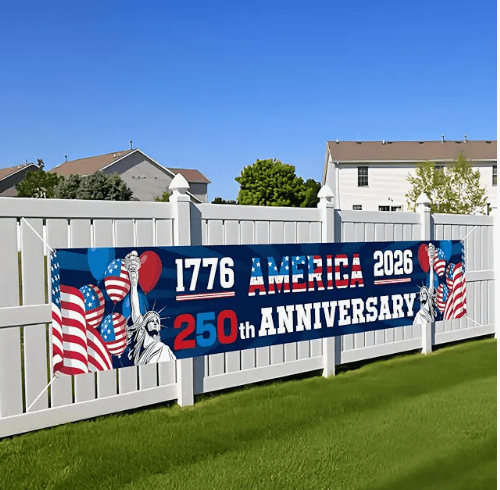
- Large "250" yard signs or banners.
- A wreath, floral arrangement, or balloon display shaped like "250."
- String lights arranged to form "1776–2026."
- A chalk mural on a driveway or sidewalk featuring the anniversary.

Blend patriotic and historical themes
- Display a timeline banner with major moments from 1776 to 2026.
- Use reproductions of historical documents such as the Declaration of Independence (avoid exposing valuable replicas to weather).
- Decorate with colonial-inspired elements: lanterns, bunting, vintage-style flags, and rustic wood signs.
- Create a "Founding Era" table centerpiece with candles, maps, and historical imagery.
Feature the official America 250 branding
The national commemoration has logos and downloadable materials available through the official America 250 program. You can use them on:
- Party invitations
- Yard signs
- Table decorations
- Community event displays

Create a "250 years of America" display
A fun conversation piece is a visual timeline:
- 1776: Independence
- 1865: End of the Civil War
- 1969: Moon landing
- 1976: Bicentennial
- 2026: Semiquincentennial
You can add family milestones alongside national ones to connect your family's story to the country's history.
Use 13-colony motifs
Since the anniversary commemorates the nation's founding:
- Thirteen stars arranged in a circle.
- Thirteen lanterns or candles.
- Thirteen small flags lining a walkway.
- Decorations inspired by early American flag designs.
Host a neighborhood display
If you're decorating outdoors:
- Create a "250 Years of Freedom" banner.
- Encourage neighbors to display coordinated bunting.
- Add signs highlighting local historical connections in your town or county.
Lighting ideas
- Red, white, and blue landscape lighting.
- Projectors displaying stars, eagles, or "250" on your house.
- Illuminated pathways with patriotic lanterns.
Family-focused touches
- A memory wall where guests write what they hope America will be like in 2076 or 2276.
- A small "time capsule" activity inspired by the national anniversary celebrations.
- A display of family members who served in the military, worked in public service, or immigrated to the United States.

A tasteful theme many people are choosing this year is "1776–2026: 250 Years of the American Story"—combining patriotic colors with historical and community-focused elements rather than relying solely on flags and fireworks imagery.
A few practical safety rules can help make the Fourth of July enjoyable and reduce the risk of injuries, fires, and heat-related problems.
Fireworks Safety
- Attend public fireworks displays whenever possible—they're generally much safer than using consumer fireworks.
- If you use legal consumer fireworks, follow all local laws and manufacturer instructions.
- Keep a bucket of water, garden hose, or fire extinguisher nearby.
- Never relight a "dud" firework. Wait at least 20 minutes, then soak it in water before disposal.
- Keep spectators at a safe distance.
- Never hold lit fireworks in your hand or aim them at people, animals, vehicles, or buildings.
- Supervise children closely. Sparklers can burn at temperatures hot enough to cause serious burns.
Grilling Safety
- Place grills well away from homes, decks, railings, and dry vegetation.
- Never leave a grill unattended while cooking.
- Check propane connections for leaks before use.
- Keep children and pets away from the grill area.
- Clean grease buildup regularly to reduce flare-ups.
Heat and Sun Safety
- Stay hydrated, especially if you'll be outside for several hours.
- Wear sunscreen and reapply it according to the product directions.
- Seek shade during the hottest part of the day.
- Watch for signs of heat exhaustion: heavy sweating, dizziness, nausea, weakness, or headache.
- Pay extra attention to older adults, young children, and anyone with medical conditions.
Water Safety
- If you're boating or swimming, wear properly fitted life jackets when appropriate.
- Never swim alone.
- Designate a sober boat operator.
- Keep a close eye on children around any body of water.

Alcohol Safety
- Have a designated driver or arrange a ride home.
- Never combine alcohol with fireworks or boating.
- Drink water throughout the day, especially in hot weather.
Pet Safety
- Many pets are frightened by fireworks.
- Keep pets indoors in a secure area during fireworks displays.
- Ensure identification tags and microchip information are up to date.
- Avoid bringing pets to large fireworks events.
Home and Neighborhood Safety
- Keep walkways clear of chairs, coolers, and extension cords.
- Be mindful of neighbors, especially young children, veterans, shift workers, and people sensitive to loud noises.
- Dispose of fireworks debris only after it has been thoroughly soaked and cooled.
If You're Hosting a Party
- Have a basic first-aid kit available.
- Know the address of the gathering location in case emergency services are needed.
- Keep emergency exits and gates accessible.
- Designate responsible adults to supervise children and activities.
Since this Fourth of July is the nation's 250th anniversary celebration, many communities are expecting larger crowds than usual. If you're attending a major event, consider arriving early, identifying meeting points for your group, and keeping your phone charged.

Comments ()