
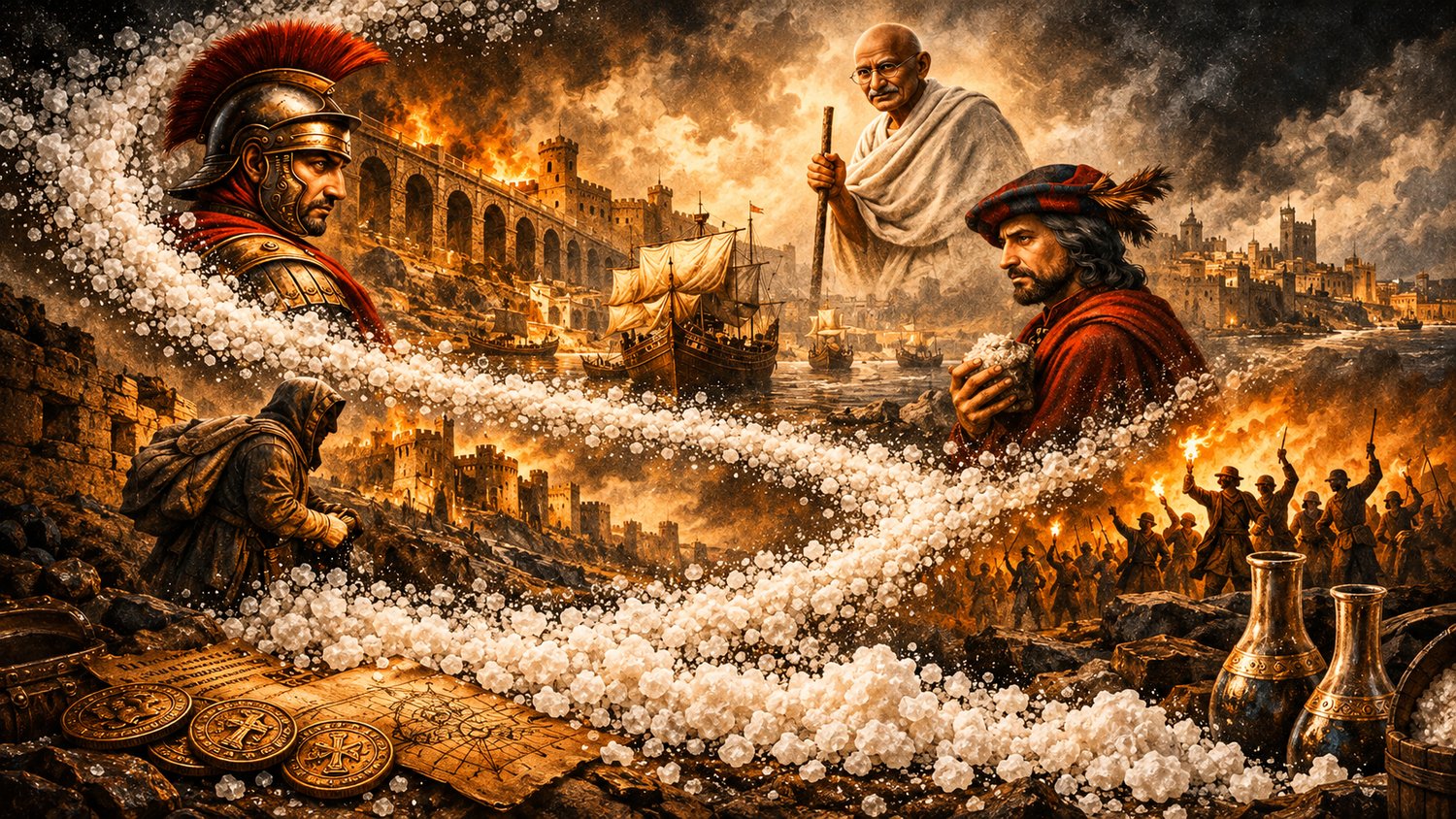
Most people think salt belongs in the kitchen and nowhere else. A simple seasoning. A white crystal in a shaker. Nothing more.
The reality is far more interesting.
Salt is not a culinary footnote. Salt is the drama of civilizations.
For thousands of years, salt helped build empires and, in some cases, helped bring them down. It financed wars, provoked revolts, enriched merchants, and shaped political power across continents. Entire economies rose around its production and trade because, long before refrigeration, salt was not a luxury. It was a necessity.
Every era had its salt crisis.
The story runs through the great salt roads of antiquity, including Rome’s Via Salaria. It appears in Venice’s efforts to dominate the salt trade. It resurfaces in France’s infamous gabelle, one of the most hated taxes in European history. Centuries later, it emerges again in Gandhi’s March to the Sea, when a handful of salt became a symbol of resistance against imperial power.
Behind every grain lies a story of control and rebellion.
There were smugglers willing to risk imprisonment, ruin, or death for a sack of crystals. Kings taxed populations on a substance their bodies could not live without. Merchants transformed brine into fortunes. Governments fought to control production, transport, and distribution. And modern scientists have spent centuries separating historical fact from the myths and legends those struggles left behind.
What makes salt fascinating is that it sits at the intersection of science, economics, politics, and survival. Few minerals have influenced daily life so deeply while remaining largely invisible in the historical narrative.
Salt is not merely a kitchen story.
It is a story of greed and ingenuity. Of power and resistance. Of human survival and human ambition. It is one of the rare substances that can reveal how civilizations functioned, what they feared, and what they were willing to fight for.
These stories, along with many other forgotten chapters from the history of humanity’s most overlooked mineral, are explored in Worth Your Salt: The Hidden Science, Forgotten History, and Surprising Future of Earth’s Most Misunderstood Mineral.
Because once you start following the history of salt, you are no longer studying a seasoning. You are studying the forces that helped shape the world we live in today.