
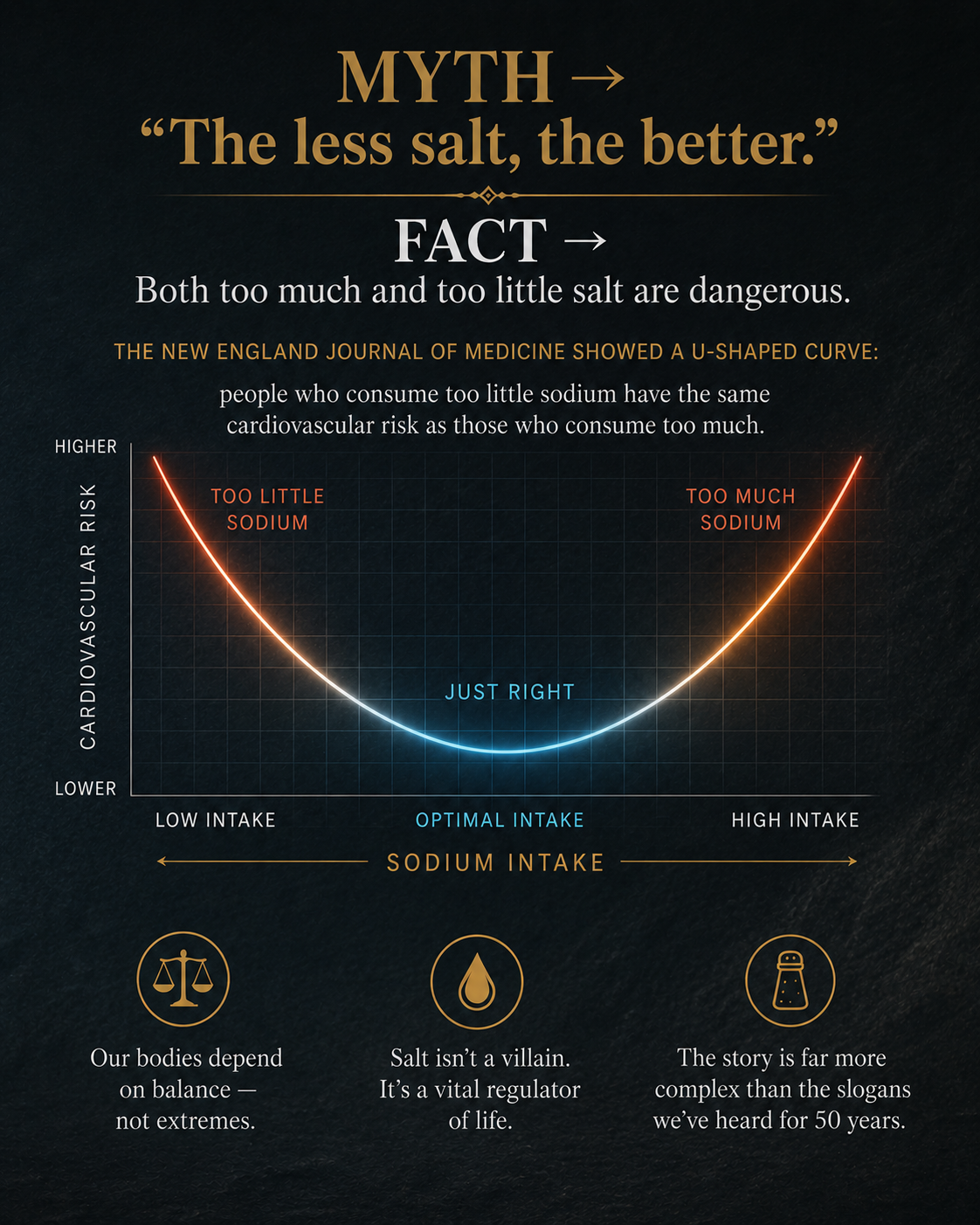
For decades, we have been taught a simple message: the less salt you eat, the healthier you will be.
The reality is more complicated.
Salt is one of the most misunderstood substances in modern nutrition, largely because public discussions often reduce a complex biological question to a simple slogan. But human physiology rarely works in absolutes.
While excessive sodium intake can be harmful, too little can also create problems.
Research published in the New England Journal of Medicine highlighted what scientists describe as a U-shaped relationship between sodium intake and cardiovascular risk. In simple terms, risk rises at both extremes. People consuming very high amounts of sodium face increased health concerns, but people consuming very low amounts may also experience elevated risk. The healthiest place is not necessarily at one end of the scale, but somewhere in the middle.¹
That finding challenges a common assumption: that every reduction in salt intake automatically leads to better health.
Our bodies depend on sodium for some of their most fundamental functions. Sodium helps regulate fluid balance, supports nerve signalling, enables muscle contraction, and plays a critical role in maintaining normal physiological function. Without it, life is impossible. The question has never been whether humans need salt. The question is how much.
This is why salt is neither a miracle food nor a villain.
Like many things in biology, its effects depend on context, individual health, overall diet, and dose. The body's needs are governed by balance, not extremes.
Yet much of the public conversation around salt has treated it as a simple enemy. Over the last half-century, scientific findings, public health campaigns, media headlines, and popular assumptions have often been compressed into messages that are easy to repeat but do not always capture the full picture.
The result is that many people know that salt is controversial, but far fewer understand why.
The history of our modern fear of salt is every bit as fascinating as the history of salt itself. It involves competing studies, shifting medical advice, public policy, nutritional debates, and enduring myths that continue to influence how millions of people think about food.
These questions, along with many other misconceptions surrounding Earth's most misunderstood mineral, are explored in Worth Your Salt: The Hidden Science, Forgotten History, and Surprising Future of Earth’s Most Misunderstood Mineral.
Because the story of salt is not a story about eating as little as possible.
It is a story about understanding one of the substances on which human life depends, and learning why balance is often more important than certainty.
¹ https://www.nejm.org/doi/pdf/10.1056/NEJMoa1311889
https://pubmed.ncbi.nlm.nih.gov/25119607/