

As 2025 draws to a close, many of us will begin refining our approach to health and fitness for the year ahead. In most areas of life, unnecessary complexity rarely leads to better outcomes - only more friction. The more rules, systems, and barriers we impose, the less likely we are to follow through.
Simplicity, when applied correctly, removes resistance. And success in one simple domain tends to bleed into others: how we eat, how we train, how we communicate, how we live. For the purposes of this two-part essay, we will focus on two of the most impactful domains where simplicity matters most - nutrition and training.
The ability to simplify means to eliminate the unnecessary so that the necessary may speak.
- Hans Hoffman
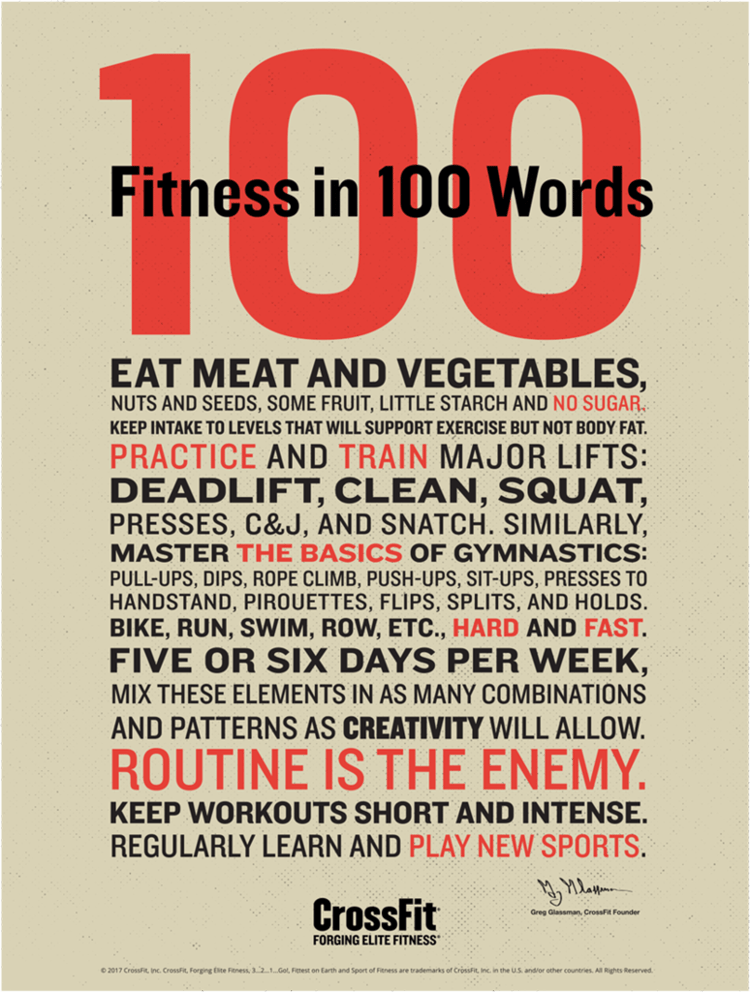
Fitness in 100 Words
Cutting right to the chase, the essence of this whole reading can be immediately taken from Greg Glassman's "Fitness in 100 words". Back in the early days of CrossFit, Glassman sought to clearly and simplistically define Fitness and through that, Health (“Mess You Up” CrossFit Journal WHAT IS FITNESS?, 2002).
Pretty straight forward, right?
As a professional within the fitness industry, the question you are most commonly asked by those beginning the journey and those deep into the journey is "How do I get fitter?". People genuinely seem to believe that we are part of some secret society, gate-keeping the elixir of lean muscle mass until you've proven yourself worthy of the ancient secrets. I wish it were as cool and mysterious as that, because it would entirely justify some cool robes and a candle-lit ceremony or two. Alas, Glassman nailed it and it really is as simple as he makes it out to be.

The Gospel
- Eat meat and vegetables, nuts and seeds, some starch, little fruit, no sugar. Keep intake to level that will support exercise but not body fat.
- Practice and train the major lifts: Deadlift, clean, squat, presses, C&J and snatch. Similarly, master the basics of gymnastics: Pull-ups, dips, rope climb, push-ups, sit-ups, presses to handstand, pirouettes, flips, splits, and holds. Bike, run, swim, row, etc. Hard and fast.
- Five or six days per week mix these elements in as many combinations and patterns as creativity will allow. Routine is the enemy. Keep workouts short and intense.
- Regularly learn and play new sports.
If you take anything away from reading this today, let it be these clear and actionable guidelines.
The Base of the Pyramid
Diving into things a little bit more, though, let's start with simplifying your nutrition.
Proper nutrition very much establishes the baseline of your capacity, it will amplify or diminish all your other efforts outside of it. In the modern landscape, nutrition is a terrifying topic, one which everyone has an opinion on. For every whole foods vegan, there is a carnivore, mediteranean, or paleo enthusiast - all of them ready and willing to die on their chosen hill. It can quickly become overwhelming for those who are uneducated in this area, as they all seem to produce results, yet all market themselves as THE ONE TRUE HUMAN DIET.
There's no such thing, don't be fooled.
These diets are marketed as producing results and working, because they all produce results and they all work. They just don't work for everyone, relative to preferences, culture, geography etc. However, the actual reason they all work is due to the common theme which they all hold at their center.
The removal of ultra-processed and processed foods in exchange for single ingredient foods.
That is very much it, it just doesn't sound as sexy as saying: "I'm a raw carnivore who starts each day by punching a mammoth to death to feed my family, as god intended." - Liver king, probably.
The main nugget to take from that is simplicity produces the results you're looking for, again, as Glassman said: Eat meat and vegetables, nuts and seeds, some startch, little fruit, no sugar. Keep intake to level that will support exercise but not body fat.
(If you want to dive into the processed vs un-processed a bit more, I covered that in more depth in my first essay, here.)
Managing the Base
Building on that, I understand that some of you may be thinking "well no shit, but I'm still not seeing results." Which is incredibly common, and generally down to one of three things:
- You're not as minimally processed as you think you are.
- You're over-estimating how active you actually are.
- You're not measuring your intake.
Now, this is where the simplicity game risks veering into the unnecessarily complex.
Until you actually understand how much you need to be eating to 'Keep intake to level that will support exercise but not body fat' there will be a requirement for some degree of tracking. This is where things also get a bit more personalized and require you having an honest conversation with yourself around where you need to start, what is simple and what is overwhelming. If the very thought of pulling out a food scale, measuring cup, or logging the day in an app has made you check-out of this, then that is not the one for you.
Fortunately, you have an alternative. Two alternatives to be precise!

The hand-size measuring guide is a highly effective tool that can be as precise—or as relaxed—as you need it to be. It removes the need for constant logging, weighing, or pulling out your phone at every meal. Instead, it relies on visual estimation that is intuitive, fast, and repeatable.
No matter where you are in the world, you will (ideally) have your hands with you. And if you’ve lost one or both, there may be more pressing concerns to address before fine-tuning your macronutrient intake.

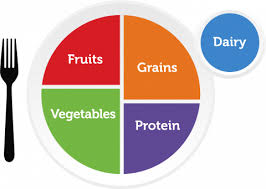
For those who prefer a broader visual framework, the MyPlate model offers a similar level of simplicity. Rather than measuring grams or tracking macros, it encourages meals built around clear proportions: roughly half the plate from fruits and vegetables, a quarter from protein, and a quarter from carbohydrate sources, with dairy optional.
Much like the hand-size guide, MyPlate removes the need for constant calculation. It provides structure without rigidity, allowing individuals to adjust portions naturally based on hunger, training demands, and body size. In practice, these two tools reinforce one another - one establishing balance, the other personalising quantity.
To Summarize
Nutrition establishes the base. Training determines how much of that base you can express. In Part 2, we’ll apply the same principle of simplicity to training - what matters, what doesn’t, and why doing less, better, for longer usually wins.