
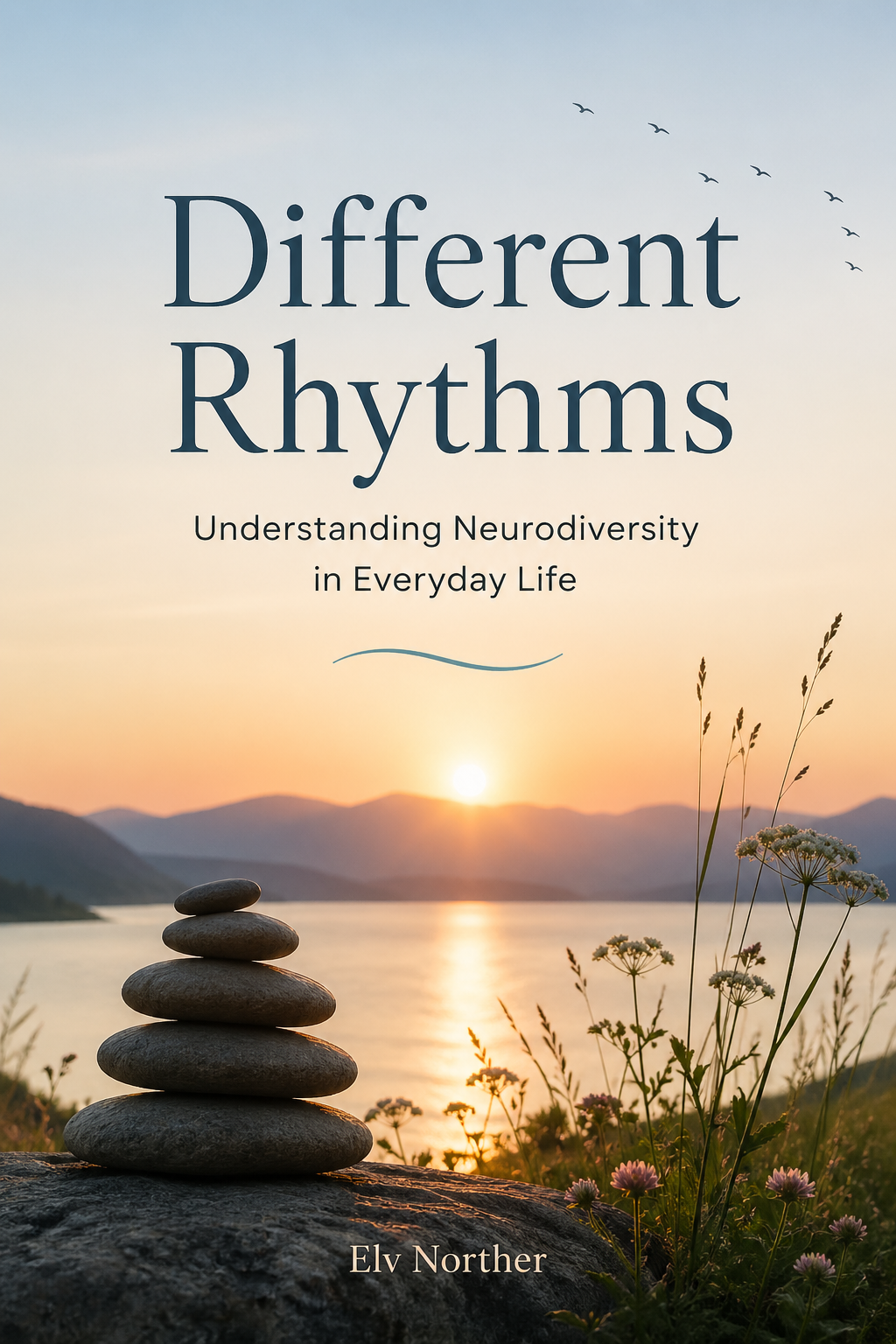
There are books that try to explain a condition, and then there are books that quietly change how you see ordinary life.
Different Rhythms: Understanding Neurodiversity in Everyday Life belongs to the second category.
It does not begin with a diagnosis. It begins with a feeling many people know but rarely know how to describe: the sense that everyday situations sometimes require more effort than they “should.” A morning routine that feels strangely heavy. A transition from work or school into rest that never quite lands. A social interaction that seems simple for others but leaves you unexpectedly drained. A moment of overwhelm that arrives without a single obvious cause.
For a long time, these experiences have been explained in individual terms—motivation, discipline, resilience, focus. But what if that explanation is incomplete?
What if the issue is not only inside the person, but also in the relationship between the person and the environment they are moving through?
This is where Different Rhythms begins.
A Different Way of Understanding Neurodiversity
Neurodiversity is often discussed in terms of labels like ADHD or sensory sensitivity, but this book approaches it differently. Instead of treating neurodivergence as a deviation from a standard, it treats it as part of natural human variation.
Some nervous systems are more sensitive to sound, light, or emotional atmosphere. Some brains shift attention rapidly and respond strongly to interest and novelty. Others require longer transitions between tasks or more recovery time after stimulation.
None of these patterns are errors.
They are variations in how human attention, perception, and regulation are organized.
And once that idea is accepted, something important changes: difficulty is no longer automatically interpreted as failure.
Why Transitions Feel So Hard
One of the most relatable themes in the book is transition.
Why does moving from structured time (like work or school) into unstructured time (like evenings, weekends, or holidays) sometimes feel unexpectedly exhausting instead of relaxing?
The book explores this through both lived experience and neuroscience. The nervous system does not switch instantly between states. It carries momentum. If a person has been in a high-demand, structured, or sensory-heavy environment, the brain and body do not immediately “reset” when that environment stops.
Instead, there is a period of adjustment.
For neurodivergent individuals—especially those with ADHD or sensory processing differences—this adjustment can be more intense. The shift from external demands to internal regulation may feel like a sudden drop in structure, which the brain has to rebuild in real time.
This is why rest does not always feel restful.
It is not a contradiction. It is a transition process.
Overload Is Not Failure
Another core idea in Different Rhythms is overload—not as a dramatic breakdown, but as a gradual accumulation.
Too much sensory input. Too many decisions. Too many social signals. Too little recovery time.
Overload is not framed as weakness. It is framed as a signal: the system has exceeded its current capacity under current conditions.
This reframing is powerful because it moves the conversation away from blame and toward understanding.
Instead of asking, “What is wrong with me?” the question becomes:
“What conditions am I in, and what would support balance?”
That shift alone can change how people interpret their own experiences.
Neurodiversity as Strength—Without Simplifying It
The book also avoids the common trap of turning neurodiversity into a simplistic “superpower narrative.”
Instead, it acknowledges something more honest:
Neurodivergent traits are both strengths and challenges, depending on context.
The same sensitivity that leads to overwhelm in one environment can support deep perception in another. The same attentional variability that makes routine tasks difficult can enable intense focus on meaningful interests. The same need for recovery time can create space for reflection, creativity, and insight.
The key is not to rank these traits as good or bad—but to understand how they interact with environment.
Why This Book Matters Now
We are living in a time where attention is constantly demanded, rest is often fragmented, and environments are increasingly complex. In that context, many people—diagnosed or not—find themselves struggling with focus, energy, and emotional regulation.
Different Rhythms offers a different lens.
Not to pathologize these struggles.
But to contextualize them.
It suggests that many of the difficulties people experience are not simply personal shortcomings, but mismatches between nervous system needs and environmental design.
And if that is true, then support is not only about individual coping strategies. It is also about changing how we design learning environments, workplaces, and even social expectations.
Who This Book Is For
This book speaks to a wide audience:
- Neurodivergent adults who have spent years adapting without explanation
- Parents trying to understand children whose needs don’t fit standard expectations
- Educators and professionals working with attention, learning, or sensory differences
- And anyone who has ever felt “out of sync” with the pace and demands of everyday life
You do not need a diagnosis to recognize yourself in these pages.
You only need experience.
A Final Thought
There is not one rhythm of attention, rest, or life.
There are many.
And most of the struggle people feel does not come from being “wrong,” but from trying to live in systems that assume only one rhythm exists.
Different Rhythms is an invitation to see that differently.
Not to simplify life.
But to understand it more accurately.
And in that understanding, to make space for more ways of being human.