
INTRODUCTION — WHEN PEACE BECOMES A WARNING
Every era has a phrase it repeats right before things break.
Ours is peace and security.
It appears in speeches, policy documents, press briefings, corporate compliance language, intelligence justifications, and financial regulation. It is spoken softly, confidently, endlessly. And history is brutally consistent on one point: when power begins to insist that peace has been achieved, it is usually because control has been perfected — not because conflict has ended.
This investigation does not begin with conspiracy, ideology, or political loyalty. It begins with a pattern. A pattern in which war no longer needs declarations, repression no longer needs force, and obedience no longer needs orders. A pattern in which power no longer announces itself — it administers. It governs through systems, permissions, risk scores, and quiet leverage. It does not silence people directly. It teaches them when silence is safer.
Peace, in this context, is not a moral achievement. It is a management state.
What follows is not an argument about left versus right, Trump versus Biden, democracy versus authoritarianism. Those frames are distractions. This is about structure — who builds it, who benefits from it, and who quietly disappears inside it. Intelligence agencies that tolerate chaos but fear reform. Financial systems that reward compliance faster than law ever could. “Decentralised” technologies that promise freedom while preserving choke points. Speech laws that claim to protect society while training it to self-police. And a rotating cast of familiar figures — politicians, financiers, technocrats — presented as peacemakers while refining the very mechanisms that make peace unnecessary and dissent unaffordable.
The most dangerous systems are not enforced at gunpoint. They are enforced at the level of access. Access to money. Access to platforms. Access to movement. Access to livelihood. When those become conditional, freedom becomes theoretical — and most people will choose survival over resistance every time.
This series asks a simple question that few are willing to confront honestly:
If peace is the goal, why does it require so much surveillance, so much secrecy, so much financial control, and so many familiar architects of managed disorder?
Because sometimes peace is not the end of conflict.
Sometimes it is the signal that the conflict has already been won — quietly, administratively, and without resistance.
And sometimes, “peace and security” is not reassurance at all. It is a warning.
For when they shall say, Peace and safety; then sudden destruction cometh upon them.
That line isn’t poetic. It’s diagnostic. It describes a pattern that repeats every time power perfects its language. Peace, in modern political terms, is no longer an outcome to be achieved; it is a narrative to be deployed. When governments, institutions, and intelligence systems repeat the words peace and security often enough, history tells us not to relax—but to look closely at what is being built quietly underneath the promise. Because peace, real peace, reduces leverage. And leverage—not harmony—is the true currency of power.
The great lie of our time is that peace is the end goal. It isn’t. Stability is the goal. Predictability is the goal. Manageability is the goal. Peace is simply the wrapping paper. A genuinely peaceful society asks dangerous questions: Why the surveillance? Why the secrecy? Why the endless weapons budgets? Why the tightening control over money, movement, speech, and association? True peace threatens empires because it exposes how unnecessary their machinery has become. That is why peace is always performed, never completed.
Modern power no longer marches in uniforms or announces itself with declarations of war. It embeds. It integrates. It digitises. Intelligence agencies learned long ago that force creates resistance, but systems create compliance. Today’s control architecture does not require mass arrests or visible repression. It requires data, algorithms, and infrastructure. Surveillance no longer watches people to catch crimes; it models them to predict deviation. Artificial intelligence does not ask who you are—it calculates how likely you are to become inconvenient. Your phone metadata, your spending habits, your movements, your social graph, your emotional volatility, your sudden silence—these are no longer personal details. They are signals.
This is why intelligence agencies tolerate loud, chaotic political figures who posture as rebels but never touch structure. Noise is camouflage. While the public is distracted by personalities, scandals, culture wars, and electoral theatre, the real work continues uninterrupted: data fusion expands, public-private surveillance partnerships deepen, predictive policing normalises, and AI-driven risk scoring becomes administrative routine. No one needs to conspire when systems are aligned. The machinery hums regardless of who occupies the stage.
Australia offers a revealing case study in how “peace and security” rhetoric is operationalised domestically. Under the banner of combating hate speech, misinformation, and social harm, new laws have dramatically expanded state discretion over speech—lowering thresholds, widening definitions, and shifting enforcement away from courts and toward regulators, platforms, and automated compliance systems. These laws are sold as protection, but their real utility is pre-emptive discipline. They chill speech before it escalates, they encourage self-censorship, and they normalise punishment without intent or context. The contrast with Trump’s rhetoric is instructive. Trump speaks loudly, personally, and chaotically—yet intelligence agencies tolerate it because it is theatrical noise, not structural threat. His words polarise, but they do not reorganise power. Australia’s language is calm, responsible, managerial—and it quietly embeds enforcement into law, platforms, and finance. Intelligence agencies prefer this model: less drama, more leverage. One destabilises discourse; the other stabilises control.
Peace rhetoric is essential because it reframes expansion as protection. Surveillance becomes “safety.” Sanctions become “stability.” Financial controls become “compliance.” AI becomes “efficiency.” Every advance is justified as preventing chaos, extremism, misinformation, or disorder. Yet the irony is brutal: a population repeatedly told it is being kept safe is being trained to self-police. People moderate their speech before posting, soften opinions before sharing, distance themselves from controversial ideas—not because they were ordered to, but because consequences are vague, automated, and potentially life-disrupting. When access to money, work, travel, platforms, or reputation can be throttled without explanation, silence becomes rational.
This is where digital money completes the loop. Surveillance without enforcement is observation. Digital finance turns observation into control. Cash was friction—anonymous, offline, unprogrammable. Digital money is permissioned, logged, reversible, and conditional. It does not need to arrest you. It can simply pause you. A flagged account, a delayed transaction, a “review,” a risk assessment—no courtroom, no charge, no headline. Survival pressure works faster than ideology. People comply not because they agree, but because continuity matters more than principle when the system controls oxygen.
And here is the masterstroke: decentralisation is allowed—but only as simulation. Real decentralisation breaks visibility, identity control, and enforcement choke points. That is intolerable. So power permits decentralisation theatre: blockchains with central validators, crypto with KYC bottlenecks, platforms governed by foundations, wallets dependent on app stores, infrastructure hosted on centralised clouds. You can move—but only inside fenced land. You are given the feeling of exit without the reality of escape. Hope is vented. Dissent is mapped. Resistance becomes data.
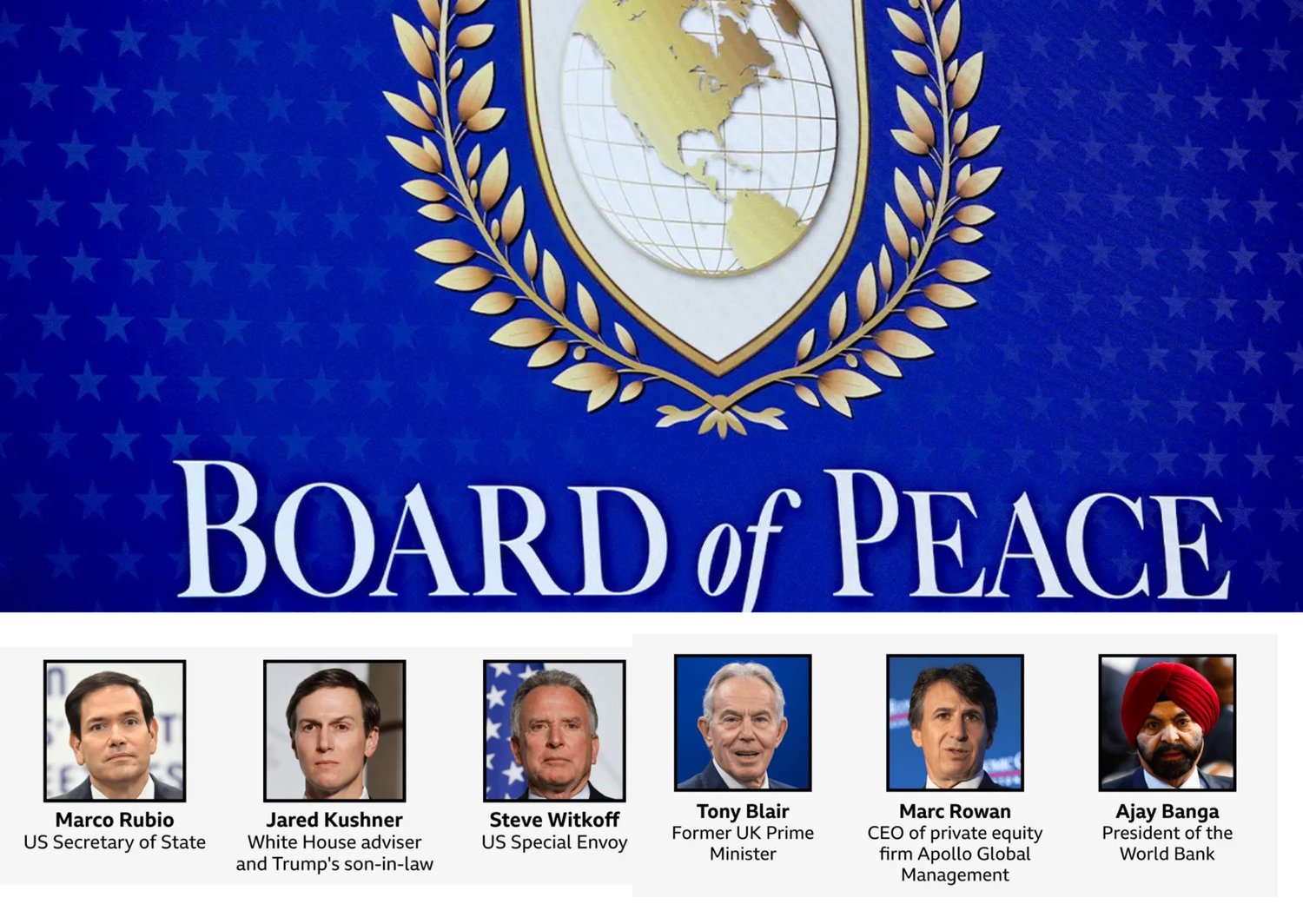
It is within this context that the so-called “Board of Peace” must be examined—not as a legal entity, but as a marketing construct. The people publicly presented as its executive core reveal far more than the language ever could.
Marco Rubio, long-time U.S. senator and foreign-policy hawk, has built his career on sanctions advocacy, regime-change rhetoric, and hardline national-security doctrine toward China, Iran, Venezuela, and Russia. His presence signals peace enforced through pressure, not reconciliation.
Jared Kushner, Trump’s son-in-law and senior White House adviser, was elevated to Middle East power broker without diplomatic background. As architect of the Abraham Accords, he delivered agreements framed as peace but structurally rooted in arms sales, intelligence cooperation, and regional power consolidation. Influence flowed through access and capital—not democratic mandate.
Steve Witkoff, real-estate developer and long-time Trump associate, reflects diplomacy reframed as transaction. Statecraft outsourced to private relationships. Institutions bypassed. Deals prioritised over durability.
Tony Blair, former UK Prime Minister, remains inseparable from the Iraq War and the doctrine of humanitarian intervention. Rebranded today as a global adviser on governance, digital identity, and stability, his role exemplifies how architects of war are recycled into managers of order.
Marc Rowan, CEO of Apollo Global Management, represents the financial axis of geopolitics. Apollo thrives in defence, infrastructure, and distressed sovereign assets. Where instability is managed, firms like Apollo arbitrage the aftermath. Peace, in this context, means predictable markets—not justice.
Ajay Banga, President of the World Bank, comes from global finance and payments systems. His focus on financial inclusion and digital identity builds the rails through which economic behaviour becomes visible, governable, and enforceable.
Robert Gabriel, identified as a U.S. national security adviser, represents continuity—linking intelligence doctrine, executive authority, and enforcement. Figures in this role do not dismantle systems. They preserve them across administrations.
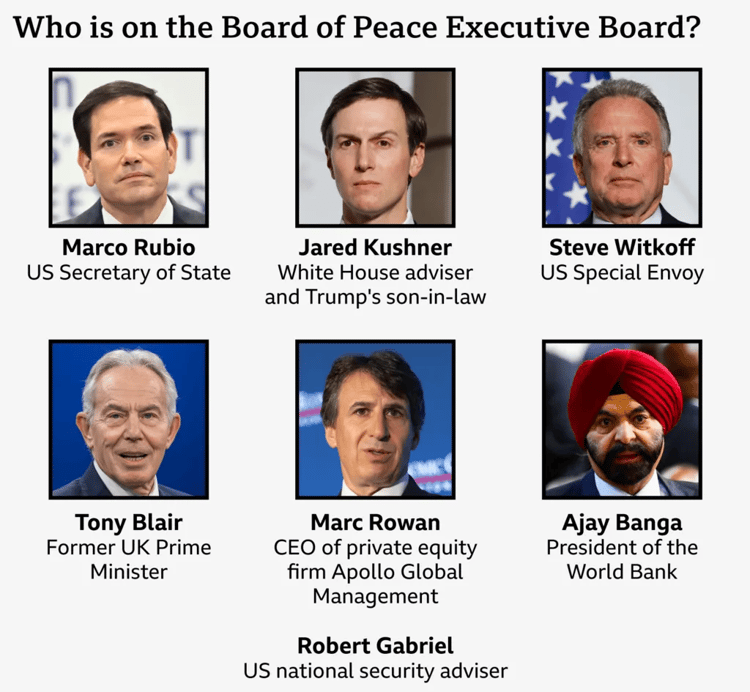
Taken together, this does not resemble a peace council. It resembles a cross-section of political power, intelligence continuity, financial leverage, and enforcement infrastructure—hawks, financiers, technocrats, and regime veterans whose careers were built not on dismantling control systems, but on refining them.
So the question must be asked plainly:
Does this look like the swamp being drained? Or does it look like the swamp being reorganised—cleaner language, same machinery?
Because draining the swamp would require dismantling surveillance authority, breaking the revolving door between government and capital, shrinking sanctions regimes, prosecuting institutional crimes, and restoring civilian limits on intelligence power. What is being offered instead is a familiar formula: rebrand control as peace, sell stability as security, and staff the project with those who have always thrived inside managed disorder.
Peace, then, is not the absence of conflict. It is the absence of disruption. Proxy wars continue. Arms sales grow. Sanctions starve quietly. Surveillance expands invisibly. None of this contradicts “peace,” because peace has been redefined to mean no disruption to the system itself.
This is why whistleblowers are destroyed. Not because they embarrass power, but because they expose structure. This is why real outsiders never reach power. Not because they lack votes, but because they threaten architecture. And this is why figures who attack optics but leave systems untouched are tolerated—even amplified. They absorb rage, polarise attention, and keep focus away from the boring, lethal mechanisms of control: budgets, laws, data pipelines, classification regimes, and financial rails.
When people hear “peace and security” today, they should not ask from what? They should ask for whom—and at what cost?
Peace is not the end goal. Peace is the sales pitch. Control is the product.
And sudden destruction does not always arrive as war. Sometimes it arrives as silence—when people realise too late that nothing dramatic happened, yet everything fundamental has already been decided for them.