
Healthcare never truly stops. Patients call before work, after office hours, and even on weekends. They want answers, appointment updates, prescription information, or help reaching the right department. When calls go unanswered, frustration grows, and staff members return to a long list of missed messages the next morning.
This is where a 24/7 voice assistant for patient communication makes a real difference. It helps healthcare providers stay connected with patients around the clock while reducing the workload on busy front desk teams. Instead of replacing people, it supports them by handling routine conversations quickly and accurately. As a result, clinics improve response times, create a better patient experience, and allow staff to focus on care that truly needs a human touch.
Why Patient Communication Needs to Improve
Every healthcare practice wants to provide excellent care. Yet many clinics struggle with limited staff, growing patient volumes, and constant phone calls throughout the day.
Patients often contact clinics to:
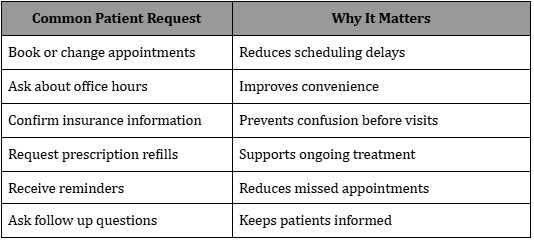
When staff members spend most of their day answering repetitive questions, they have less time for patients standing at the front desk or those requiring immediate assistance.
A modern communication solution helps balance both needs.
The Value of Around-the-Clock Support
Healthcare questions do not always arise during business hours. Someone may need to cancel an appointment late at night. Another patient may remember to schedule a visit early in the morning before work.
Instead of waiting until the office opens, patients appreciate immediate assistance.
A 24/7 voice assistant for patient communication gives patients the ability to:
- Schedule appointments
- Confirm upcoming visits
- Receive reminders
- Get answers to common questions
- Reach the correct department
- Leave detailed requests for clinical staff
This creates a smoother experience while reducing unnecessary waiting.
A Better Front Desk Without Extra Pressure
The front desk is often the busiest place in any clinic. Staff members answer phones, greet visitors, manage schedules, verify information, and coordinate with providers throughout the day.
Adding more employees is not always practical.
That is why many organizations are exploring conversational AI for the healthcare front desk to manage routine conversations while allowing reception teams to focus on patients who need personal attention.
Instead of placing callers on hold, the system responds immediately, understands spoken requests, and guides patients through the next steps using natural conversation.
Patients feel heard, while staff members gain valuable time.
How EnSofia Supports Healthcare Communication
EnSofia, Inc. is a Silicon Valley-based healthcare software company focused on improving patient engagement through intelligent cloud-based communication solutions.
Its platform helps healthcare organizations strengthen communication across multiple channels while improving workflow efficiency.
Rather than offering a basic answering system, EnSofia provides patient engagement solutions that support communication, automation, and patient journey management throughout the healthcare experience.
Its technology is designed to:
- Improve communication between patients and providers
- Reduce repetitive administrative work
- Support patient engagement across multiple communication channels
- Increase operational efficiency
- Improve patient satisfaction
- Help healthcare organizations deliver better outcomes
This balanced approach benefits both patients and healthcare teams.
Designed by Healthcare and Technology Experts
Technology works best when it solves real problems.
The leadership behind EnSofia™ combines decades of experience in healthcare, cloud communications, software engineering, speech technologies, and large-scale enterprise systems.
Founder and CTO Sameh Michael has built technology solutions throughout his career with organizations including Ericsson, AT&T, Intel, and Nuance. His expertise in speech technology, natural language processing, cloud communications, and healthcare innovation helped shape EnSofia's patient engagement platform.
Vice President Emad Fahmy brings extensive experience in healthcare process improvement, customer success, and enterprise technology leadership. His personal healthcare experiences inspired a strong focus on improving patient communication while helping clinics operate more efficiently.
Supported by experienced software engineers, quality assurance specialists, user interface developers, and artificial intelligence engineers, the EnSofia team continues building practical solutions that meet the everyday needs of healthcare organizations.
Benefits for Healthcare Providers
Healthcare providers experience several operational improvements when communication becomes more efficient.
Some of the biggest advantages include:
- Fewer missed calls
- Better appointment management
- Lower administrative workload
- Faster patient responses
- Improved scheduling efficiency
- Better patient satisfaction
- Increased staff productivity
These improvements help clinics provide consistent service without placing additional pressure on employees.
Benefits for Patients
Patients also notice immediate improvements.
Instead of waiting for office hours, they receive assistance whenever they need it.
Patients enjoy:
- Faster responses
- Convenient scheduling
- Simple appointment confirmations
- Helpful reminders
- Reduced waiting times
- Better overall communication
When communication becomes easier, patients feel more connected to their healthcare providers.
The Future of Patient Communication
Healthcare continues to evolve, and patient expectations continue to rise. People now expect quick responses, simple scheduling, and convenient access to information.
Communication technology helps healthcare providers meet these expectations while improving internal efficiency.
Instead of replacing human interaction, intelligent voice solutions support clinical teams by handling routine conversations and allowing healthcare professionals to spend more time delivering quality care.
Practices that invest in better communication today are preparing themselves for stronger patient relationships tomorrow.
Final Remarks
Effective communication has become one of the most important parts of modern healthcare. Patients expect timely answers, convenient scheduling, and reliable support whenever they reach out. A 24/7 voice assistant for patient communication helps healthcare providers meet those expectations while reducing administrative burdens and improving everyday operations. When combined with conversational AI for the healthcare front desk, clinics can create a smoother experience for both patients and staff.