
When we think about our relationship with God, we often think about prayer, worship, reading Scripture and growing in faith.
But what about the way we care for ourselves physically?
Our bodies, minds and daily habits are also part of the lives God has entrusted to us.
Biblical wellness isn’t about obsessing over our appearance, following the latest health trend or trying to create a perfectly disciplined life. Nor does Scripture promise that making all the “right” choices will protect us from illness or difficult seasons.
Instead, healthy living can become an act of stewardship — learning to care for ourselves with wisdom, gratitude and grace.
“So whether you eat or drink or whatever you do, do it all for the glory of God.” — 1 Corinthians 10:31
Sometimes honouring God happens in the seemingly ordinary choices too: nourishing ourselves well, allowing our bodies to rest, moving when we can, caring for our minds and recognising when we need to slow down.
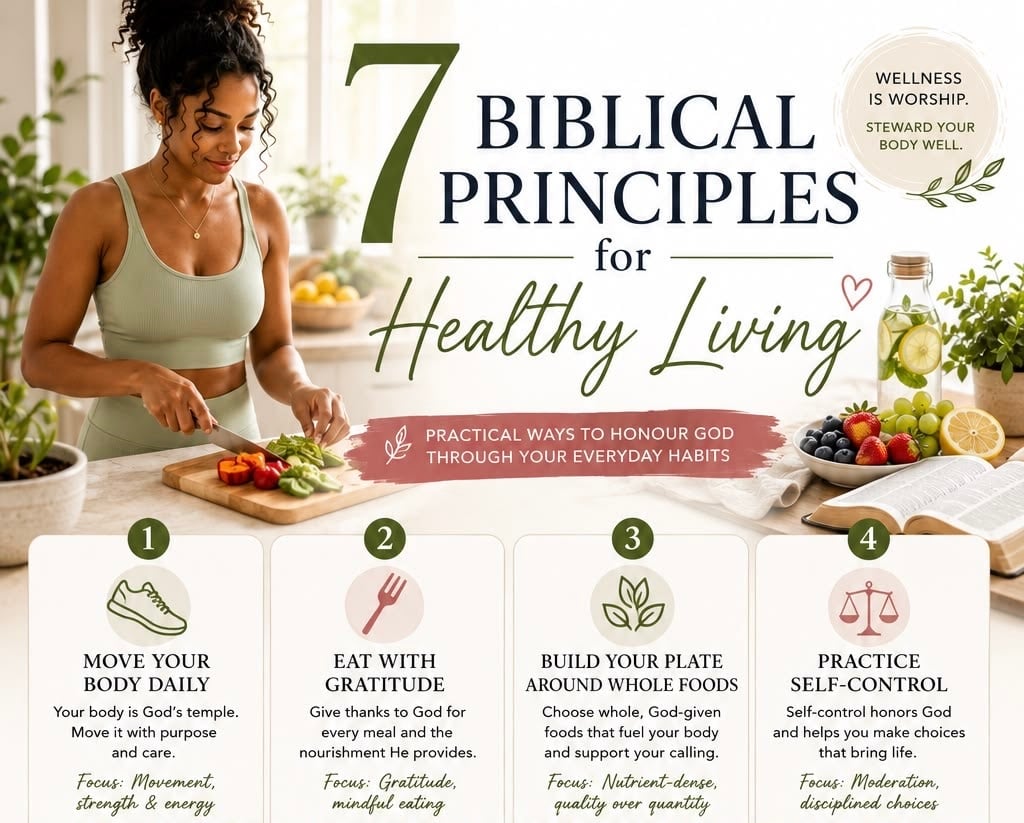
Here are seven biblical principles that can help us approach wellness from a place of faith rather than pressure.
1. Move Your Body With Gratitude
Our bodies were designed for movement, but movement doesn’t have to mean punishing workouts or chasing a certain appearance.
Walking, stretching, strength training, dancing around your home or simply spending time outdoors can all be ways of caring for the body you’ve been given.
“For physical training is of some value…” — 1 Timothy 4:8
This verse is particularly interesting because Scripture acknowledges the value of physical training while keeping it in perspective. Spiritual growth remains greater, but physical wellbeing isn’t dismissed.
Movement can therefore become less about “I need to change my body” and more about:
“I’m grateful for what my body allows me to do, and I want to care for it well.”
That small shift can transform exercise from punishment into stewardship.
2. Eat With Gratitude
Food is more than fuel.
Throughout Scripture, meals appear in moments of fellowship, provision, celebration and thanksgiving.
Jesus Himself regularly shared meals with others.
Instead of allowing food to become surrounded by guilt, restriction or anxiety, we can practise gratitude for the nourishment available to us.
Before eating, even a simple prayer can change our posture:
Lord, thank You for this food. Thank You for providing what my body needs today.
Gratitude reminds us that nourishment is a gift rather than something we have to earn.
3. Build Your Plate Around Nourishing Foods
Scripture doesn’t give us a modern meal plan — and we shouldn’t pretend it does.
But it repeatedly presents food, harvest and provision as gifts from God.
Fruits, vegetables, grains, seeds and other nourishing foods can form part of caring wisely for our physical needs.
The goal doesn’t need to be dietary perfection.
A more sustainable question is:
What can I add to my meals that will nourish me well?
Perhaps it’s more vegetables. More protein. More fibre. More whole foods. Or simply making time to eat properly instead of constantly rushing through the day.
Healthy living often grows through small choices repeated consistently.
4. Practise Self-Control Without Becoming Restrictive
Self-control is one of the fruits of the Spirit.
“But the fruit of the Spirit is love, joy, peace, forbearance, kindness, goodness, faithfulness, gentleness and self-control.” — Galatians 5:22–23
But biblical self-control shouldn’t be confused with harshness.
There is a difference between discipline and deprivation.
Self-control may look like recognising when something is no longer serving you well, learning moderation, creating healthier routines or choosing what supports your wellbeing rather than simply what feels easiest in the moment.
And sometimes self-control means knowing when enough is enough — including refusing to turn wellness itself into an obsession.
Grace still belongs in the process.
5. Prioritise Rest
This may be one of the most overlooked biblical wellness principles.
We live in a culture that often treats exhaustion as evidence of ambition.
Scripture gives us a very different picture.
“Come with me by yourselves to a quiet place and get some rest.” — Mark 6:31
Jesus did not treat human limitations as moral failures.
He withdrew. He rested. He slept.
And God established a rhythm of Sabbath long before our modern culture started talking about burnout.
Rest isn’t laziness.
Sometimes rest is recognising that you were never created to function as though you have limitless energy.
Sleep, quiet time, boundaries, slower evenings and genuine downtime can all become part of stewarding yourself well.
You don’t have to earn the right to rest by reaching complete exhaustion first.
6. Stay Hydrated and Honour Your Physical Needs
Not every healthy habit needs a profound spiritual explanation.
Sometimes your body simply needs water.
And there is something beautiful about recognising that caring for ourselves often happens through very ordinary things.
Drinking enough water, eating regularly, sleeping, getting fresh air and attending to physical needs may seem small, but small acts of care accumulate.
Stewardship isn’t always dramatic.
Often, it’s simply paying attention.
Instead of repeatedly ignoring what your body is telling you, begin asking:
What does my body genuinely need from me today?
7. Care for Your Mind Too
Biblical wellness isn’t only physical.
What repeatedly occupies our minds can influence the way we experience our days.
Paul writes:
“Whatever is true, whatever is noble, whatever is right, whatever is pure, whatever is lovely, whatever is admirable… think about such things.” — Philippians 4:8
This doesn’t mean pretending difficult emotions don’t exist.
Biblical peace isn’t denial.
We can acknowledge grief, disappointment, anger, uncertainty and fear while still being intentional about what we continually feed our minds.
Caring for your mind might mean spending time in Scripture, praying honestly, reducing unnecessary noise, setting healthier boundaries, seeking wise support or being more discerning about the voices you allow to shape your thoughts.
Protecting your peace doesn’t require ignoring reality.
Sometimes it means becoming much more intentional about what receives access to you.
Wellness Is Stewardship, Not Perfection
Perhaps the most important principle is this:
You do not have to pursue wellness perfectly for your life to honour God.
There will be seasons when exercising regularly feels easy and seasons when rest is what your body needs most.
There may be times when your routines are beautifully consistent and others when illness, motherhood, grief, work, financial pressure or simply life changes what is realistic.
Grace belongs in those seasons too.
Your health is not a spiritual scorecard.
Taking care of yourself is not about proving that you are disciplined enough, faithful enough or “good” enough.
It’s about recognising that the life God has given you is worth tending to.
Some days stewardship may look like preparing a nourishing meal.
Another day it may look like taking a walk.
Sometimes it will mean going to bed earlier.
And occasionally, the wisest thing you can do will simply be to admit:
I need rest today.
A Gentle Wellness Check-In
Rather than trying to overhaul your entire lifestyle at once, take a moment to reflect:
- What is one healthy habit that already makes me feel more energised and grounded?
- Where have I been neglecting rest?
- Am I caring for my body from gratitude — or criticising it into change?
- What has been taking up too much space in my mind lately?
- What is one realistic way I could steward my wellbeing better this week?
You don’t need seven new habits tomorrow.
Start with one.
Small acts of stewardship, repeated with intention, can become rhythms that support you for years.
A Prayer for Healthy Living
Father,
Thank You for the life You have given me.
Help me care for my body with gratitude rather than criticism, and with wisdom rather than pressure.
Teach me when to move and when to rest. Help me make choices that nourish my body, protect my mind and support the life You have called me to live.
Give me self-control without obsession, discipline without condemnation and wisdom to recognise what I genuinely need in each season.
May the way I care for myself become another quiet expression of gratitude for all You have entrusted to me.
Amen.
Remember
You were created to thrive, not simply survive.
Wellness doesn’t have to become another standard you struggle to reach.
Let it become a gentle practice of stewardship — caring for your body, mind and spirit while keeping God at the centre.
“So whether you eat or drink or whatever you do, do it all for the glory of God.” — 1 Corinthians 10:31
Discover The 3 Day Esther Fast