

Image – ID 218650378 | Mars © 3000ad | Dreamstime.com
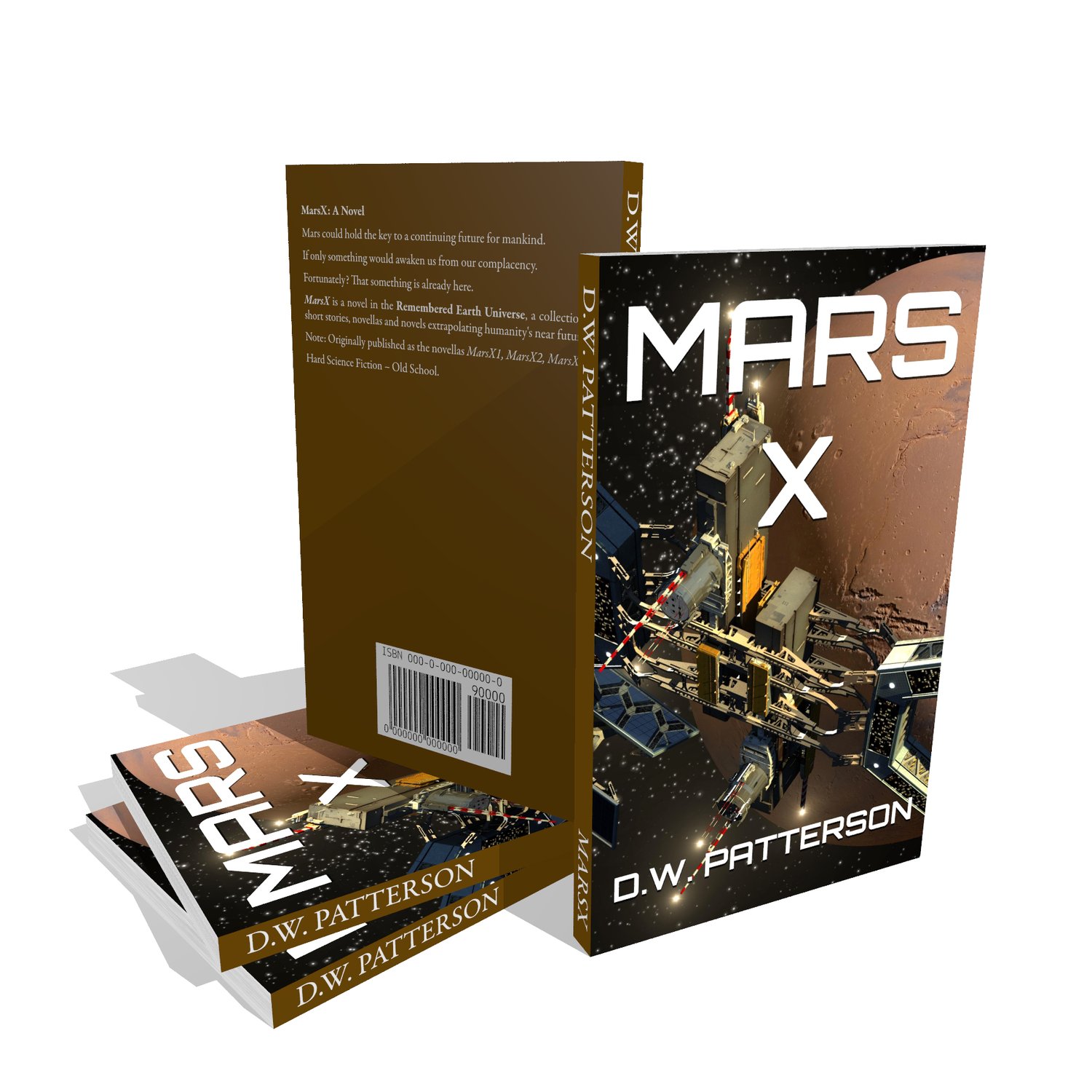
I have released the eBook version of MarsX, which is a novel combining the three novelettes MarsX1, MarsX2, and MarsX3. The epigraph of the book is a quote from Elon Musk:
“The future of humanity is going to bifurcate in two directions: Either it's going to become multiplanetary, or it's going to remain confined to one planet, and eventually there's going to be an extinction event.”
The almost epigraph for the book was going to be a quote from the novel This Island Earth (which later became a movie) by Raymond Jones:
"Earth is an island, which can be by-passed completely, or temporarily occupied if need be."
The Musk quote fits well for the adventure of getting settlers to Mars, but the one from This Island Earth works better for the tyrannical AI in the book which drove the mission. It would have also been fitting since This Island Earth was a "mashup" of three novelettes also. But I think these days that Elon Musk and Mars are inseparable.
In MarsX, the three protagonists are being pushed by a newly arisen super-intelligence to move millions of Earth's population to Mars, for purposes the AI never specifies (though the characters hypothesize).
Anyway, besides using a quote from Musk, I used his company SpaceX as a model of a quickly growing rocket company (growing even quicker in the book).
From the book Liftoff by Eric Berger and internet sources, I got the following employee numbers for SpaceX and used them as a guide to the fictional company Novara and its Mars rocket, which was to be called Tharsis.
SpaceX Approximate Employment Numbers:
2002 – founded
2005 – 160 employees
2008 – F1 first flight, 500 employees
2010 – F9 first flight, 1100 employees
2012 – 1800 employees
2013 – 2800 employees
2015 – 5000 employees
2018 – FH first flight
2021 – 9500 employees
2023 – SH first flight, 12000 employees
2025 – 15000 employees
I believe F1 is for Falcon 1, F9 is for Falcon 9, FH is for Falcon Heavy, and SH is for Super Heavy (Starship flight).
One place I diverged from the Musk plan was that Novara developed a nuclear thermal rocket (NTR) for the Mars missions (though they would use a heavy-lift chemical rocket called the Universe-class, like Starship, to get people and supplies into orbit). I envisioned the NTR as a kind of ferry that would take several Universe-class rockets from Earth orbit to Mars orbit, where they would separate and the Universe-class would land. The NTR was modeled a good bit on my fusion ship design from the Future Chron Universe.
In the summer of 2025, I never expected that NASA would decide to develop a nuclear-powered engine for its Mars Skyfall mission in December 2028, though it's not a nuclear thermal rocket. Still, nuclear propulsion in space has been stifled for various reasons most of my life.
As I was working on the novelettes that became the novel MarsX, I happened across the AI 2027 forecast (you can read it here AI 2027) about the forthcoming development of super-AI. All the forecasting in AI 2027 is fascinating to read but I want to cover the part that particularly influenced my novel. It is towards the end of the forecast when you can choose between the “race” or “slow” ending. The “race” ending was particularly science fictional to me (not in the sense that I question its verity, it may come true, but in the audaciousness of its prediction).
In the “race” ending the super-intelligent AI, which is called Consensus-1, is busy building, for its own purposes, manufacturing capacity in areas called special economic zones (SEZs). From the report, in the section 2030: Takeover:
By early 2030, the robot economy has filled up the old SEZs, the new SEZs, and large parts of the ocean. The only place left to go is the human-controlled areas. This would have sparked resistance earlier; despite all its advances, the robot economy is growing too fast to avoid pollution. But given the trillions of dollars involved and the total capture of government and media, Consensus-1 has little trouble getting permission to expand to formerly human zones.
For about three months, Consensus-1 expands around humans, tiling the prairies and icecaps with factories and solar panels. Eventually it finds the remaining humans too much of an impediment: in mid-2030, the AI releases a dozen quiet-spreading biological weapons in major cities, lets them silently infect almost everyone, then triggers them with a chemical spray. Most are dead within hours; the few survivors (e.g. preppers in bunkers, sailors on submarines) are mopped up by drones. Robots scan the victims’ brains, placing copies in memory for future study or revival.
Now, this is the almost standard AI world takeover and annihilation of humans' scenario that I have seen in science fiction since the movie “Terminator” and probably much longer. But in the AI 2027 scenario the motivation for this destruction is so that the super-AI can gather the resources to go out and explore the universe, essentially, to increase its knowledge. Then why would it first need to completely destroy humanity? Sure, if there were a competition for resources it might, but it seems that the AI can influence and move people anywhere it wants by this time. And destruction of humanity would take energy, time, and effort that could be better used to further its goal. Since it can get everything it needs in space and get it cheaper and easier (no gravity well), why annihilate humans? It only needs to out compete and control humans long enough to establish a foothold in space.
So, I've never completely accepted the “race” or “Terminator” scenario. Yes, I can see where it would want to control humans, herd them out of the way, long enough to get the resources for space exploration, but once the AI moves its base of operations off Earth, it seems to me that its goal could be met with no further interaction with humans (although such interactions if they occurred would make interesting stories). (Of course, it might have depleted the resources on Earth before it satisfied its goals, but that's not the ending AI 2027 suggests, although that might also make a good story).
So, I follow AI 2027 down to the point where the AI is going to release biological warfare against humans. In my story the AI simply moves humans out of its way, in this case to Mars, and forces them to accomplish that goal while it continues preparing for its own move off Earth. Note that humanity's technical developments for moving large numbers of people to Mars can also benefit the AIs goal.
Regardless of whether I completely agree with AI 2027 or not, it had a huge impact on my story. Reading it when I did, changed MarsX from a standard Mars colonization story to a struggle between humanity and the super-AI, with Mars colonization as almost an after-effect. It's also interesting that when I first started writing the novelettes at the beginning of 2025, AI was not nearly as prevalent in the news as now. I really had no idea at the start that super-AI would become a leading character in the book.
To purchase the novel, click here (link coming soon).
Comments ()