

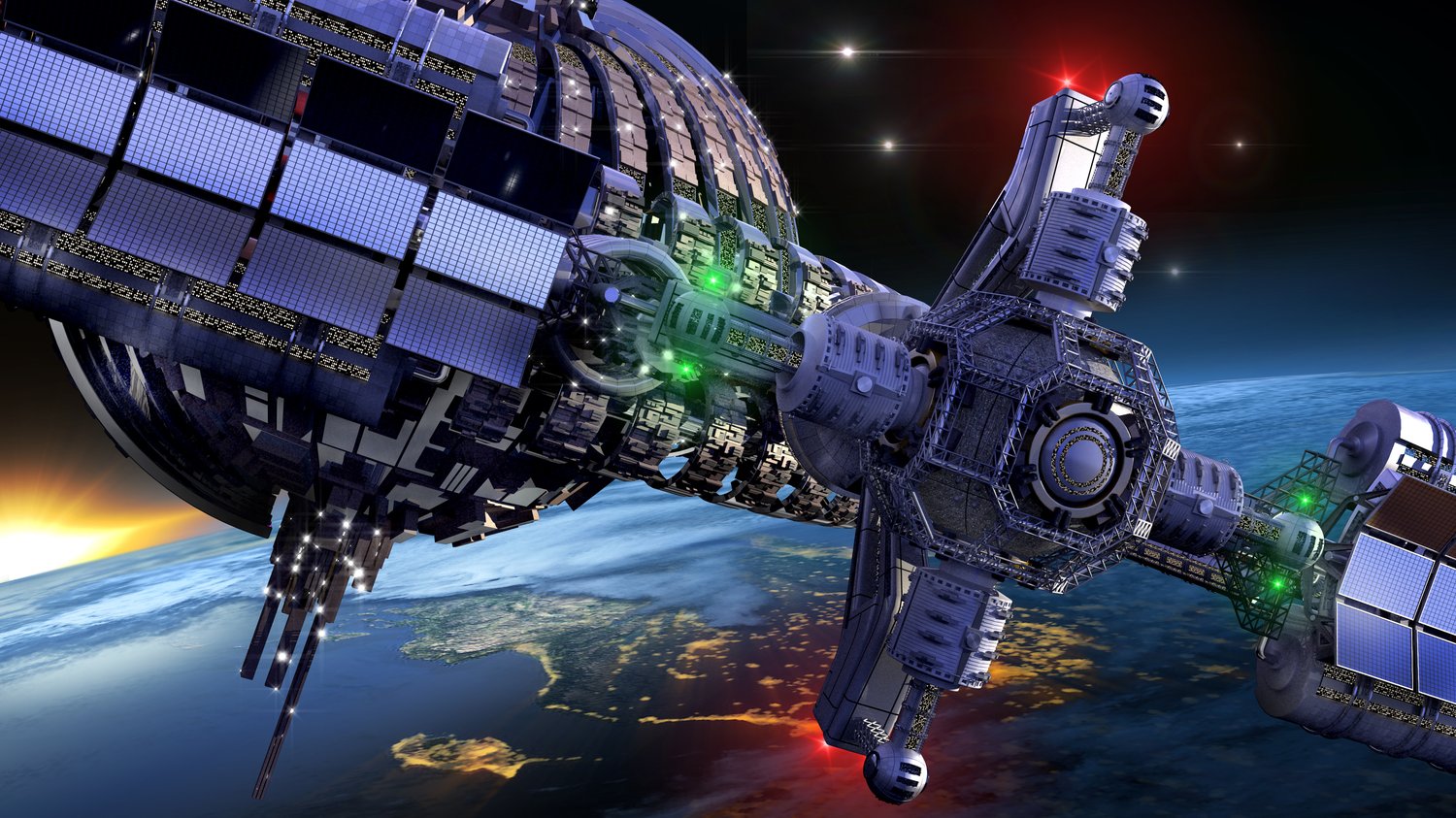
3000ad - Spaceship wheel near Earth - dreamstime.com
ACKNOWLEDGMENTS
Ideas about the geopolitics of the war described herein follow closely those outlined in the book The Next 100 Years by George Friedman, highly recommended.
Chapter 1
Donner Jackson was thirteen years old when his family moved to the remote valley. At first, he found it lonely and frightening, the way the wind howled through the pines at night sounding like an animal alive. And the darkness, Donner found it all-enveloping, almost suffocating. It was too dark, almost too dark to sleep.
Donner busied himself with getting a satellite internet connection so that his nights wouldn't seem quite so lonely. Although Donner's dad, Jack, was too busy to help, Donner had no trouble setting up the old mini-dish and modem bought at a yard sale. The dishes and their electronics were cheap now since the introduction of the omni-directional antennas a few years earlier. The new antennas didn't require the careful alignment that the dishes needed. But cheap was good on Donner's budget.
He used his dad's metalworking equipment in the barn to attach the dish to his telescope mount for accurate tracking. It wasn't necessary to track the satellites in the array, but it would bring in a stronger, steadier signal and consequently, a higher data rate. If he could get the data rate high enough, he could even play online games again with his friends.
Luckily, the house was located across the grassy field from the mountains and slightly above the valley floor which kept the peaks from masking the satellites Donner needed. He worked at locking his makeshift antenna onto their signals. He managed to catch an occasional signal. And the more he worked on his system the better it got at tracking and locking onto the satellites.
The next step was decoding the signal. Donner would use his personal AI device, called an ANI (Artificial Narrow Intelligence) or Annie. Annies could learn to do anything with a little software and a lot of machine learning. They learned by training on data sets that the user submitted to them. It was very important to use complete, correct and valid data. Good data, good result; bad data, bad result. Donner's Annie was a portable device but still had the power to decode the satellite data streams if enough samples from the satellites could be acquired to train it.
Because of the obstacles the mountains offered, Donner had a twenty-minute window with each satellite which was reduced somewhat as the dish took time to lock onto the signal. So it was hit or miss for a while. But slowly Donner built a database of satellite data. And his Annie became better and better at decoding the data.
Once his Annie could decode the data sufficiently Donner was quick to renew his game-play. His friends were happy to have him back online because he was a good game player although they would kid him about being out in the sticks. Donner also got his shows and movies and access to online bookstores again. Unlike his friends, Donner had a love for physical books. His mother, Phylicia, found Donner's latest purchase one morning when a delivery drone landed in the front yard with a package addressed to her son. She was upset that Donner would be so extravagant when he could easily have downloaded the e-book version.
When she told his dad about Donner's exploits, his dad suggested to Donner that it might be a good idea to get the family's media Annie online so that his mom could catch some of her shows too, Donner could charge the service to his father’s credit account. Donner did so and the incident faded from family memory.
With his dad's support, Donner soon had two dishes running. One could be receiving from the satellite currently visible while the other was locking onto the following satellite in the array. Because of the high data rate he was getting, he was even able to meet up with his old friends using his virtual reality helmet, almost feeling as if he was back home. It helped relieve the loneliness.
The setup worked great unless his mother was recording something off one of the satellites, then he was back to one dish. He solved this by talking his dad into buying a cheap used dish, amplifier and tracking mount and adding it to his setup. Now he had at least two dishes at all times to monitor his internet satellites.
Then he got the idea that he could use his setup to receive more television channels for his mom if he could receive the satellites in geosynchronous orbit, about ten times further away. All he had to do was combine the signals from his dishes to get enough signal strength to pull in the weaker signals. In effect, he would create one large dish out of his three smaller ones.
He talked to his dad.
“Son,” replied his father. “You are right in theory but in practice that is a very difficult engineering job. And professional equipment that could do something like that costs in the five-figure range. It would be easier and probably cheaper to get one of the newer omni-directional antennas and the appropriate electronics.”
But not as much fun, thought Donner. “But if I wanted to try, what would I need?”
“Well,” said his dad. “You would need to phase lock the signals from the different antennas so that they don't destructively interfere. You want the signals to synchronize so that they build in amplitude like ocean waves approaching the shore. To do that you will need a super-accurate clock that would allow you to compensate for position and tracking errors between the dishes. So, it's quite a challenge, isn't it?”
“Yeah,” said Donner. “I'm going to have to think about it for a while.”
Chapter 2
To Staff Sergeant Emily Rosen they weren't just sleek flying machines. The hypersonics were her babies. She programmed the onboard flight ANI and nurtured the “beast,” the hypersonic scramjet that put the hyper in hypersonic.
And every one of the more than thirty hypersonics located at the secret west Pacific island airbase had a personality as far as Emily was concerned. She was sure that “Supersonic,” as she had christened one of her charges, would no doubt make a success of any mission he was assigned. But as for “Lex” well, he would do okay as long as the others led the way. Lex hadn't exactly shown himself a leader.
Most of the squad were kinetic energy weapons. The size of a small fighter jet, they would deliver their bulk against the target at hypersonic speeds. The resultant destructive force would pierce any target no matter how hardened it had been constructed. A couple of hypersonics in the squadron provided reconnaissance, they would help guide the others if local conditions required. They were the only two that might return from the mission. Emily had named them “Looker” and “Booker”.
She was talking to Looker now.
“Looker report status,” Emily said to her Annie which relayed the request to Looker.
“Status nominal. Download of latest reconnaissance mapping from DOD satellite is complete. Integration into existing database is proceeding. Estimated completion, sixteen hundred hours.”
“Looker, memory upgrade sufficient for new information download?”
“Yes, a ten percent buffer will be maintained.”
Emily worried over that number a moment.
“Looker, how much did this last download decrease memory capacity?”
“Memory capacity decreased by five percent.”
Damn, thought Emily. Even with all my efforts memory is still going to be a problem. I can't believe the red tape involved in procuring upgrades. I ask for a thousand terabytes and I get ten.
Okay relax, she said to herself. Time to go off-script.
When Emily went off-script she meant she was going to solve the problem through her own efforts. The brass didn't need to know.
“You still talking to machines Sgt. Rosen?” asked a voice behind her.
Emily turned to see Lieutenant Warner.
“Sir,” said Emily as she saluted. “I find the audio interface far more efficient than a keyboard.”
“Yes, you've made that clear to me and the other officers Sgt. Rosen. But it still seems strange to me.”
“Sir, I can assure you that there is nothing strange about it. These machines have the same intelligence as the Annies most of us carry. And sometimes more,” said Emily, referring to her unauthorized modifications to the ANI in the aircraft which only she knew about.
“Well, carry on,” said the Lieutenant.
“Yes sir,” said Emily saluting.
After the Lieutenant had left the hangar, Emily said quietly, “Good thing he has a great head of hair, makes him at least look like an officer.”
“I agree,” said Looker.
Emily laughed.
To purchase click here.
(link to come)