

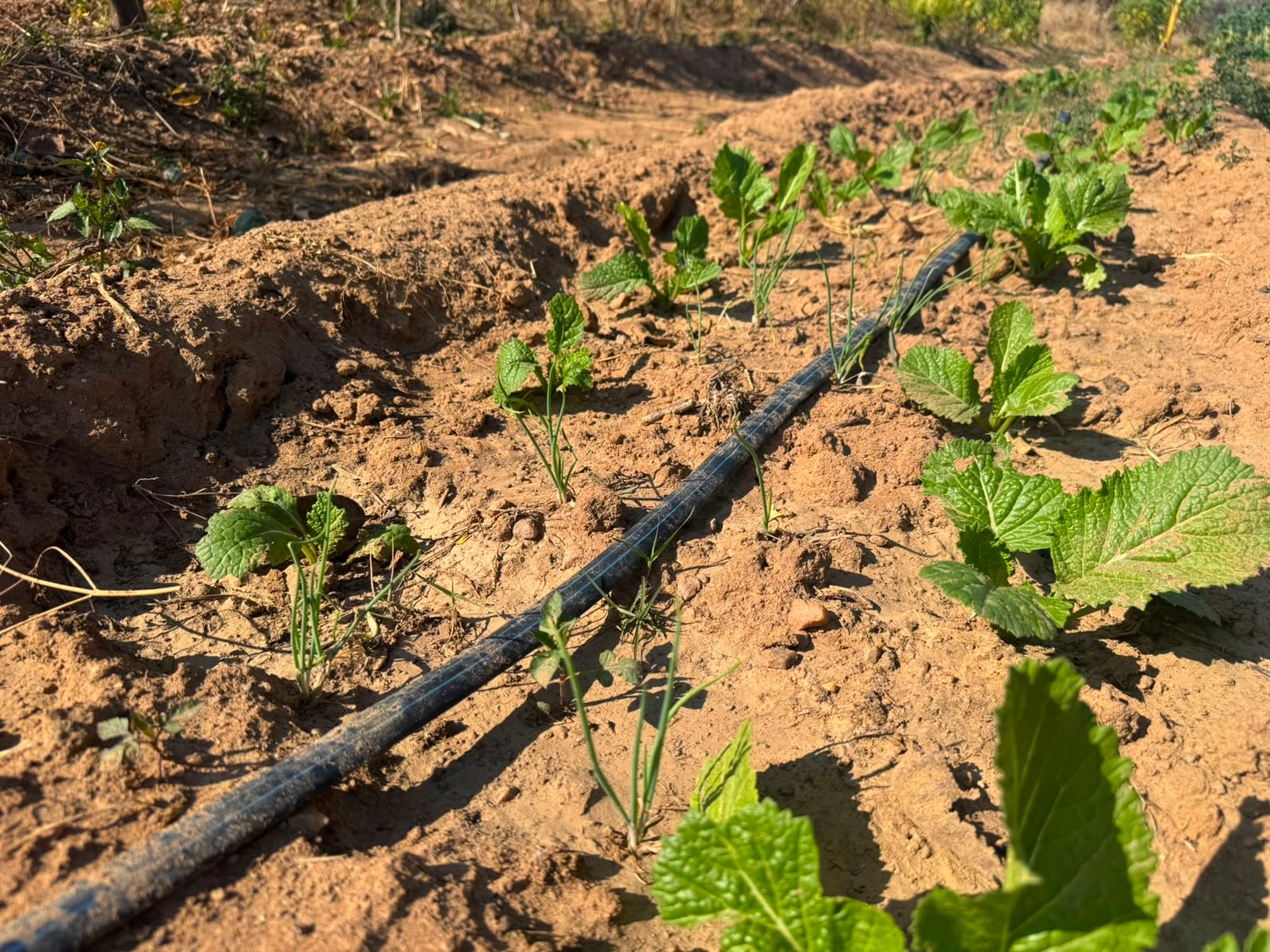
The first post in a series on low-cost, chemical-free natural farming.
The day the fertiliser won
If you've ever stood in your garden after a long dry spell and watched your soil turn to dust, you already know the feeling. You did everything "right". You bought the fertiliser. You watered. You weeded. And still, the tomatoes came out small, the leaves yellowed early, and the ground beneath them was hard, pale, and dead.
I remember that season. I remember the receipt from the agro-dealer more than the harvest. Fertiliser had gone up again. Pesticides were another expense. Water was scarce. And the soil — the one thing I actually depended on — was getting worse every single year, not better.
Here's the question that changed everything for me:
Has anyone ever fertilised a forest?
No one spreads NPK under an oak tree. No one sprays the Amazon for pests. Yet a forest is the most productive, self-sustaining, abundant living system on land. It builds its own soil. It stores its own water. It feeds itself. For free.
So why were we farming in a way that fights nature — and paying for the privilege of losing?
The expensive trap we were sold
Most of us were taught a simple, broken story: soil is a dead sponge. You grow a crop; you feed it chemicals; you harvest; you repeat. If yields drop, buy more chemicals.
It sounds logical until you watch what it actually does:
- Sandy soil drains nutrients and water like a sieve. Most of what you pay for washes away before the plant can use it.
- Bare soil bakes in the sun. Organic matter burns off, microbes die, and the ground turns hard.
- Every season, the soil gets poorer — so you need more inputs just to stand still.
It's not a farming method. It's a treadmill. And every year it costs more to stay on.
There had to be another way.
Then I found syntropic farming
Syntropic farming is a method that does something almost radical: it copies how a forest works and then speeds it up.
It was pioneered by a man named Ernst Gotsch, who took degraded, desertified land in Brazil — the kind of place people had given up on — and turned it into lush, productive food forests.
Not in centuries.
Sometimes in just a few seasons.
Where nature alone would have taken hundreds of years to rebuild that soil, he did it in a fraction of the time.
The principle is simple, even if the execution takes practice: stop working against nature and start imitating it.
A forest never leaves its soil bare. A forest always mixes many species together. A forest fertilises itself with fallen leaves and pruned branches. A forest layers plants of every height so that sunlight is captured fully, water is held in the ground, and every organism has a role.
Syntropic farming takes that blueprint and applies it to food production. And the results are hard to argue with:
- No chemical fertilisers. The system builds its own fertility through mulch, legumes, and soil life.
- Far less water. Covered soil holds moisture instead of losing it to sun and wind.
- More food per square metre. Layered, diverse plantings out-yield single-crop rows.
- Lower costs, every single season. Because the farm feeds itself.
The mindset shift that makes it work
Before any technique, syntropic farming asks you to change how you see a few things:
- Weeds are not enemies. Many are pioneer plants, sent by nature to cover bare soil and prepare it for what comes next.
- Pests are messengers. They tell you something is out of balance – they're not a target to spray.
- Bare soil is a problem, not a clean garden. Covered soil is the goal.
- "Waste" is fertiliser in disguise. Leaves, prunings, kitchen scraps — none of it should leave your land.
When you stop fighting nature and start copying it, two things happen at once: your costs drop, and your yields rise. That's not a trade-off. That's the whole point.
What if you don't have good land?
This is the part that sold me, because it's exactly my situation.
Syntropic farming was practically designed for poor, sandy, water-scarce soil — the kind of land most smallholders and home gardeners in southern Africa actually have. Instead of replacing the soil or buying amendments forever, you build it, layer by layer, using free local materials: leaves, grass, manure, pruned branches, and nitrogen-fixing plants.
You turn a sieve into a sponge. And you do it with what's already lying around your neighbourhood for free.
So I built a course
I spent months pulling together the research – soil science, conservation agriculture, agroecology, and Gotsch's syntropic principles – and I kept hitting the same problem. The information was out there, but it was scattered, academic, and hard to turn into action.
So I built the course I wish I'd had when I started.
Grow More Food With Less: Syntropic Farming for Poor Soils, Low Water & Low-Cost Natural Production is a beginner-friendly, step-by-step course that takes you from "my soil is dead and I'm broke" to "here is my own plantable syntropic design, ready to go in the ground this week."
It's built around doing, not just reading:
- 7 modules, 33 lessons, each with a clear goal, simple explanation, practical steps, and a local example.
- Ready-made planting designs for vegetables, grains, pulses, and tree crops — adapted for southern African conditions.
- 5 worksheets and checklists, including a 30-day starter action plan.
- A final design project so you finish with a real plan for your own land.
No experience required. No chemicals required. No expensive equipment required.
If you take one thing from this post
You don't need better soil to start. You need to start to get better soil.
A forest doesn't wait until conditions are perfect. It begins with whatever is there — a pioneer weed, a fallen leaf, a seed in the dust — and it builds. You can do exactly the same thing on a single bed, starting this weekend, with materials you can gather for free.
That's the whole promise of syntropic farming: grow more food, with less money, on land you thought was useless, by finally working with the system that's been growing forests for millions of years.
If that idea speaks to you, the course is live now.
Next in this series: The five principles that make a syntropic system work — and why each one is free.
Frequently asked
Do I need a big farm? No. A single 1m × 5m bed is enough to start. The course is designed for backyards and smallholdings alike.
Do I need to buy fertilisers or chemicals? No. The entire method is built around building fertility for free from local organic materials.
I have terrible sandy soil. Will this work? That's exactly the problem syntropic farming was designed to solve. Poor, dry, sandy land is its sweet spot.
Is this relevant to all countries? Yes. The course is localised for all countries and conditions, crops, and climate.