
If you've started researching resilience frameworks for your organization, you've probably run into these two terms used almost interchangeably and that's where the confusion starts. ISO 22301 vs Business Continuity Plan is one of the most common questions we hear from teams building out their resilience programs, and it's an important one to get right before you invest time, budget, or headcount in the wrong direction.
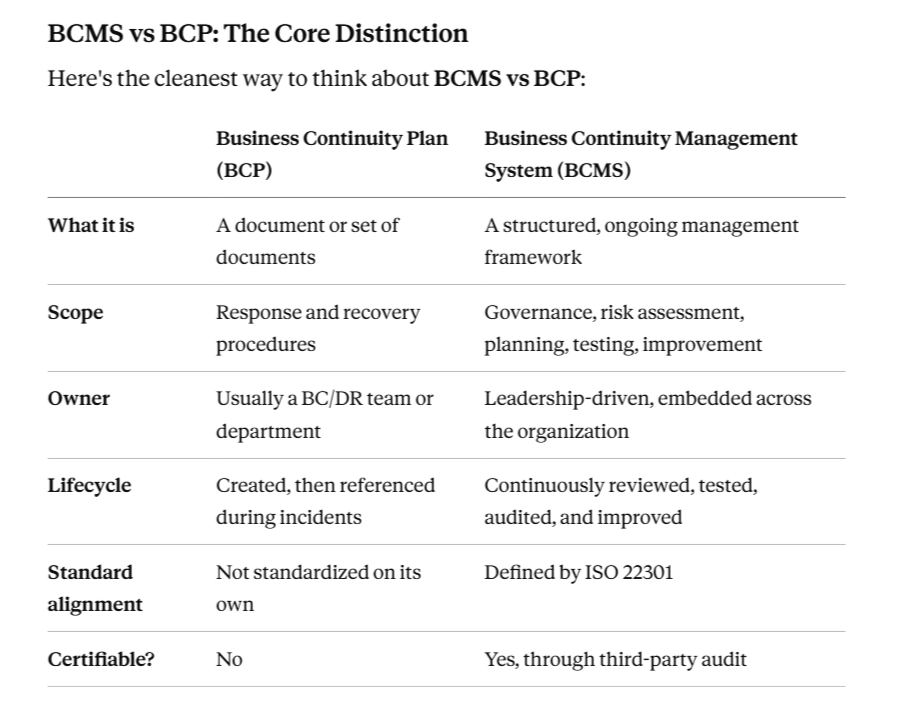
The short answer: a Business Continuity Plan (BCP) is a document. ISO 22301 is a management system standard. One tells your people what to do during a disruption. The other tells your organization how to build, run, and continuously improve the entire discipline that produces and sustains that plan.
Let's break down exactly how they differ, how they relate, and why most organizations eventually need both.
What Is a Business Continuity Plan (BCP)?
A business continuity plan is a practical, operational document. It outlines the specific steps your organization will take to keep critical functions running or get them running again quickly during and after a disruption, whether that's a cyberattack, a natural disaster, a supplier failure, or a system outage.
A typical BCP includes things like:
- Critical business functions and their recovery priorities
- Recovery time objectives (RTOs) and recovery point objectives (RPOs)
- Roles and responsibilities during an incident
- Emergency contact lists and escalation paths
- Alternate work locations or failover systems
- Communication plans for employees, customers, and regulators
In short, a BCP is a playbook. It's what your incident response team pulls up when something goes wrong. It's tactical, specific, and action-oriented.
But here's the catch: a BCP on its own doesn't tell you how it was built, who is responsible for keeping it accurate, how often it should be tested, or how your organization identifies new risks as the business changes. That's where ISO 22301 comes in.
What Is ISO 22301?
ISO 22301 is the international standard for a Business Continuity Management System (BCMS). Rather than being a single document, it's a comprehensive framework that governs the entire lifecycle of business continuity within an organization — planning, implementation, testing, monitoring, and continual improvement.
Where a BCP answers "what do we do when disruption hits?", ISO 22301 answers a much bigger question: "how does our organization systematically identify threats, prepare for them, respond to them, and get better at handling them over time?"
The standard's core ISO 22301 requirements include:
- Context of the organization — understanding internal and external factors, interested parties, and the scope of the BCMS
- Leadership and governance — top management commitment, policy, and defined roles
- Risk assessment and Business Impact Analysis (BIA) — identifying critical activities and the impact of their disruption
- Business continuity strategies and solutions — deciding how the organization will respond to identified risks
- Documented plans — including, yes, the BCP itself, as one output of the system
- Exercising and testing — validating that plans actually work
- Performance evaluation — internal audits and management review
- Continual improvement — using lessons learned to strengthen the BCMS over time
This is why organizations increasingly talk about ISO 22301 business continuity as a management discipline, not a single deliverable. The BCP is a component of the system — not the system itself.
BCMS vs BCP: The Core Distinction
How ISO 22301 and BCP Work Together
It's tempting to see these as competing approaches, but in practice, ISO 22301 and BCP are complementary — not either/or.
Think of it this way:
- ISO 22301 provides the structure. It tells you to conduct a Business Impact Analysis, assess risks, define recovery strategies, and establish governance.
- The BCP is a required output of that structure. Once you've done the risk assessment and defined your recovery strategies under ISO 22301, the BCP is where those decisions get translated into actionable, step-by-step procedures.
- ISO 22301 keeps the BCP alive. Without a management system around it, a BCP tends to go stale — written once, forgotten, and outdated by the time it's actually needed. ISO 22301's requirements for testing, review, and continual improvement ensure the plan evolves as the business does.
In other words, you can have a BCP without ISO 22301 certification. But you can't have a compliant BCMS under ISO 22301 without producing (and maintaining) a BCP as part of it.
Why This Distinction Matters for Your Organization
Understanding the difference isn't just academic — it has real implications for how you resource and scope your resilience program:
- If you only build a BCP, you may check a box for auditors or customers asking "do you have a continuity plan?" — but you likely won't have the governance, testing cadence, or risk assessment process to keep it relevant, and you won't be able to pursue certification.
- If you build toward the ISO 22301 standard, you get a defensible, auditable, continuously improving program — one that produces a stronger BCP as a natural byproduct, and one that can be certified to demonstrate resilience maturity to customers, regulators, and partners.
For organizations facing vendor security questionnaires, regulatory scrutiny (especially in finance, healthcare, and critical infrastructure), or enterprise customers who require proof of resilience, ISO 22301 certification is increasingly becoming table stakes — a standalone BCP simply doesn't carry the same weight.
Which One Do You Need?
- Just need a working plan for internal use? A well-built BCP may be enough as a starting point.
- Need to demonstrate resilience maturity to customers, auditors, or regulators? You'll want a full ISO 22301 Business Continuity Management program, built around a certifiable Business Continuity Management System (BCMS).
- Already have a BCP? Good news it's not wasted work. It becomes a foundational input as you build out the broader BCMS structure required by the standard.
Final Thoughts
The debate isn't really ISO 22301 vs Business Continuity Plan — it's about recognizing that one is a document and the other is the system that keeps that document accurate, tested, and effective. A BCP tells your team what to do in a crisis. ISO 22301 ensures that plan was built on real risk data, gets tested regularly, and keeps improving as your organization grows.
If you're serious about resilience — not just for your own peace of mind, but to meet customer, regulatory, or contractual expectations — the path forward is building a proper BCMS aligned with the ISO 22301 standard, with your BCP as one strong, well-maintained piece of a much bigger picture.
Want to understand how a full BCMS comes together? Read our complete guide to ISO 22301 Business Continuity Management.