
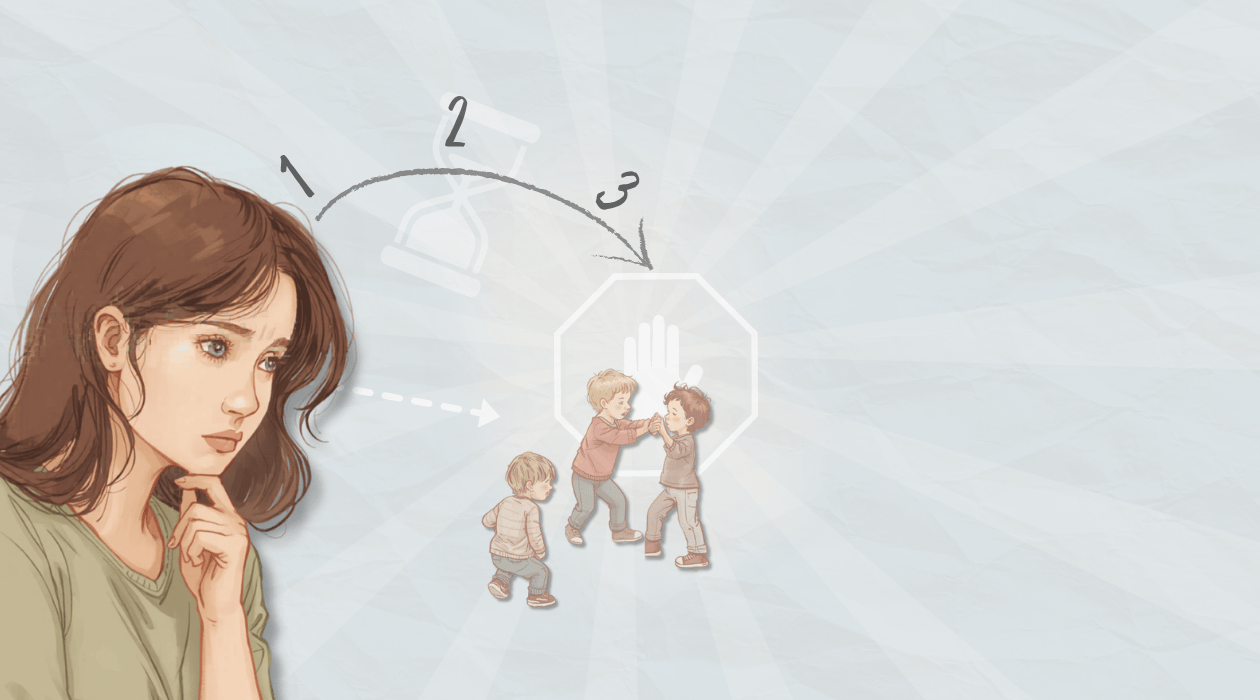
I know, I know.
You don't like to discipline.
It makes you uncomfortable.
It makes you feel… I don't know — mean?
So, when your toddler's pushing those boundaries (like they naturally will)...
You see a behavior you don't love.
You know they shouldn't be doing it.
It's a bit dangerous, maybe...
But you hesitate.
You warn, with a little smile.
You redirect.
But they don't stop.
So, you warn again.
And your voice gets a little louder this time.
The behavior keeps going; why don't they listen?
But now you're all out of ideas.
You guess they're just "being bad" and there's nothing you can do about it, and besides, you don't like to make your child unhappy.
So you look away and hope it stops.
It doesn't.
It escalates — and escalates.
Then something bad happens (like it always does!)
Now you're overwhelmed, snapping, yelling, maybe you're even punishing them — because now you're mad.
Afterward, you think: "Why does this always happen? I was trying so hard to be nice."
It's because this is a cycle.
I call it the passive/reactive parenting cycle.
It happens when you try to avoid the small, uncomfortable moments that call for focused discipline — only to end up even angrier later, possibly lashing out with random punishments, and no teachable moment.
This isn't because you're a bad parent.
It's because you waited too long to step in, and when you were finally forced to act, it was from anger rather than intention.
And here's why that's the problem.
The Problem
Toddlers learn through experience more than words. They’re still learning how words connect to actions and meaning.
When your words don't match your actions, their brain gets mixed signals.
You say "no."
But nothing actually happens. You don't back up what you're saying or show them what you mean.
So their brain thinks:
"What exactly does 'no' mean? And what should I do?"
So they test again. At this age, they're collecting the data they need to program their brains, and toddlers are like little detectives gathering clues about how the world works.
Like the mystery of what “no” actually means — and whether they’re really allowed to do the thing you’re telling them not to do.
When your response isn't clear, they need to test again.
And again.
And again.
Not because they want to be "bad."
But because their brain won't rest until they get a clear answer.
If there's no clear connection between the words you're saying and what you're showing them they mean, your toddler will keep "experimenting" until they can tease out a definition.
Because they’re building an internal manual around how words work.
And unfortunately, in this case, your child is learning:
"No doesn't really mean no unless I make mommy mad, then something finally happens."
That "something" is usually your breaking point.
But the problem is that by the time you step in, you're reacting to your own anger and the internal crisis it's causing for you — but you're still not really answering your child's original question.
So that first, specific question the behavior was originally asking —"Can I do this specific thing?"— gets lost in this bigger situation.
That's because toddler brains aren't wired to analyze individual moments. At this age, they're taking in general patterns.
When you wait too long, their brain can't connect the outcome to the specific behavior, but they will see the bigger picture of how you react and how they can get your attention.
So instead of learning “I can’t do this thing,” they may learn something different.
They might learn that they don't really have to listen unless Mommy is yelling.
Or
They learn they can keep doing risky or unhelpful things until something serious happens — because before that, nothing really changes.
So what starts as a simple question —"Can I do this?" — turns into:
"How far do I have to push before someone reacts?"
Or
"Do I actually have to listen when someone says no?"
And if a child starts to internalize the idea that "no" doesn't really mean no — or that they have to escalate behavior to feel seen and heard — those patterns can quietly follow them into later relationships and social situations.
We've all met adults like that.
This is often where it begins.
That's what passive/reactive parenting is:
- Passive at first.
- React later.
And the result is unclear parenting that creates more questions than it answers.
Over time, it can wear the people who interact with your child down — especially you.
So here's a simple three-step method to help you override the instinct to let things slide.
When you follow these steps, you give your toddler's brain the clear answers it's looking for by stopping the passive/reactive pattern in its tracks.
This method is simple, empowering, and designed to help you stay calm while turning difficult moments into teachable ones your toddler can actually learn from.
At its core, it keeps you focused on one important thing — making sure your words and your actions send the same clear message, quickly.
If the thought of getting more actively involved in these teachable moments feels a bit uncomfortable, just think of it like this:
- When you act early, you’re not being harsh.
- You’re helping your toddler stay out of trouble by giving their brain clear, usable information right away.
And that’s a lot kinder than letting things spiral out of control and ending up angry later.
The Method: See It → Stop It → Stay in Control
1. See It — Don't Let It Slide
The moment you see a behavior that crosses a boundary, that's your window.
- Not five minutes later.
- Not after three warnings.
- Not when you're already annoyed.
Right now.
Resist the urge to look the other way, resist the idea that you don't play a part in this phase of learning.
Jumping in straight away and taking care of the situation doesn't make you mean; this is a gift you give to your toddler — the gift of clarity.
It also shows them that you see them and you care enough to help them understand how to move through the world in a way that's safe and respectful.
2. Stop It — As Soon As You See It
Physically stop the behavior.
- If they're climbing the counter — lift them down.
- If they're swinging a stick — take it away.
- If they're hitting — separate them immediately from the other child and give a time-out.
No yelling from across the room.
No long explanations.
No bribes or begging.
Just clear cause and effect.
Behavior → Consequence.
Toddlers don't need volume or intensity.
They need clarity.
This early action is what makes the lesson clear.
It helps your toddler connect the behavior to what you said and the fact that you meant it, even if you weren't mad, so they begin to understand that this "thing" isn't allowed, no matter what.
They also start to learn that you don't have to be angry for them to take you seriously.
They don't have to push you to your breaking point to gain insight, because now, your words have weight — when you say something, you mean it, because you've shown them that you will follow through.
And last, but not least: you've put a physical stop to a behavior. Now your child knows what "stop" means in relation to how they need to control their body in this situation.
But remember— this is a learning process, so you'll have to do this over and over again for your child to internalize the lesson. You'll know it's landed when they start to listen to "no" just from you telling them.
And consistency is what makes it stick.
3. Stay in Control — Keep Your Cool
This is the part that gives you true parenting power.
You don't have to be emotionless.
But you do need to stay regulated enough to act intentionally.
If you wait until you're angry, your brain shifts into fight-or-flight.
Now you're reacting to your own frustration instead of responding to the behavior.
When you stay in control:
- Your child learns to take your words seriously.
- Consequences stay predictable and controlled.
- And your child feels safer — even if they're upset — because you're not out of control.
And here's the truth:
Calm discipline builds respect in ways that over-the-top reactions never can.
When you react in anger or become unpredictable and out of control, your child may learn to fear you and feel anxious around you, but that's not the same thing as respect. And while that might stop a behavior in the moment, it creates emotional distance—and sometimes rebellion — that can show up now and later in life.
Calm, intentional discipline works differently.
It teaches your child to avoid the behavior that causes the consequence.
There's no fear of you involved — just a clear understanding that certain actions lead to certain consequences.
They might not like the consequences, or you very much in that moment, but instinctively they know they're still safe.
This approach allows you to teach and guide your child through clear communication, helping them understand that your words can help them make better choices.
Fear pushes your child away.
Respect keeps your bond intact while still teaching the lesson.
Staying calm enough to give a clear response to behaviors builds that respect.
And here's a little something special just for you, to help remember the lesson:
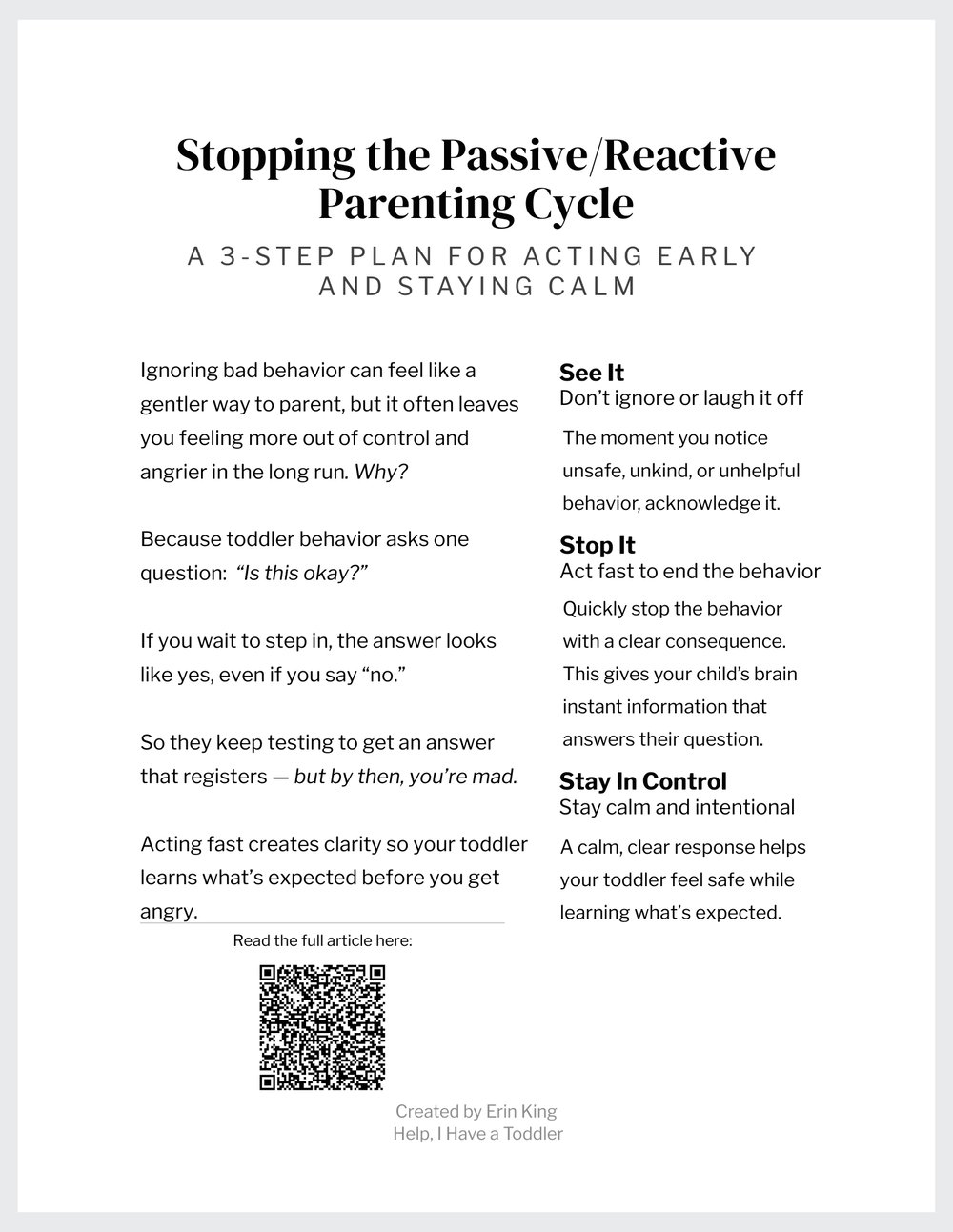
You won't find this in my regular resources section; this is a special private link just for toddler moms who read this post. A gentle reminder to print and post on your fridge.💗
I know you want fast solutions, and this can help you stay on track.
CLICK HERE for exclusive access to your very own FREE "Stopping the Passive/Reactive Parenting Cycle Cheatsheet."
Why This Works
Toddler brains are busy building:
- Impulse control
- Emotional regulation
- An understanding of cause and effect
- A picture of how the world works
- The meaning of words
- Relationships with you and other people
When they push boundaries, they're not trying to be "bad," and they're not ignoring you on purpose.
They're gathering information.
When your child does something unhelpful, unkind, or unsafe, and you:
- See it
- Stop it
- Stay in control
Their brain gets clear, usable information.
Your response connects the behavior to the meaning of your words and to the consequences that follow.
This helps your child build an understanding of language, cause and effect, and how to move through the world safely with other people — while keeping your relationship with them strong.
And when things make sense, toddlers don't need to keep testing the same boundaries.
Understanding reduces testing.
And over time, as your child internalizes these patterns, the lessons become internalized much faster.
Which in turn lowers your stress.
The Bottom Line
Passive parenting doesn't make you a nicer, gentler parent.
It just makes you more reactive later.
Avoiding a necessary lesson in the moment doesn't make your toddler's need for answers go away.
If anything, it makes that need stronger.
And the less clear the lesson is, the more your child will push for clarity.
Which just makes everything louder, messier, and angrier.
But when you step in early, act clearly, and keep your cool:
- You stop fighting your toddler's developmentally natural behavior.
- You start working with it.
- You lead — both through your actions and your words, because they match up.
- And you become the steady, predictable anchor your toddler's brain is looking for.
So remember, if you want to be a kinder, gentler parent, stick to this simple three-step method:
- See it.
- Stop it.
- Stay in control.
Simple.
Effective.
100% doable.
You've got this, Toddler Mama. 💛
And I've got you.
📜To go deeper into some related subjects, read these:
- Do My Feelings Affect My Toddler's? How your emotions shape your child’s behavior and nervous system🧠
- Why Does My Toddler Make Me So Angry? Science says there's a reason for this, and I have strategies that help.
🎁🎁If you'd like some free resources to help you work on your own big feelings in a toddler-centered way, check out these:
- The Mindful Mama Reset: Awareness Tools for Triggered Moments FREE Download
- The Mindful Mama Reset: Awareness Tools for Mom-Rage Dysregulation & Recovery FREE Download
- Mindful Mama: Awareness Tools For Co-Regulation FREE Download