

There are words that give you information.
There are words that give you inspiration.
And then there are sacred words that, when received in the right space, have the power to change the very way you experience yourself and existence.
This is the world of Sastra, Stotra and Sutra.
The ancient seers (Rishis) did not look upon sacred knowledge as intellectual entertainment. Truth was not discovered merely so that it could be discussed, debated, memorized or preserved.
Truth was transmitted so that a human being could live it, experience it and ultimately become it.
That is why approaching scripture only as literature misses its deepest purpose.
You may read hundreds of pages about peace and still become disturbed by one sentence spoken against you.
You may memorize verses about the Self and still live from fear, insecurity and comparison.
You may chant the names of the Divine every morning and spend the rest of the day worrying about tomorrow.
Then understand:
The sacred words have entered the memory.
They have not yet entered the being.
The purpose of scripture is not merely to make you knowledgeable.
Its purpose is transformation (lead to Brahm-Gyan - God-Realization)
Sastra gives direction.
Stotra awakens devotion.
Sutra plants concentrated truth within consciousness.
Three expressions.
Three approaches.
One sacred possibility:
Moving from knowing the Truth to living the Truth.

Sastra: Knowledge That Becomes a Path
Sastra is sacred knowledge that gives structure and direction to human life.
It can illuminate dharma, consciousness, yoga, worship, ethics, the nature of existence and the path toward liberation.
But there is a beautiful distinction to understand.
Information tells you about something.
Sastra shows you how to transform through that understanding.
Imagine that you are traveling through unknown mountains.
Someone who has already walked those mountains gives you a map.
The map shows where the rivers flow.
It shows dangerous cliffs.
It reveals pathways hidden from an inexperienced traveler.
It shows where one road ends and another begins.
That map is precious.
But possessing the map does not mean you have completed the journey.
You can study a map of the Himalayas for twenty years.
You can memorize the names of the mountains.
You can know the rivers and pathways.
You can give lectures about Himalayan geography.
Still, you have not felt the Himalayan wind upon your face.
This is the difference between knowledge and experience.
Knowing about meditation is not meditation.
Knowing about peace is not peace.
Knowing about the Self is not Self-realization.
Knowing about the Divine is not experiencing the Divine.
Sastra gives the map.
You have to walk.
The Responsibility to Raise Yourself
The Bhagavad Gita declares:
"Uddhared atmanatmanam
natmanam avasadayet."
Bhagavad Gita 6.5
"Let a person raise oneself by oneself; let one not lower oneself."
Contemplate the tremendous responsibility contained in this teaching.
Human beings often wait for the outer world to change before changing their inner world.
- "If this person behaves differently, I will be peaceful."
- "If my financial situation changes, I will stop worrying."
- "If people appreciate me, I will feel confident."
- "If my circumstances become stable, I will become happy."
But this gives the key to your inner space to everybody except you.
The scripture calls you back to responsibility.
Not responsibility as a burden.
Responsibility as power.
You can raise yourself.
From reaction to awareness.
From fear to understanding.
From confusion to clarity.
From resentment to completion.
From helplessness to conscious action.
Every time you choose awareness instead of unconscious reaction, you raise yourself.
Every time you choose truth instead of a convenient falsehood, you raise yourself.
Every time you refuse to nourish hatred, you raise yourself.
Every time you become conscious of a pattern instead of simply repeating it, you raise yourself.
This is when Sastra stops being a book.
It becomes your path.

Stotra: What You Remember, You Become
If Sastra gives direction to intelligence, Stotra opens the heart.
Stotra is sacred praise.
For thousands of years, seekers have sung and chanted the names, forms and qualities of the Divine.
Why?
- Does the Infinite require compliments?
- Does Shiva become greater because you praise Shiva?
- Does Devi become more powerful because you sing to Devi?
- Does the Divine need human approval?
Of course not.
The Divine does not need the remembrance.
You need the remembrance.
This distinction changes the entire understanding of prayer.
Your Mind Is Already Chanting
Observe your mind for one ordinary day.
You may discover that it is continuously chanting an invisible Stotra.
Unfortunately, the object of worship is often the problem.
- "My problem."
- "My fear."
- "My money."
- "My failure."
- "My relationship."
- "My enemy."
- "My reputation."
- "My future."
- "What will happen?"
- "What will people think?"
- "What if I fail?"
The words change.
The pattern remains.
Attention continuously flows toward whatever has been given importance.
And whatever repeatedly receives your attention begins influencing the quality of your consciousness.
If you continuously remember fear, fear becomes your inner climate.
If you continuously remember anger, anger begins coloring everything you see.
If you continuously remember someone's betrayal, that person continues occupying your consciousness even when physically absent.
Now understand the intelligence behind Stotra.
Stotra consciously redirects the power of remembrance toward the sacred.
When you chant the qualities of Shiva, Devi, Vishnu, Ganesha or another expression of the Divine, you interrupt the endless repetition of limitation.
For those moments, you are no longer worshipping your worries.
Your attention has been redirected toward something greater than your immediate mental drama.
That redirection itself can become a spiritual practice.
Devotion Is Not Weakness
Sometimes devotion is misunderstood as emotional dependence.
Authentic devotion is the opposite.
Devotion is the courage to allow the small identity to melt before something immeasurably greater.
When gratitude arises without calculation, there is devotion.
When you experience wonder without needing to possess what you see, there is devotion.
When the heart bows not from fear but from recognition of the sacred, there is devotion.
Stotra gives language to this experience.
And gradually, something beautiful happens.
You begin with words.
Then the words become feeling.
The feeling becomes remembrance.
The remembrance becomes presence.
Finally, even silence becomes prayer.
What you continuously remember, you begin to radiate.
That is the secret of Stotra.
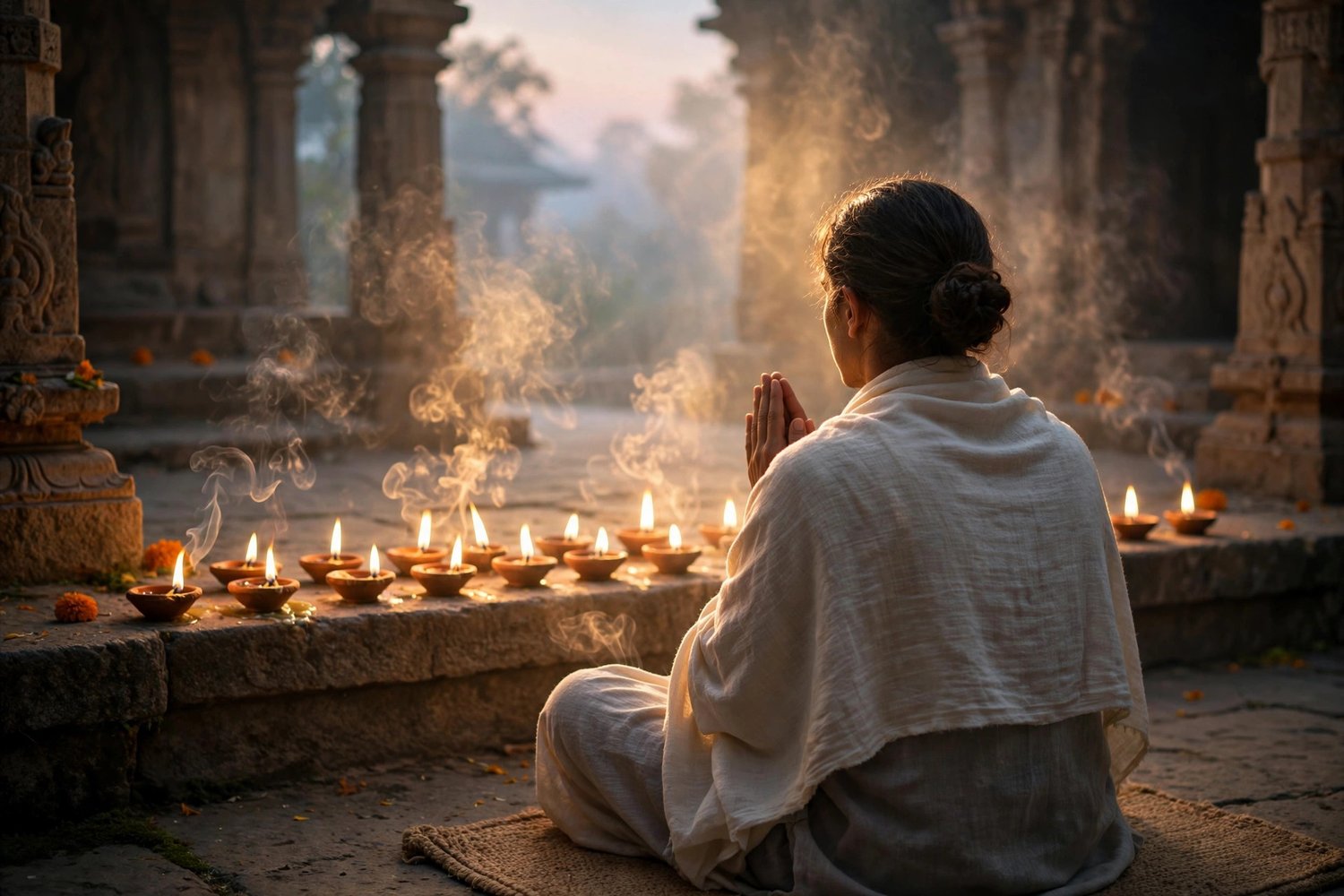
Sutra: An Ocean Inside a Drop
Then comes Sutra.
A Sutra can be astonishingly small.
A few words.
Sometimes one short statement.
Yet an entire spiritual universe may be contained within it.
The word Sutra carries the sense of a thread.
Just as a thread can hold many flowers together in a garland, a Sutra holds an immense body of understanding within a concentrated expression.
Do not measure a Sutra by the number of its words.
A seed is small.
But an entire tree is hidden inside it.
In the same way, a Sutra is a seed placed into consciousness.
It has to be contemplated.
It has to be allowed to open.
The Extraordinary Power of "Now"
Patanjali begins the Yoga Sutras:
"Atha yoga anushasanam."
Yoga Sutra 1.1
"Now, the discipline of Yoga."
Many people immediately move toward the next Sutra.
But stop.
The first word itself can become a meditation.
Atha. Now.
Look at your life.
- How much of it is being postponed?
- "When this problem is solved, I will be peaceful."
- "When I have enough money, I will relax."
- "When my responsibilities reduce, I will meditate."
- "When my children are settled, I will focus on myself."
- "When people understand me, I will be happy."
- "When everything becomes right, I will begin living."
- The mind is constantly negotiating with the future.
- But have you ever experienced tomorrow?
- Whenever tomorrow arrives, what is it?
Now.
- You have never lived yesterday.
- You remember yesterday now.
- You have never lived tomorrow.
- You imagine tomorrow now.
- Every experience you have ever had happened in one place:
Now.
- Meditation can happen only now.
- Love can happen only now.
- Awareness can happen only now.
- Transformation can happen only now.
- The Divine can be experienced only now.
- Suddenly one word from a Sutra becomes enough for a lifetime of contemplation.
This is the power of Sutra.

The Greatest Danger: Spirituality Becoming Information
There is a subtle danger for every sincere seeker.
The mind can convert even spirituality into entertainment.
You read one scripture.
Then another.
You watch one discourse.
Then ten more.
You collect quotations.
You learn spiritual terminology.
You discuss different philosophies.
You become very knowledgeable about enlightenment.
And yet the same anger controls you.
The same insecurity controls you.
The same fear controls you.
The same patterns repeat themselves.
Then spirituality has become information rather than transformation.
This is why one question is more valuable than collecting another hundred quotations:
Am I transforming?
Ask yourself:
- Am I less controlled by anger than I was one year ago?
- Can somebody disagree with me without destroying my inner peace?
- Am I becoming more compassionate?
- Am I becoming more truthful?
- Can I recognize fear without immediately obeying it?
- Can I sit silently with myself without constantly reaching for distraction?
- Do I recover from emotional disturbances more consciously?
- Is gratitude becoming more natural?
These questions reveal whether sacred knowledge has begun entering life.
You have not completed a scripture simply because you reached its final page.
A scripture begins fulfilling its purpose when its truth starts expressing itself through you.
One Verse Can Transform a Life
There is no need to consume hundreds of teachings every day.
Sometimes spiritual greed becomes another form of restlessness.
Take one teaching.
Just one.
And live it intensely.
If the teaching is compassion, practice compassion precisely when compassion is difficult.
If the teaching is truthfulness, become conscious of every word leaving your mouth.
If the teaching is non-attachment, observe what happens inside you when something does not happen according to your expectation.
If the teaching is about awareness, watch your thoughts without immediately identifying with them.
Sit silently.
A thought appears.
It remains for a few moments.
Then it disappears.
Another appears.
That disappears too.
Now ask:
If I can observe thoughts coming and going, can I be merely those thoughts?
Do not hurry to produce an intellectual answer.
Remain with the question.
Watch.
Experience.
Now scripture has stopped being philosophy.
It has become inner investigation.

The Scripture Is Speaking About You
Never read sacred texts only as stories about somebody else's spiritual journey.
When the Bhagavad Gita speaks about confusion, look at your confusion.
When the Upanishads inquire into the Self, inquire into yourself.
When Patanjali describes the movements of the mind, observe your mind.
When Stotra celebrates divine qualities, discover whether those qualities can awaken within you.
Then the scripture becomes intensely personal.
The battlefield is not merely somewhere in history.
There is a battlefield every time two opposing tendencies struggle within you.
The pilgrimage is not only to a sacred geographical place.
There is an inner pilgrimage from unconsciousness to awareness.
The temple is not merely constructed from stone.
Your own consciousness can become a sacred space.
The lamp is not only the flame placed before a deity.
Awareness itself can become the lamp illuminating the darkness within.
When scripture is approached this way, every symbol begins speaking.
Bring the Teaching Into Ordinary Life
Do not reserve spirituality only for the prayer room.
If the Truth cannot enter your ordinary life, what is its use?
Bring Sastra into your decisions.
Bring Stotra into your emotions.
Bring Sutra into your contemplation.
Bring awareness into business.
Bring integrity into money.
Bring compassion into relationships.
Bring consciousness into conflict.
Bring gratitude into success.
Bring stability into failure.
Bring silence into moments of chaos.
The real test of peace is not whether you can remain peaceful when everybody agrees with you.
What happens when someone criticizes you?
The real test of non-attachment is not what you say about possessions.
What happens when something you value is taken away?
The real test of compassion is not loving people who love you.
What happens when you encounter someone difficult?
The real test of spiritual understanding is life itself.
Every situation becomes an opportunity to see how deeply the teaching has entered you.
From Reading to Becoming
There are different stages in our relationship with sacred knowledge.
First, you read.
Then you begin to understand.
Understanding becomes contemplation.
Contemplation becomes practice.
Practice ripens into experience.
And experience eventually becomes your natural way of being.
At that point, you no longer need to remind yourself constantly to practice the teaching.
Compassion becomes natural.
Awareness becomes natural.
Gratitude becomes natural.
Inner stability becomes natural.
The teaching has entered your nervous system, your decisions, your relationships and your very way of seeing existence.
This is when knowledge becomes wisdom.
Sastra, Stotra, Sutra - Three Doors, One Truth
Sastra gives you the map.
Stotra opens your heart.
Sutra plants the seed of direct contemplation.
Sastra says:
Understand.
Stotra says:
Remember and love.
Sutra says:
Contemplate and experience.
But all three ultimately point beyond themselves.
They point toward transformation.
A map fulfills its purpose when you begin walking.
A song fulfills its purpose when your heart opens.
A seed fulfills its purpose when it breaks open and becomes a tree.
Likewise, scripture fulfills its purpose when its truth begins living through you.

Let Your Life Become the Commentary
People have written commentaries on sacred scriptures for thousands of years.
But there is another kind of commentary.
Your life.
How you respond when you are challenged is your commentary on the teachings.
How you behave when nobody is watching is your commentary.
How you use wealth and influence is your commentary.
How you treat someone who can do nothing for you is your commentary.
How quickly you return to awareness after becoming disturbed is your commentary.
How deeply you can love without possession is your commentary.
The most beautiful explanation of compassion is a compassionate human being.
The most convincing explanation of peace is a peaceful presence.
The greatest commentary on courage is a life lived courageously.
The deepest commentary on Truth is a human being who lives it.
Become the Living Scripture
One day, if you continue sincerely, something extraordinary begins happening.
You no longer remember the teachings only when you open a book.
They become the way you see.
The way you listen.
The way you respond.
The way you love.
The way you work.
The way you face uncertainty.
The way you experience yourself.
Then Sastra is no longer outside you.
Its clarity has become part of your intelligence.
Stotra is no longer only something you chant.
Gratitude itself has become your prayer.
Sutra is no longer only a sentence you contemplate.
Awareness has become your inner space.
Then:
Your clarity becomes Sastra.
Your gratitude becomes Stotra.
Your awareness becomes the living Sutra.
Read the Sastra.
Sing the Stotra.
Contemplate the Sutra.
But never stop with the words.
Walk where Sastra points.
Become what Stotra celebrates.
Experience what Sutra reveals.
Live the Truth so deeply that the distance between the scripture and you disappears.
Then you are not simply reading sacred knowledge.
Your life itself becomes scripture.
Hari Om Tat Sat