
By Om Tat Sat · Hindu Seeker Library · 19 October 2026
The Narada Bhakti Sutras are 84 short Sanskrit aphorisms on bhakti, devotion to God, attributed to the sage Narada. Their central teaching fits in one line, sutra 2: bhakti is parama-prema, supreme love for the Divine. Over five chapters Narada describes what that love is, why it is greater than action, knowledge and yoga, how to cultivate it, and what a person filled with it is like.
What are the Narada Bhakti Sutras?
A sūtra is a "thread": a compressed saying meant to be memorised and then unfolded by a teacher. The Narada Bhakti Sutras are among the best-known texts of the bhakti tradition, alongside the Shandilya Bhakti Sutras. They are attributed to Devarshi Narada, the wandering sage of the Puranas who travels the worlds with his vina, singing the Name of Narayana. The date of composition is uncertain; the text shares much of its spirit with the Bhagavad Gita and the Bhagavata Purana, and it names earlier teachers of bhakti such as Vyasa, Garga and Shandilya.
Unlike many philosophical works, it does not argue. It describes. Narada writes as someone pointing at a condition of the heart that real people have lived, the gopis of Vraja above all.
How are the 84 sutras organised?
- Chapter: 1 | Sutras: 1–24 | Theme: The nature of supreme love: what bhakti is and how teachers have defined it
- Chapter: 2 | Sutras: 25–33 | Theme: Its greatness: why love is higher than action, knowledge and yoga
- Chapter: 3 | Sutras: 34–50 | Theme: The means: how devotion is cultivated, and what to avoid
- Chapter: 4 | Sutras: 51–66 | Theme: The indescribable nature of love, and how a devotee lives
- Chapter: 5 | Sutras: 67–84 | Theme: The glory of the true devotee, and the eleven forms of love
What are the most important sutras?
Sutra 1: the beginning
अथातो भक्तिं व्याख्यास्यामः ।
athāto bhaktiṃ vyākhyāsyāmaḥ
"Now, therefore, we shall explain bhakti."
Meaning: the form deliberately echoes the Brahma Sutras (athāto brahma-jijñāsā, "now, therefore, the inquiry into Brahman"). Where the Vedantin inquires, Narada explains love. "Now" marks the moment the seeker is ready.
Sutra 2: the whole book in one line
सा त्वस्मिन् परमप्रेमरूपा ।
sā tv asmin parama-prema-rūpā
"Bhakti is, indeed, of the nature of supreme love for Him."
Meaning: bhakti is not first ritual, belief or obedience. It is love, and not ordinary love but love freed of bargaining and fear. Narada simply says asmin, "toward this One", so the devotee of Krishna, Rama, Shiva, the Mother or the formless Self can all read themselves into it.
Sutra 3: love as nectar
अमृतस्वरूपा च ।
amṛta-svarūpā ca
"And it is of the nature of immortal nectar."
Meaning: amṛta means both "immortal" and "nectar". Love for the eternal shares its eternity, and it is sweet in itself, not only a means to a later reward.
Sutra 19: Narada's own definition
नारदस्तु तदर्पिताखिलाचारता तद्विस्मरणे परमव्याकुलतेति ।
nāradas tu tad-arpitākhilācāratā tad-vismaraṇe parama-vyākulateti
"But Narada says that bhakti is offering every action to Him, and feeling the deepest anguish whenever He is forgotten."
Meaning: after quoting Vyasa (love of worship), Garga (love of hearing His stories) and Shandilya (love in harmony with delight in the Self), Narada gives two tests you can apply today. Is my day offered? And do I miss God when I forget?
Sutra 21: the example
यथा व्रजगोपिकानाम् ।
yathā vraja-gopikānām
"For example, the gopis of Vraja."
Meaning: the highest model is not a scholar or ascetic but village women whose every chore was soaked in remembrance of Krishna.
Sutras 25–26: greater than action, knowledge and yoga
सा तु कर्मज्ञानयोगेभ्योऽप्यधिकतरा । फलरूपत्वात् ।
sā tu karma-jñāna-yogebhyo 'py adhikatarā · phala-rūpatvāt
"Bhakti is greater even than action, knowledge and yoga, because it is itself the fruit."
Meaning: other paths are means to an end. Love is both the path and the arrival.
Sutra 38: how it really comes
मुख्यतस्तु महत्कृपयैव भगवत्कृपालेशाद्वा ।
mukhyatas tu mahat-kṛpayaiva bhagavat-kṛpā-leśād vā
"But principally it comes through the grace of great souls, or through a touch of the Lord's grace."
Meaning: practice prepares the ground, but love is finally received, not manufactured. This is why the tradition prizes satsang, the company of the holy.
Sutras 51–52: beyond words
अनिर्वचनीयं प्रेमस्वरूपम् । मूकास्वादनवत् ।
anirvacanīyaṃ prema-svarūpam · mūkāsvādanavat
"The essential nature of love is beyond description. It is like the taste of something delicious to a person who cannot speak."
Meaning: one of the most quoted images in all of bhakti. The experience is real and full, but it cannot be handed over in words.
Sutra 72: no barriers
नास्ति तेषु जातिविद्यारूपकुलधनक्रियादिभेदः ।
nāsti teṣu jāti-vidyā-rūpa-kula-dhana-kriyādi-bhedaḥ
"Among them there is no distinction of birth, learning, appearance, family, wealth, occupation or the like."
Meaning: the door of bhakti is open to everyone.
What are the 11 forms of bhakti in Narada's sutra 82?
Narada says love is one, yet it shows itself in eleven ways (ekadhāpy ekādaśadhā bhavati):
1. Guṇa-māhātmya-āsakti: love of His glorious qualities
2. Rūpa-āsakti: love of His beauty
3. Pūjā-āsakti: love of worship
4. Smaraṇa-āsakti: love of remembrance
5. Dāsya-āsakti: love as a servant (Hanuman)
6. Sakhya-āsakti: love as a friend (Arjuna)
7. Vātsalya-āsakti: love as a parent (Yashoda)
8. Kāntā-āsakti: love as a beloved (the gopis)
9. Ātma-nivedana-āsakti: love through total self-offering
10. Tanmayatā-āsakti: love through complete absorption
11. Parama-viraha-āsakti: love in the agony of separation
You do not have to choose one. Most devotees find two or three that are natural for them. That is where to begin.
How do you practise the Narada Bhakti Sutras?
Chapter 3 is practical. Drawing on sutras 35–37:
- Let go of what pulls you away (viṣaya-tyāga, saṅga-tyāga, sutra 35): not by force, but by noticing which habits leave the heart dry.
- Keep worship unbroken (avyāvṛtta-bhajana, sutra 36): a short daily practice that is never skipped matters more than a long one done occasionally.
- Hear and sing of God even in the middle of worldly life (sutra 37): kirtan, stories, bhajans, the Name.
- Seek good company (sutras 38–39): the company of great souls is "rare, hard to recognise, and unfailing in its effect".
A simple start: choose one Name, chant it for eleven minutes each morning, and once in the day pause to ask Narada's question from sutra 19: did I offer this, and did I miss Him when I forgot?
Narada Bhakti Sutras vs Shandilya Bhakti Sutras: what is the difference?
Both define bhakti as supreme love. Shandilya's 100 sutras are more philosophical: they discuss the relation between devotion and knowledge in the language of Vedanta. Narada's 84 sutras are shorter, warmer and more practical, written to be lived. Many readers start with Narada and go on to Shandilya.
Frequently asked questions
How many sutras are there? 84, in five chapters, in the commonly printed text.
Who wrote them? They are traditionally attributed to Devarshi Narada. The date is uncertain.
Do I need to know Sanskrit? No. A good edition gives the Devanagari, a transliteration and a word-by-word meaning so you can chant and understand together.
Is bhakti only for followers of Krishna? No. Narada leaves the object open (asmin, "toward this One"). The gopis are his example, but the teaching applies to any form of the Divine you love.
What is the last sutra? Sutra 84 promises that whoever trusts and has faith in this teaching "becomes full of devotion and attains the Most Beloved", and repeats the last words for emphasis.
Where should a beginner start? Read sutras 1–24 slowly, one a day, with a short reflection. That alone is a three-week sadhana.
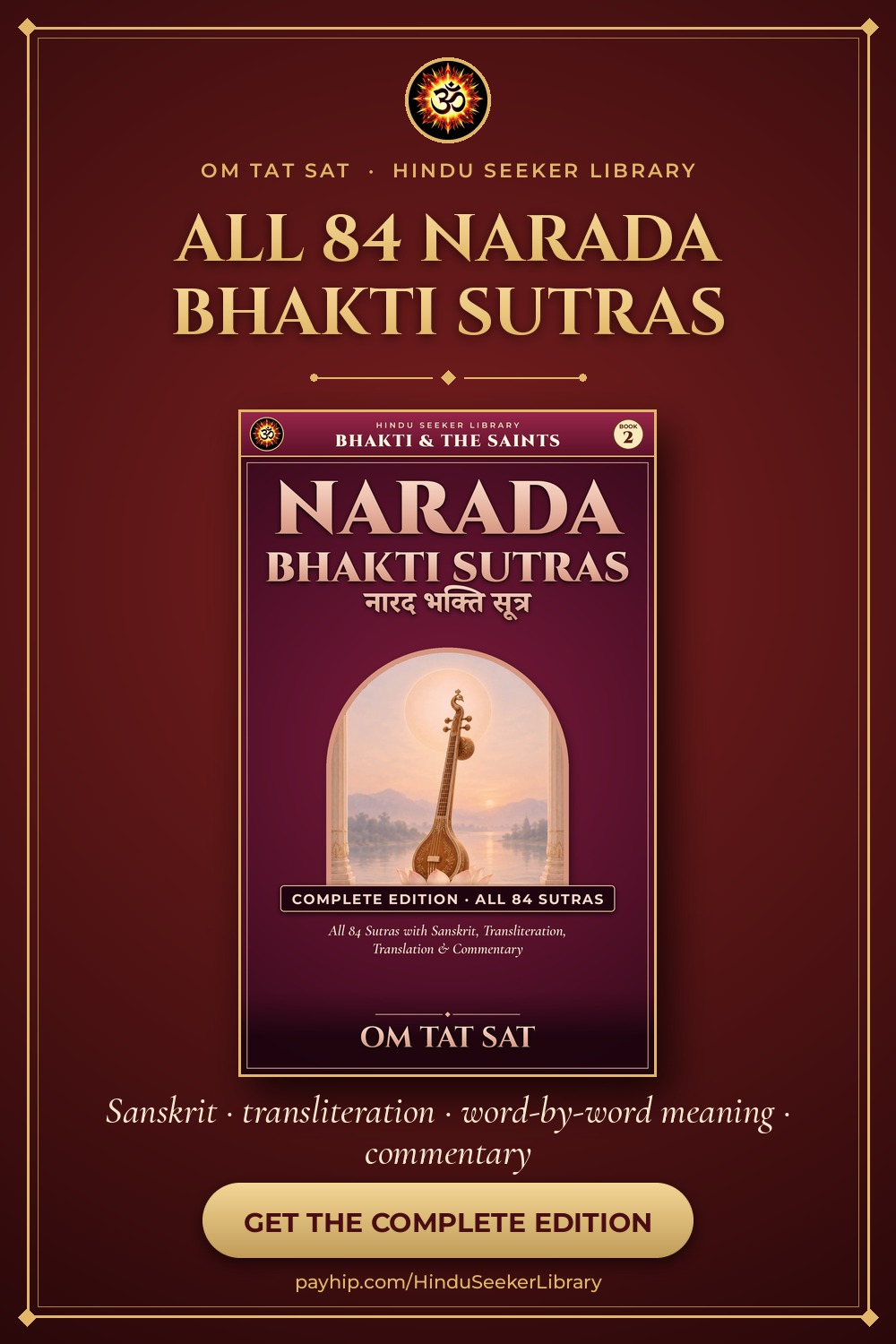
Read every sutra. Narada Bhakti Sutras: The Complete Edition gives all 84 sutras in Devanagari, transliteration, word-by-word meaning and translation, with a commentary and a living practice for each one: https://payhip.com/b/yOBaH
Start free. Narada Bhakti Sutras, Part One covers the opening chapter: https://payhip.com/b/pn97z
Go further on the bhakti path. Shandilya Bhakti Sutras (all 100 sutras): https://payhip.com/b/Vmq8d · Bhakti Yoga for Beginners (free): https://payhip.com/b/352hs · Naam Smaran (free): https://payhip.com/b/foPaH
A free daily practice. The 11-Minute Daily Mantra Practice, five essential mantras with a 21-day tracker: https://payhip.com/b/R23E6
Om Tat Sat · Hindu Seeker Library