
By Om Tat Sat · Hindu Seeker Library · 19 October 2026
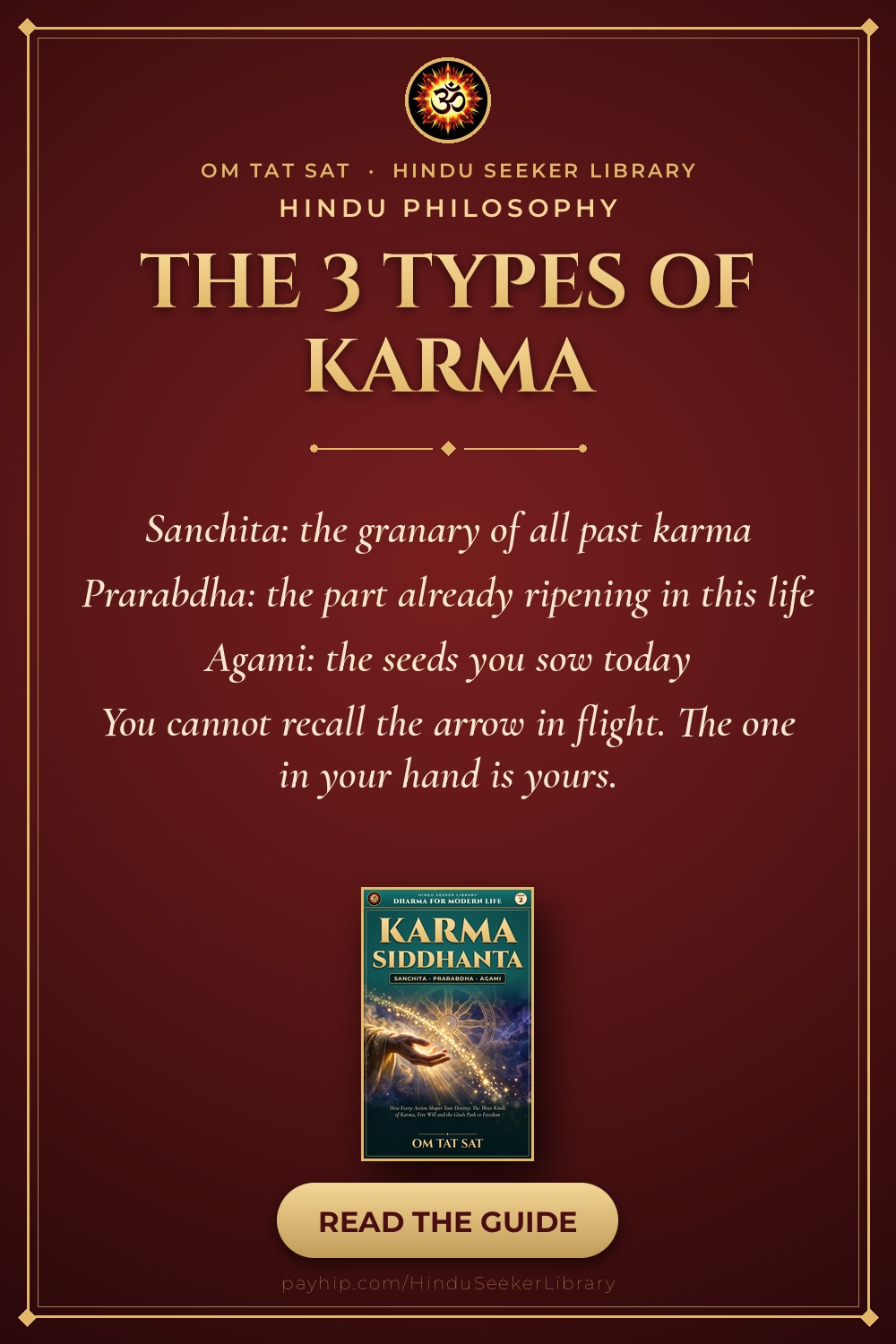
Hindu philosophy describes three types of karma. Sanchita is the total store of past karma not yet experienced. Prarabdha is the portion of that store that has "begun" and is shaping this life now. Agami (often called Kriyamana) is the new karma we create through present choices. You cannot undo prarabdha, but you are fully free in agami, and in Vedanta the knowledge of the Self dissolves the stored sanchita.
What does karma actually mean?
Karma comes from the Sanskrit root kṛ, "to do". It first means simply action, and then the law that every action carries consequences, seen and unseen. It is not cosmic reward and punishment handed out by a judge. It is closer to a law of nature: what is sown is reaped.
The Upanishads state the principle plainly:
यथाकारी यथाचारी तथा भवति । साधुकारी साधुर्भवति पापकारी पापो भवति ।
yathākārī yathācārī tathā bhavati · sādhukārī sādhur bhavati pāpakārī pāpo bhavati
"As one acts and as one conducts oneself, so one becomes. The doer of good becomes good; the doer of harm becomes harmful." (Bṛhadāraṇyaka Upaniṣad 4.4.5)
The same passage traces karma back to its root, desire: "As a person's desire is, so is their will; as their will is, so is their deed; and whatever deed they do, that they reap." Karma starts in the heart before it reaches the hands.
Where does the "three types of karma" teaching come from?
The threefold division is standard in Vedanta. The short primer Tattva Bodha, traditionally attributed to Adi Shankaracharya, puts it in one line:
कर्माणि कतिविधानि सन्तीति चेत् आगामिसञ्चितप्रारब्धभेदेन त्रिविधानि सन्ति ।
karmāṇi katividhāni santīti cet āgāmi-sañcita-prārabdha-bhedena trividhāni santi
"If it is asked how many kinds of karma there are: they are of three kinds, as āgāmi, sañcita and prārabdha."
The three types at a glance
- Type: Sanchita | Sanskrit: सञ्चित | Literally: "accumulated" | Simple picture: the granary: everything stored | Can it be changed?: Yes. Vedanta teaches it is burned by Self-knowledge
- Type: Prarabdha | Sanskrit: प्रारब्ध | Literally: "begun" | Simple picture: this season's harvest, already ripening | Can it be changed?: No. It is lived through, but how you meet it is free
- Type: Agami / Kriyamana | Sanskrit: आगामि / क्रियमाण | Literally: "coming" / "being done" | Simple picture: the seeds you are sowing today | Can it be changed?: Completely. This is your free will
1. Sanchita karma: the granary
Sañcita means "heaped together". It is the total of all past actions, from this life and, in the traditional view, from countless previous lives, whose results have not yet appeared. You cannot see it, but it shows up as tendencies (saṃskāras): talents that came easily, fears that have no obvious cause, patterns you keep repeating.
2. Prarabdha karma: the season you are in
Prārabdha means "already begun". From the vast granary, one portion has started to bear fruit: the portion that produced this body, this family, this temperament and the major circumstances of this life. A classic teaching image is the archer. An arrow that has left the bow cannot be called back. Prarabdha is the arrow in flight. It must land.
This is why the tradition says even a realised sage still lives out the prarabdha of the body: they still fall ill, still age. The difference is that it no longer touches who they know themselves to be.
3. Agami (Kriyamana) karma: the seeds you sow today
Āgāmi means "coming"; kriyamāṇa means "being done". Different teachers use the two words slightly differently. Some use kriyamana for the actions you are doing now and agami for the future results they will produce; many simply treat them as one category. Either way, this is the arrow still in your hand. You decide where it goes.
(A technical note: Tattva Bodha itself uses āgāmi for the karma done by the body of the wise after Self-knowledge has arisen. In everyday teaching, agami is used more broadly for all new karma.)
Is karma the same as fate?
No, and this is the most common misunderstanding. Prarabdha decides what arrives. It does not decide how you respond. Every response is a fresh action, and so a fresh seed. Two people can face the same loss: one sows bitterness, the other compassion. Same prarabdha, different agami, different futures.
The Bhagavad Gita insists that we lift ourselves:
उद्धरेदात्मनात्मानं नात्मानमवसादयेत् ।
uddhared ātmanātmānaṃ nātmānam avasādayet
"Lift yourself by your own self; do not let yourself sink." (Bhagavad Gītā 6.5)
What do the types of karma look like in the Bhagavad Gita?
The Gita adds its own threefold lens on action itself:
कर्मणो ह्यपि बोद्धव्यं बोद्धव्यं च विकर्मणः । अकर्मणश्च बोद्धव्यं गहना कर्मणो गतिः ॥
karmaṇo hy api boddhavyaṃ boddhavyaṃ ca vikarmaṇaḥ · akarmaṇaś ca boddhavyaṃ gahanā karmaṇo gatiḥ
"One must understand what action is, what wrong action is, and what inaction is. Deep indeed is the way of karma." (Bhagavad Gītā 4.17)
- Karma: right action, in line with dharma.
- Vikarma: wrong or prohibited action, which binds and brings suffering.
- Akarma: "actionless action": action done without ego and without craving for its fruit, which does not bind at all.
That last category is the doorway out. Its most famous expression:
कर्मण्येवाधिकारस्ते मा फलेषु कदाचन ।
karmaṇy evādhikāras te mā phaleṣu kadācana
"Your right is to the action alone, never to its fruits." (Bhagavad Gītā 2.47)
Can karma be changed or burned?
The tradition gives three answers, one for each type:
1. Agami is changed simply by acting well: honestly, kindly, without selfish attachment to results. This is karma yoga.
2. Prarabdha is not erased, but its sting is transformed by acceptance, prayer and equanimity. The event remains; the suffering added on top of it does not have to.
3. Sanchita is dissolved by knowledge of the Self. The Gita says:
यथैधांसि समिद्धोऽग्निर्भस्मसात्कुरुतेऽर्जुन । ज्ञानाग्निः सर्वकर्माणि भस्मसात्कुरुते तथा ॥
yathaidhāṃsi samiddho 'gnir bhasmasāt kurute 'rjuna · jñānāgniḥ sarvakarmāṇi bhasmasāt kurute tathā
"As a blazing fire turns firewood to ash, Arjuna, so the fire of knowledge turns all karma to ash." (Bhagavad Gītā 4.37)
Devotional traditions add a fourth: grace. Surrender to God, in the spirit of Gita 18.66, is said to loosen what effort alone cannot.
A five-minute karma practice for tonight
- Recall one moment from today that went badly.
- Ask: was this arriving (prarabdha) or was it my response (agami)?
- For the arriving part, say inwardly: "I accept what has come."
- For your response, ask: "What seed did I sow, and what seed will I sow next time?"
- Offer the day: "Whatever I did, I offer to You."
Frequently asked questions
What is the difference between Sanchita and Prarabdha? Sanchita is the whole stored account; prarabdha is the part already being paid out in this life.
Is Kriyamana the same as Agami? Often yes. Some teachers distinguish present action (kriyamana) from its future result (agami); the practical lesson is the same.
Does bad prarabdha mean I deserve suffering? The teaching is about cause and effect, not blame. It is never a reason to withhold compassion from anyone, including yourself.
Do animals create karma? Traditionally, karma that binds is created by beings who act with choice and self-awareness, chiefly humans.
Can prayer change karma? Prayer is itself an action, and a powerful one. It sows new seeds and changes how prarabdha is met.
Does karma theory deny free will? No. Free will lives in agami, in every present choice.
Understand karma completely. Karma Siddhanta: The Law of Karma Explained covers Sanchita, Prarabdha and Agami with everyday examples, free will and destiny, rebirth, karma yoga and how karma is burned, with a short practice at the end of every chapter: https://payhip.com/b/ZWep7
See the bigger picture. Sanatana Dharma for Modern Life: karma, dharma, the four yogas and daily practice: https://payhip.com/b/g68Ou · Ṛta: Before There Was Dharma (free), the Vedic cosmic order behind karma: https://payhip.com/b/XsGjI · The Krishna Mindset (free), Gita lessons for acting without fear: https://payhip.com/b/PscOE
A free daily practice. The 11-Minute Daily Mantra Practice: https://payhip.com/b/R23E6
Om Tat Sat · Hindu Seeker Library