
By Om Tat Sat · Hindu Seeker Library · 19 October 2026
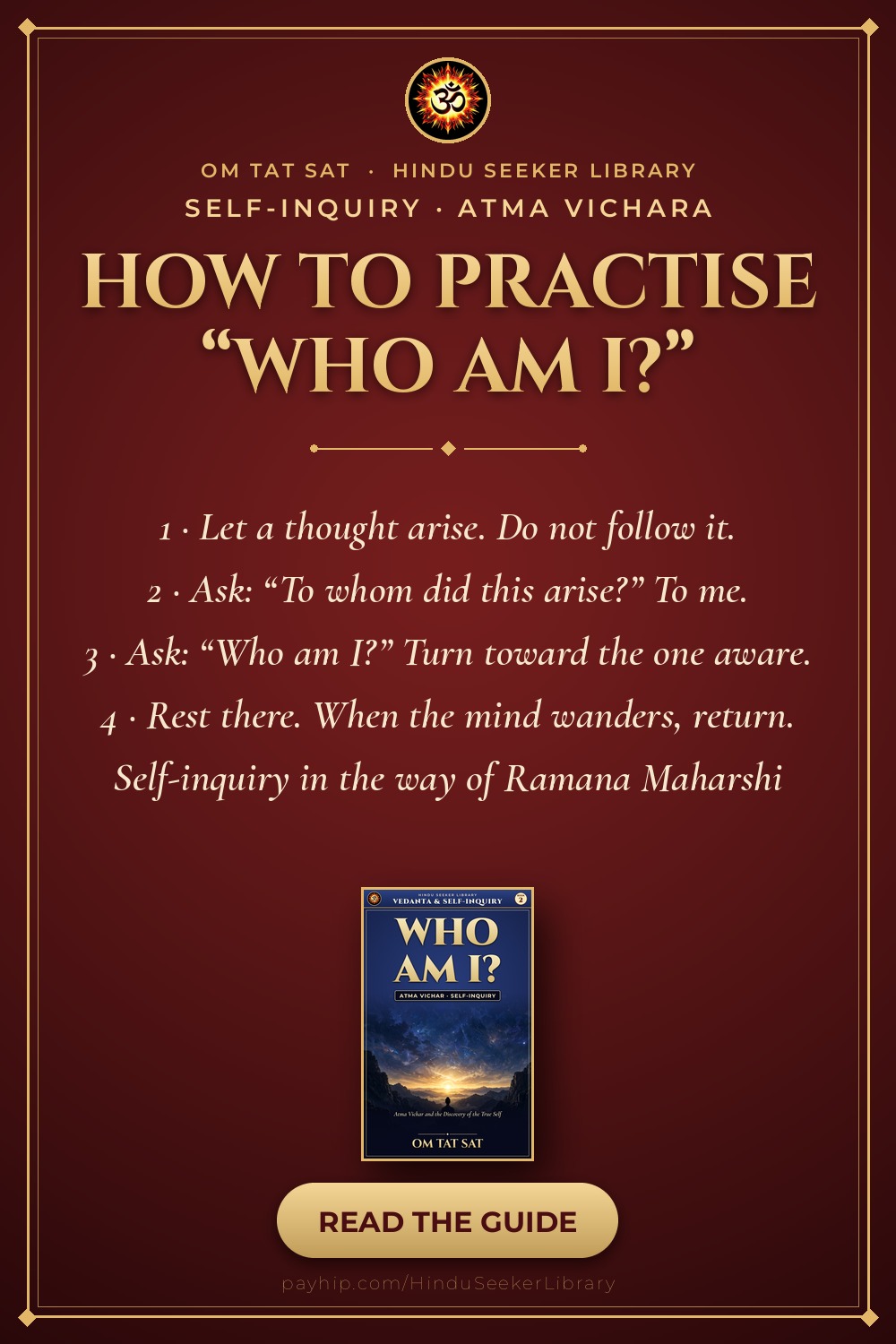
Self-inquiry (ātma-vicāra) is the practice of turning attention back to the sense of "I" and asking "Who am I?" until the false identification with body and mind falls away and the Self, pure awareness, is recognised. It was made famous in modern times by Sri Ramana Maharshi (1879–1950), but its roots are in the Upanishads. The practice is simple: whenever a thought arises, do not follow it; ask "To whom did this arise?", and let the attention rest on the one who is aware.
Who was Ramana Maharshi?
Ramana Maharshi was born in Tamil Nadu in 1879. At about sixteen, in Madurai, he went through a sudden, vivid experience of facing death: he lay down, let the body go still as a corpse, and asked what it was that dies. He discovered a presence, an "I", that the death of the body did not touch. Weeks later he left home for the holy hill of Arunachala in Tiruvannamalai, where he lived for the rest of his life.
His earliest teaching, Nāṉ Yār? (Who Am I?), grew out of questions put to him around 1902 by an early devotee, Sivaprakasam Pillai. Ramana was then mostly silent and answered many of them in writing. Those answers, later arranged as a short essay, remain one of the clearest manuals of self-inquiry ever written.
What does "Who am I?" really mean?
It is not a request for a description ("I am a teacher, a mother, an anxious person"). Every such answer describes something you can observe: a body, a role, a mood, a memory. Whatever you can observe is an object. The question points to the one observing, the subject that never becomes an object.
The Upanishads call this the Ātman, the Self:
अणोरणीयान्महतो महीयानात्माऽस्य जन्तोर्निहितो गुहायाम् ।
aṇor aṇīyān mahato mahīyān ātmāsya jantor nihito guhāyām
"Subtler than the subtlest, greater than the greatest, the Self is hidden in the heart of every creature." (Kaṭha Upaniṣad 1.2.20)
How do you practise self-inquiry? Seven simple steps
- Sit comfortably for ten minutes. Upright and still helps, but no special posture is required.
- Let thoughts come. Do not try to stop them. Wait for the next one; it will not keep you waiting long.
- Do not follow it. When a thought appears ("I need to answer that email"), do not ride it outward.
- Ask, once and sincerely: "To whom did this thought arise?" The honest answer is: "To me."
- Then ask: "Who am I?" Not to get a verbal answer, but to turn the attention back toward the sense of "I" itself.
- Rest there. Notice what remains when you are not busy with objects: a quiet, open awareness. Do not name it or try to hold it.
- When the mind wanders, repeat. Each return is the practice. Ramana compared the question to the stick used to stir a funeral pyre: it burns up the other thoughts and, in the end, is consumed itself.
(Our paraphrase of Ramana's teaching in Nāṉ Yār?)
What is "neti neti"?
The Upanishads give a second, complementary method:
अथात आदेशो नेति नेति ।
athāta ādeśo neti neti
"Now, therefore, the teaching: 'Not this, not this.'" (Bṛhadāraṇyaka Upaniṣad 2.3.6)
Neti neti means setting aside everything that is seen. I am aware of my body, so I am not merely the body. I am aware of my thoughts, so I am not merely the thoughts. I am aware of my emotions and memories, so I am not merely those. What is left when everything observable has been set aside cannot be set aside, because it is the one doing the setting aside. That is the Witness (sākṣī).
Neti neti clears the ground; "Who am I?" turns you to face what remains.
What do "Aham Brahmasmi" and "Tat Tvam Asi" mean?
These are two of the mahāvākyas, the "great sayings" of the Upanishads, which describe what self-inquiry reveals:
अहं ब्रह्मास्मि ।
ahaṃ brahmāsmi
"I am Brahman." (Bṛhadāraṇyaka Upaniṣad 1.4.10)
तत्त्वमसि ।
tat tvam asi
"That you are." (Chāndogya Upaniṣad 6.8.7)
They do not mean that the small, personal "me" is God. They mean that the awareness at your core, stripped of every limitation, is one with the infinite reality, Brahman. The ego does not become divine; it is seen through.
What are the common mistakes in self-inquiry?
- Chanting the question like a mantra. Repeating "who am I, who am I" keeps the mind busy. Ask once, sincerely, and follow where it points.
- Answering with philosophy. "I am the Atman" is true, but in practice it is just another thought. Rest in the not-knowing.
- Turning it into psychoanalysis. Inquiry does not ask why you feel as you do; it asks who feels.
- Expecting fireworks. What is found is usually quiet and ordinary-seeming, which is why it is so easily overlooked.
- Forcing. Effort is needed, but gentle effort. The Gita's advice applies: the restless mind is held "through practice and dispassion" (abhyāsena tu kaunteya vairāgyeṇa ca gṛhyate, 6.35).
What happens as the practice deepens?
At first the question feels like a mental exercise. With regular practice, three changes are commonly described. Thoughts lose their grip: they still come, but you notice them sooner and follow them less. A background of quiet appears: the awareness you turn toward begins to feel present even in the middle of the day, behind conversations and work. The sense of "I" softens: reactions that once felt personal ("they insulted me") are seen more lightly, because the one who was insulted is no longer so solid. None of this needs to be forced or measured. The Kaṭha Upaniṣad says the Self is seen "through the clarity of mind and senses" (dhātu-prasādāt). Clarity grows by itself when you keep turning.
Is self-inquiry compatible with devotion?
Yes. Ramana himself said that self-inquiry and surrender lead to the same place: either find out who you are, or surrender completely, and the ego dissolves either way. Many seekers chant in the morning and practise inquiry in the evening. Adi Shankaracharya, the great teacher of Advaita, also composed some of the most moving devotional hymns in Sanskrit, such as Bhaja Govindam.
A 21-day self-inquiry plan
- Days 1–7: five minutes daily. Notice the next thought; ask "To whom?"; rest.
- Days 8–14: ten minutes daily, plus three one-breath "Who am I?" pauses during the day: before eating, before opening your phone, before sleep.
- Days 15–21: fifteen minutes daily. Add neti neti before the inquiry: body, breath, thoughts, emotions, each noticed and set aside.
Keep a one-line journal: "Today, the clearest moment was…"
Frequently asked questions
How long should I practise? Start with five to ten minutes. Ramana encouraged inquiry throughout the day, not only in formal sitting.
Do I need a guru? A teacher helps, and the tradition values grace highly. But the question itself is open to anyone, now.
Is it the same as mindfulness? Mindfulness watches the contents of experience. Self-inquiry turns to the one who watches.
Can it be unsettling? Sometimes. If you are going through serious emotional difficulty, practise gently and seek support from a qualified professional alongside your spiritual practice.
Which Upanishads teach self-inquiry? The Bṛhadāraṇyaka, Chāndogya, Kaṭha and Māṇḍūkya are the classic sources.
Go deeper. Who Am I? Atma Vichar is a step-by-step guide to self-inquiry: the masks of "I", the Witness, neti neti, the Atman in the Upanishads, Aham Brahmasmi, and a practical method you can use daily: https://payhip.com/b/1NwDL
Free Vedanta ebook. The Ever-Shining Self: the Hastamalaka Stotram, a gem of the Advaita tradition, with meaning and commentary: https://payhip.com/b/KxYAC
More on the one Self. The Elephant Nobody Sees: one truth, many paths: https://payhip.com/b/UxY3Q · Bhaja Govindam Meaning (free): https://payhip.com/b/DbzId
A free daily practice. The 11-Minute Daily Mantra Practice: https://payhip.com/b/R23E6
Om Tat Sat · Hindu Seeker Library