

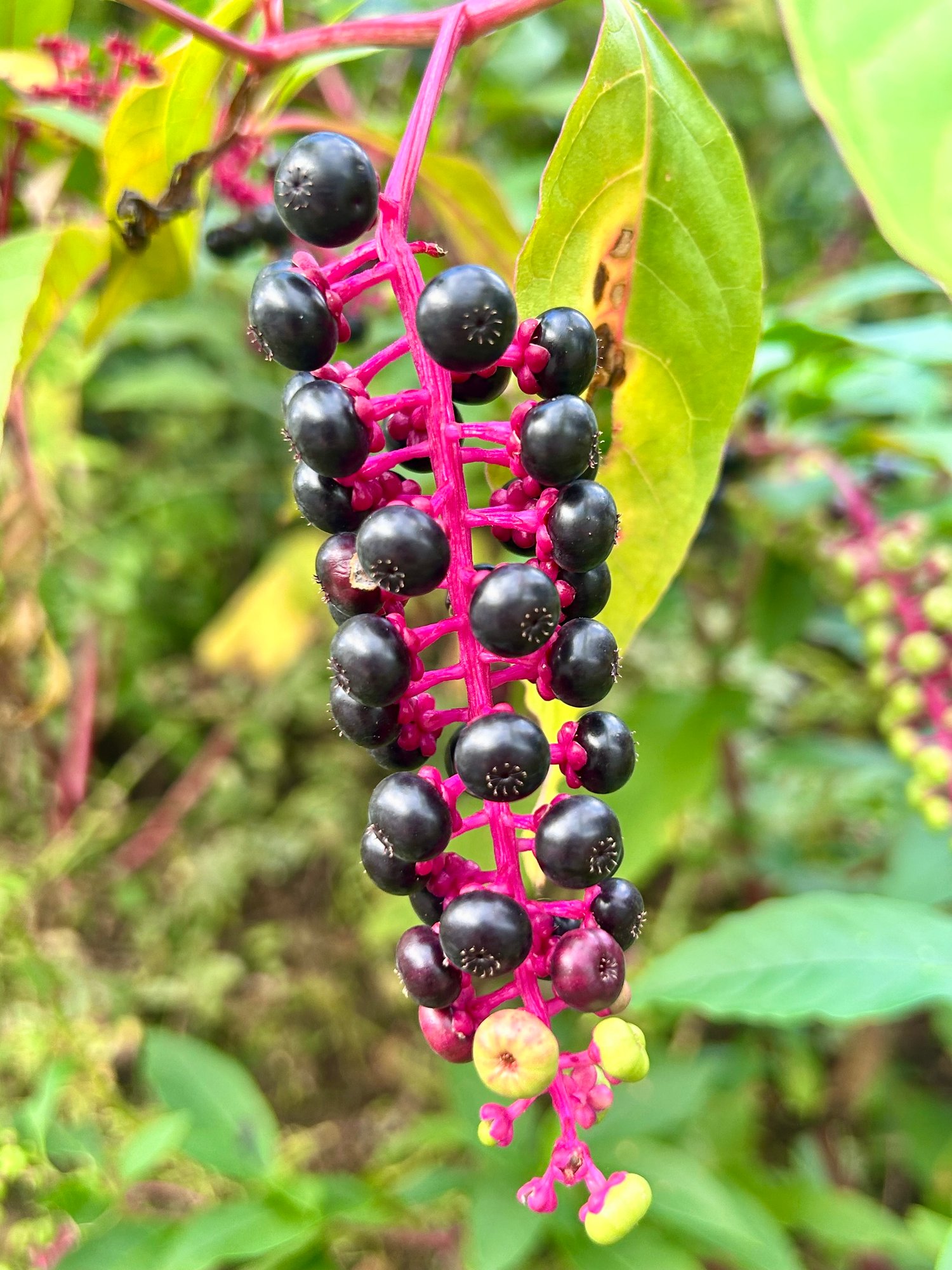
Walk along the edge of a woodland, an old field, or a country road in late summer and you may spot a striking plant standing several feet tall, with reddish-purple stems and clusters of glossy, deep-purple berries.
This is American pokeweed (Phytolacca americana).
Most people who recognize pokeweed have probably heard one warning:
“Don’t eat it. It’s poisonous.”
That warning has an important basis in fact. American pokeweed contains compounds capable of causing significant poisoning, particularly when the plant is eaten raw or improperly prepared. The root is especially dangerous.
But that isn't the whole story.
Pokeweed is also a fascinating example of something herbalism teaches us again and again: a plant can be medicinally interesting and toxic at the same time.
For generations, pokeweed has appeared in traditional foodways and folk medicine. Modern researchers have also identified numerous biologically active compounds in Phytolacca species and are investigating their pharmacological potential.
So rather than asking, “Is pokeweed poisonous or medicinal?” perhaps the better question is:
How can it be both?
Meet American Pokeweed
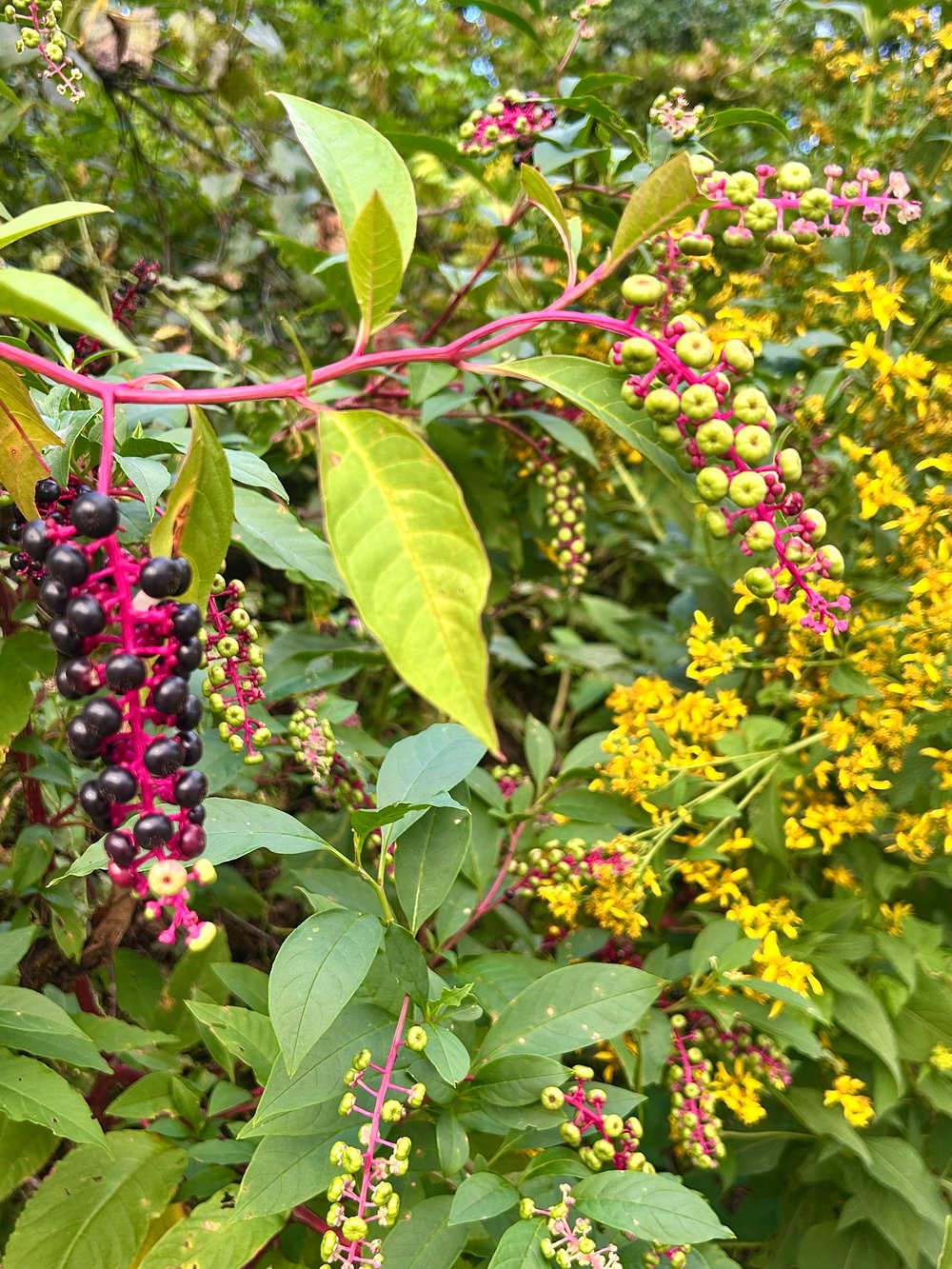
American pokeweed is a large perennial plant native to North America and especially familiar throughout the eastern United States.
A mature plant may reach roughly 4–10 feet tall and can be recognized by:
- Large, smooth green leaves
- Thick stems that often become reddish or purple
- Small greenish-white flowers
- Hanging clusters of berries
- Berries that mature from green into a striking dark purple-black
- A large underground taproot
Historically, pokeweed has had many names, including poke, pokeberry, inkberry, pigeonberry, poke salad, and poke sallet.
And humans have found an impressive number of uses for it. Pokeweed has historically been used as food, folk medicine, dye, ink, and more.
Yes—Pokeweed Really Is Toxic
This is where herbal education needs to be responsible. Calling pokeweed poisonous isn't simply modern fearmongering. The plant genuinely contains toxic constituents.
Pokeweed contains several biologically active compounds, including triterpenoids and triterpenoid saponins. Poisoning can cause severe gastrointestinal irritation.
Symptoms reported after pokeweed ingestion include:
- Nausea
- Vomiting
- Abdominal cramping
- Diarrhea
- Weakness
- Rapid heart rate
- Low blood pressure
More serious poisoning can produce bloody diarrhea, breathing difficulties, muscle spasms, seizures, and other dangerous complications.
All portions of the plant should therefore be treated cautiously, and the root is particularly hazardous. This is not an herb to casually turn into a tea, tincture, smoothie, or homemade supplement.
But “Toxic” Doesn't Mean “Medicinally Worthless”
Here's where pokeweed becomes fascinating. In herbalism, the categories toxic and medicinal aren't necessarily opposites. A plant may contain powerful compounds that affect human physiology while also having a very narrow margin between a biologically active amount and a harmful one.
That distinction matters.
Modern scientific reviews of Phytolacca plants have identified compounds including:
- Triterpenoids
- Triterpenoid saponins
- Polysaccharides
- Flavonoids
- Antiviral proteins
- Other phytochemicals
Laboratory and preclinical research has reported anti-inflammatory, antimicrobial, antifungal, antiviral and other biological activities associated with compounds or extracts from Phytolacca species. That makes pokeweed scientifically interesting.
But there is an enormous difference between saying:
“This plant contains compounds with pharmacological activity.”
and saying:
“Eating this plant will treat disease.”
The first statement has scientific support.
The second generally does not.
Much of the research remains laboratory, animal, phytochemical, or traditional-medicine research rather than high-quality human clinical evidence.
Pokeweed's Long History in Traditional Medicine
Long before modern laboratories began isolating pokeweed compounds, people were experimenting with the plant medicinally.
Various pokeweed preparations have appeared in traditional practices for conditions involving inflammation, swollen tissues, infections and other complaints.
The plant also developed a reputation in some American folk traditions as a powerful “spring tonic.” That history shouldn't automatically be dismissed—but neither should traditional use automatically be interpreted as proof of safety or effectiveness.
Traditional herbal knowledge often developed through generations of observation and experimentation. Sometimes modern research eventually supports portions of that knowledge. Other times it reveals risks our ancestors couldn't scientifically measure.
Both pieces of information matter.
The Famous Southern Tradition of “Poke Sallet”
Pokeweed also occupies an unusual place in Southern Appalachian and rural Southern food history. For generations, people harvested very young pokeweed shoots and leaves in early spring and prepared a dish commonly called poke sallet.
The plant wasn't simply picked and eaten raw.
Traditional preparation involved repeatedly boiling the young greens, discarding the cooking water, and cooking them again.
That tradition tells us something important:
The people who ate pokeweed traditionally also understood that the plant required special handling.
Modern poison-control authorities still caution against eating pokeweed because toxin concentrations can vary and home preparation cannot guarantee that a finished dish is safe.
So poke sallet is worth appreciating as part of American ethnobotanical history without treating it as a DIY wild-food recommendation.
The Root Is an Entirely Different Matter
One of the biggest mistakes someone could make is assuming that because young leaves were historically prepared as food, the entire plant can be treated similarly.
It cannot.
Pokeweed root should not be eaten.
Serious poisonings have occurred after people consumed the root, including cases in which pokeweed was mistaken for another medicinal root.
This is especially important for herbalists and foragers because pokeweed develops an enormous, substantial taproot that can look exactly like the sort of root someone might assume belongs in an herbal preparation.
With pokeweed, identification alone isn't enough. Knowing which plant part you're dealing with matters tremendously.
What Modern Research Is Finding
Scientific interest in the Phytolacca genus continues because these plants contain an unusually diverse collection of active constituents.
Researchers have reported pharmacological activity involving inflammation, microorganisms and other biological processes.
Pokeweed-derived proteins have also attracted scientific attention.
But this is where responsible herbal education separates promising research from proven medicine.
For example, laboratory studies suggesting that pokeweed constituents affect viruses, fungi, inflammatory pathways or tumor cells do not mean that drinking pokeweed tea will safely treat viral infections, inflammatory diseases or cancer.
In fact, clinical evidence supporting many popular medicinal claims remains inadequate.
Sometimes the medicinal future of a toxic plant isn't eating the plant itself.
Instead, scientists may identify a useful molecule within that plant, study how it works, determine an appropriate dose, modify it, isolate it, or potentially develop a safer therapeutic compound from it. That process is very different from home herbalism.
Poison and Medicine Have Always Shared a Border
Pokeweed gives us a wonderful opportunity to rethink one of the biggest misconceptions surrounding medicinal plants.
Natural does not automatically mean gentle.
Some plants primarily nourish us.
Some plants gently support normal physiological processes.
And some contain extremely powerful chemicals capable of dramatically affecting the human body.
Those plants demand far greater respect.
The fact that a plant can cause poisoning does not erase its ethnobotanical history or its pharmacological potential. But its medicinal history doesn't erase its toxicity either.
Both truths can exist at once.
A Plant to Study Rather Than Experiment With
For the home herbalist, American pokeweed may be best approached as a plant to learn from rather than a plant to casually consume.
Study its identification.
Learn its history.
Explore how Indigenous, Appalachian and Southern plant traditions interacted with powerful native plants.
Learn about its phytochemistry.
Watch how wildlife interacts with its berries.
And appreciate the extraordinary chemistry growing quietly along woodland edges and roadsides. But don't allow curiosity about traditional medicine to turn into casual experimentation with pokeweed preparations.
Because potency deserves respect.
The Bigger Herbal Lesson
American pokeweed challenges the simplistic idea that plants belong in only two categories:
“good medicinal herb” or “bad poisonous weed.”
Nature is far more complicated.
Pokeweed is toxic.
Pokeweed has been used medicinally.
Pokeweed contains compounds with genuine biological activity.
Scientists continue to investigate those compounds. And none of those statements contradict one another.
Perhaps that's the most valuable lesson this dramatic purple plant has to teach us:
Herbal wisdom isn't about believing that every plant is harmless. It's about learning enough about plants to respect both their healing potential and their power to cause harm.
Safety Note
American pokeweed (Phytolacca americana) is a toxic plant and should not be self-prescribed internally. Poison-control and medical sources advise against consuming pokeweed because serious poisoning can occur. The root is particularly dangerous. If pokeweed is accidentally ingested and poisoning is suspected, contact Poison Control in the United States at 1-800-222-1222.
This article is for educational and ethnobotanical purposes and is not intended as instructions for preparing or using pokeweed medicinally.
Comments ()