

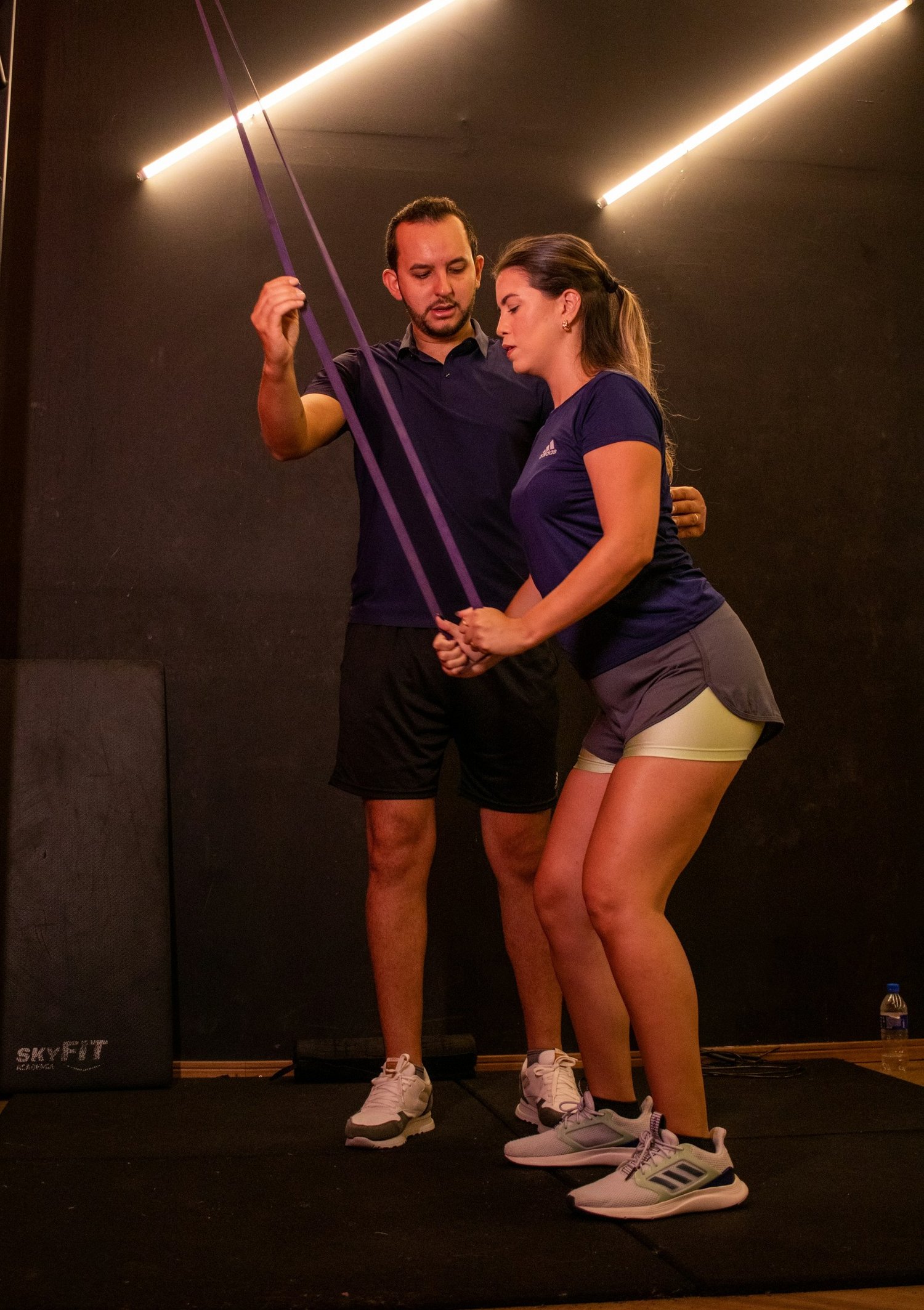
Lifting heavier doesn't always mean you're getting stronger. Sometimes, the greatest progress comes from learning how to lift better.
Walk into almost any gym, and you'll see people challenging themselves with heavier dumbbells, loaded barbells, and increasingly demanding exercises. While progressive overload is essential for building strength and muscle, there's one important principle that should never be overlooked: proper form comes before heavier weight.
It's easy to become focused on how much weight you're lifting, especially when you're eager to see results. However, strength training isn't simply about moving weight from one position to another. It's about teaching your muscles, joints, and nervous system to work together efficiently.
When you prioritize proper technique, you're not just improving your workouts. You're building the foundation for better movement, long-term joint health, greater muscular development, and sustainable progress.
Let's explore why proper form matters, how poor technique can interfere with your results, and what you can do to become stronger without unnecessarily increasing your risk of injury.
What Is Proper Form in Weight Training?
Proper form refers to the technique, positioning, coordination, and control used to perform an exercise effectively.
Every exercise has specific movement requirements designed to challenge particular muscle groups. Proper technique helps you direct the intended training stimulus toward those muscles while managing the forces placed on your joints and connective tissues.
For example, during a Romanian deadlift, the goal is to strengthen your glutes and hamstrings through a controlled hip-hinge movement. If you repeatedly bend through your lower back instead of moving primarily through your hips, you may place unnecessary demands on your spinal muscles and reduce the effectiveness of the exercise.
Similarly, during a squat, your hips, knees, and ankles should work together to support the movement. The goal isn't to force everyone into one identical squat position, but to find a technique that accommodates individual anatomy, mobility, and strength.
Good form isn't about looking perfect. It's about moving with intention, control, and efficiency.
Why Proper Form Matters More Than the Number on the Weight
One of the most common misconceptions in strength training is that lifting heavier automatically produces better results.
Although increasing resistance is an important part of progressive overload, the weight must remain appropriate for your current strength and technical ability.
When a load becomes too heavy to control, you may begin compensating by using momentum, shortening your range of motion, or changing your body position to complete the repetition. These adjustments aren't always dangerous. Experienced lifters sometimes use deliberate variations in technique for specific training purposes. However, consistently losing control of your movement can reduce training effectiveness and increase unnecessary stress on certain tissues.
Prioritizing proper form helps you:
- Improve muscle recruitment: Better positioning and control can help you challenge the intended muscles more effectively.
- Manage joint stress: Appropriate technique helps distribute forces across muscles and joints.
- Develop coordination: Your nervous system becomes more efficient at organizing movement.
- Improve exercise consistency: Repeating movements with similar technique makes it easier to measure progress.
- Build long-term confidence: Understanding how to perform exercises correctly makes increasing resistance less intimidating.
The objective isn't to avoid heavy lifting. It's to develop the skill and strength necessary to lift challenging weights effectively.
Your Nervous System Plays a Major Role in Strength
Muscles don't work independently. Every movement begins with communication between your brain, spinal cord, nerves, and muscle fibers. When you begin strength training, some of your earliest improvements come from neurological adaptations rather than noticeable muscle growth. Your nervous system becomes better at recruiting motor units, coordinating muscle contractions, and producing force during specific movements. This explains why beginners can become significantly stronger during their first several weeks of training without experiencing dramatic changes in muscle size.
Practicing exercises with consistent technique helps reinforce these adaptations. Think about learning to drive a car. Initially, steering, braking, checking mirrors, and monitoring traffic require considerable concentration. With practice, those actions become more coordinated and automatic. Strength training works similarly. As movement patterns become familiar, your body can perform them more efficiently.
The better you become at controlling a movement, the more effectively you can develop strength within that movement.
Common Weight Training Mistakes That Can Increase Injury Risk
Even experienced gym-goers occasionally develop habits that interfere with their technique. Recognizing these patterns early can help you make adjustments before they become persistent problems.
1. Using Momentum Instead of Muscle Control
Swinging dumbbells during bicep curls or bouncing through repetitions may allow you to move heavier weights, but it can also reduce the amount of work performed by the intended muscles.
How to correct it: Choose a manageable weight and control both the lifting and lowering portions of the exercise. Momentum isn't inherently wrong in every exercise, but it should be intentional rather than a substitute for control.
2. Sacrificing Range of Motion for Heavier Weights
Partial repetitions can be useful when programmed intentionally. However, unintentionally shortening your range of motion just to lift heavier may limit the strength you develop through the rest of the movement.
How to correct it: Work through the greatest comfortable range of motion you can control while maintaining appropriate technique.
3. Ignoring Core Stability
Your core helps stabilize your trunk and transfer force between your upper and lower body.
During exercises such as squats, deadlifts, rows, and overhead presses, inadequate trunk control may make the movement less efficient.
How to correct it: Practice bracing your abdominal muscles while maintaining an appropriate breathing strategy. For heavier lifts, a brief, deliberate brace may be useful, while lighter exercises often allow more continuous breathing.
4. Moving Too Quickly Through Repetitions
Rushing through exercises can make it difficult to recognize changes in positioning or control.
How to correct it: Use a deliberate tempo, particularly during the lowering phase. Not every repetition needs to be slow, but you should remain in control of the weight.
5. Continuing to Lift After Technique Breaks Down
Muscle fatigue is a normal and necessary part of challenging resistance training. However, significant deterioration in technique can indicate that you've reached your current limit for that exercise.
How to correct it: End the set when you can no longer perform another repetition with acceptable control, or reduce the weight to maintain the intended technique.
The Mind–Muscle Connection: Why Awareness Matters
Have you ever completed an exercise and realized you barely felt the muscle you were trying to train?
For example, you might perform glute bridges but feel most of the effort in your hamstrings, or complete rows while primarily noticing tension in your arms.
This is where the mind–muscle connection can be helpful. The mind–muscle connection refers to consciously directing your attention toward the muscles involved in an exercise.
Research suggests that focusing internally on a target muscle can increase its activation during certain exercises. However, greater activation doesn't automatically guarantee greater muscle growth, and focusing on the movement itself can sometimes be more useful for strength and athletic performance. A practical approach is to use both strategies.
During a glute bridge, for example, concentrate on extending your hips and contracting your glutes without excessively arching your lower back. During a squat, focus on maintaining balance and moving smoothly through your hips, knees, and ankles.
Remember that not feeling a muscle intensely doesn't necessarily mean it isn't working. Muscle soreness, burning sensations, and the feeling of a pump are not required for an effective workout.
How Proper Form Supports Muscle Growth
Building muscle requires sufficient mechanical tension, progressive training, adequate nutrition, and recovery. Proper technique helps you apply that tension consistently to the muscles you're trying to develop.
Consider two people performing dumbbell shoulder presses. The first person uses weights that are too heavy, repeatedly arches their lower back, and struggles to control the movement. The second person uses slightly lighter dumbbells, maintains appropriate trunk stability, and completes controlled repetitions through a comfortable range of motion.
Although the first person is moving more weight, the second may be providing a more consistent training stimulus to the intended muscles.
Over time, the second person can progressively increase resistance while maintaining that technique.
This is the foundation of sustainable muscle development.
Progressive Overload: When Should You Increase the Weight?
Prioritizing form doesn't mean lifting light weights forever. In fact, challenging your muscles is essential for continued progress.
Progressive overload means gradually increasing the demands placed on your muscles as they adapt. You can accomplish this by increasing resistance, performing additional repetitions, improving range of motion, or gradually increasing training volume.
One beginner-friendly strategy is called double progression.
Suppose your program calls for three sets of 8–12 repetitions of goblet squats. Start with a weight you can lift for eight controlled repetitions. Over the following workouts, gradually work toward performing 12 repetitions in all three sets.
Once you can complete those repetitions with consistent technique and still have approximately one or two good repetitions left in reserve, consider increasing the weight slightly. You can then return to the lower end of the repetition range and repeat the process. This allows your muscles and movement skills to develop together rather than forcing progress before you're ready.
Practical Tips for Improving Your Lifting Technique
You don't need to become a fitness professional to improve your form. Small adjustments can make a meaningful difference.
Start with lighter practice sets. Before performing your working sets, complete a few repetitions with lighter resistance to become familiar with the movement.
Record yourself occasionally. Watching your technique from the side or at an angle can help you identify changes in posture, range of motion, and control that you may not notice while lifting.
Use mirrors thoughtfully. Mirrors can provide visual feedback, but avoid twisting your neck or changing your natural movement just to watch yourself.
Learn the purpose of each exercise. Understanding which joints should move and which muscles are being challenged makes it easier to recognize when something feels different.
Don't confuse discomfort with progress. Muscular effort and fatigue are expected during challenging workouts. Sharp pain, sudden joint discomfort, numbness, or persistent pain should not be ignored. Stop the movement and seek appropriate professional evaluation when necessary.
Be patient with the learning process. Strength training is a skill. Your technique will improve with practice, feedback, and experience.
A Simple Form-First Beginner Workout
If you're new to resistance training, try this foundational full-body routine two or three nonconsecutive days per week.
1. Goblet Squats
Sets: 2–3
Repetitions: 8–12
Strengthens your quadriceps, glutes, and core while improving lower-body stability and squat mechanics.
2. Dumbbell Romanian Deadlifts
Sets: 2–3
Repetitions: 8–12
Targets your hamstrings and glutes while teaching proper hip-hinge mechanics and strengthening your posterior chain.
3. Incline Push-Ups
Sets: 2
Repetitions: 8–12
Builds upper-body strength by targeting your chest, shoulders, and triceps while engaging your core.
4. Seated Cable Rows
Sets: 2–3
Repetitions: 10–12
Strengthens your back and arms while supporting better posture and upper-body stability.
5. Glute Bridges
Sets: 2–3
Repetitions: 10–15
Strengthens your glutes, supports hip extension, and helps improve pelvic stability.
6. Farmer Carries
Sets: 2
Duration: 20–30 seconds
Develops grip strength, core stability, and functional strength for everyday activities.
Beginner Training Tips
Begin with a five-minute warm-up and a few lighter practice repetitions. Rest approximately 60–120 seconds between sets, or longer when needed. Choose weights that challenge your muscles without compromising your technique. As your strength and coordination improve, gradually increase resistance.
Remember: The goal isn't to lift the heaviest weight possible. It's to build strength through proper form, consistency, and controlled progression.
Begin with a five-minute warm-up and a few practice repetitions of your first exercises. Rest approximately 60–120 seconds between sets, or longer if needed to maintain good technique. Choose weights that feel moderately challenging without forcing you to sacrifice control. As your strength improves, gradually increase resistance.
The goal isn't to leave the gym completely exhausted. It's to build a foundation that allows you to return stronger and more confident for your next workout.
Why Proper Form Becomes Even More Important as We Age
Strength training is one of the most valuable habits you can develop for healthy aging. As we get older, maintaining muscle mass, balance, bone health, and functional movement becomes increasingly important.
Learning effective lifting mechanics can help you continue training consistently while adapting exercises to your changing needs. And that matters because strength isn't just about what happens inside the gym. It's about being able to lift your luggage, carry groceries, climb stairs, enjoy outdoor activities, and maintain your independence throughout life.
Proper form helps make those activities more manageable by developing strength that translates into everyday movement.
Final Thoughts: Train Smarter, Grow Stronger
Building real strength requires more than determination. It requires patience, consistency, and a willingness to master the fundamentals. There's nothing wrong with wanting to lift heavier. In fact, increasing your strength is something worth celebrating!
But the weight on the barbell should never become more important than the quality of the movement. When you prioritize proper form, you create the foundation for greater strength, more effective muscle development, improved coordination, and a more sustainable fitness journey.
Don't rush to lift more weight. Build the ability to lift it well. Your future body will thank you.
Your Next Step Toward Stronger, Smarter Training
At Holistify Me, I believe fitness should empower your body, not wear it down. Building strength isn't about competing with the person lifting beside you or chasing numbers at the expense of your health. It's about understanding your body, respecting its capabilities, and challenging yourself in ways that support long-term wellness.
That's why my holistic approach to fitness emphasizes proper movement mechanics, progressive strength training, mobility, recovery, and nutrition as interconnected parts of a healthier lifestyle.
If you're ready to stop guessing your way through workouts and begin building strength with greater confidence and purpose, explore the Holistify Me Strength-Training Program and discover how intentional movement can support your fitness journey.
Because the strongest version of yourself isn't built by rushing the process. It's built one intentional repetition at a time.
— Crystal
Holistify Me
Comments ()