

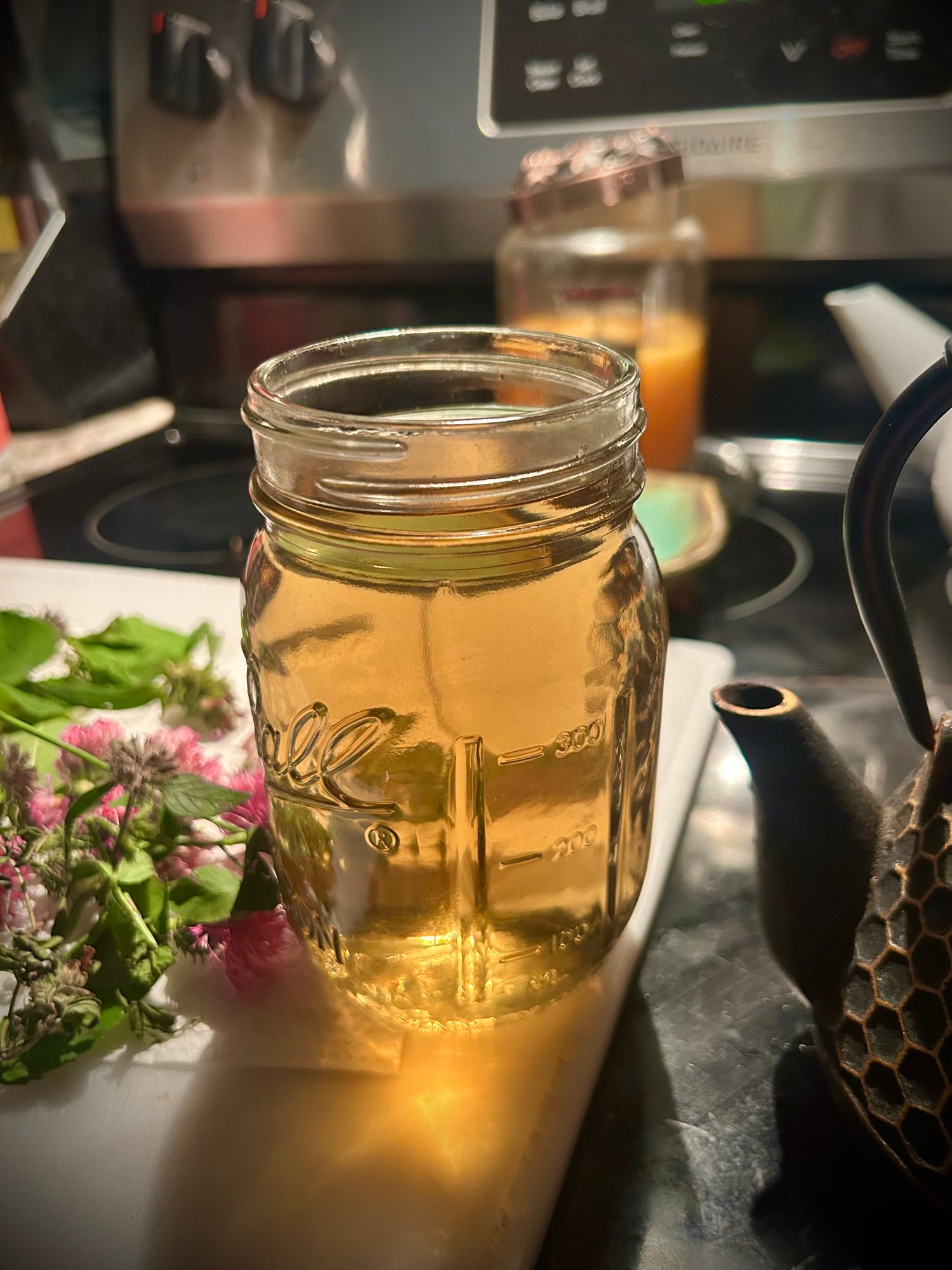
There is something deeply satisfying about recognizing a plant growing in the wild, learning its story, harvesting it responsibly, and eventually sitting down with a warm cup of tea made from herbs you gathered yourself.
On a recent foraging adventure, I brought home several herbs to create a fresh herbal infusion: red clover, heal-all, wild bergamot (bee balm), wild basil, and lesser burdock.
Each plant brings something different to the blend—not only in flavor and aroma, but also through its long history of traditional herbal use.
Let’s take a closer look at what’s in my cup. 🌿
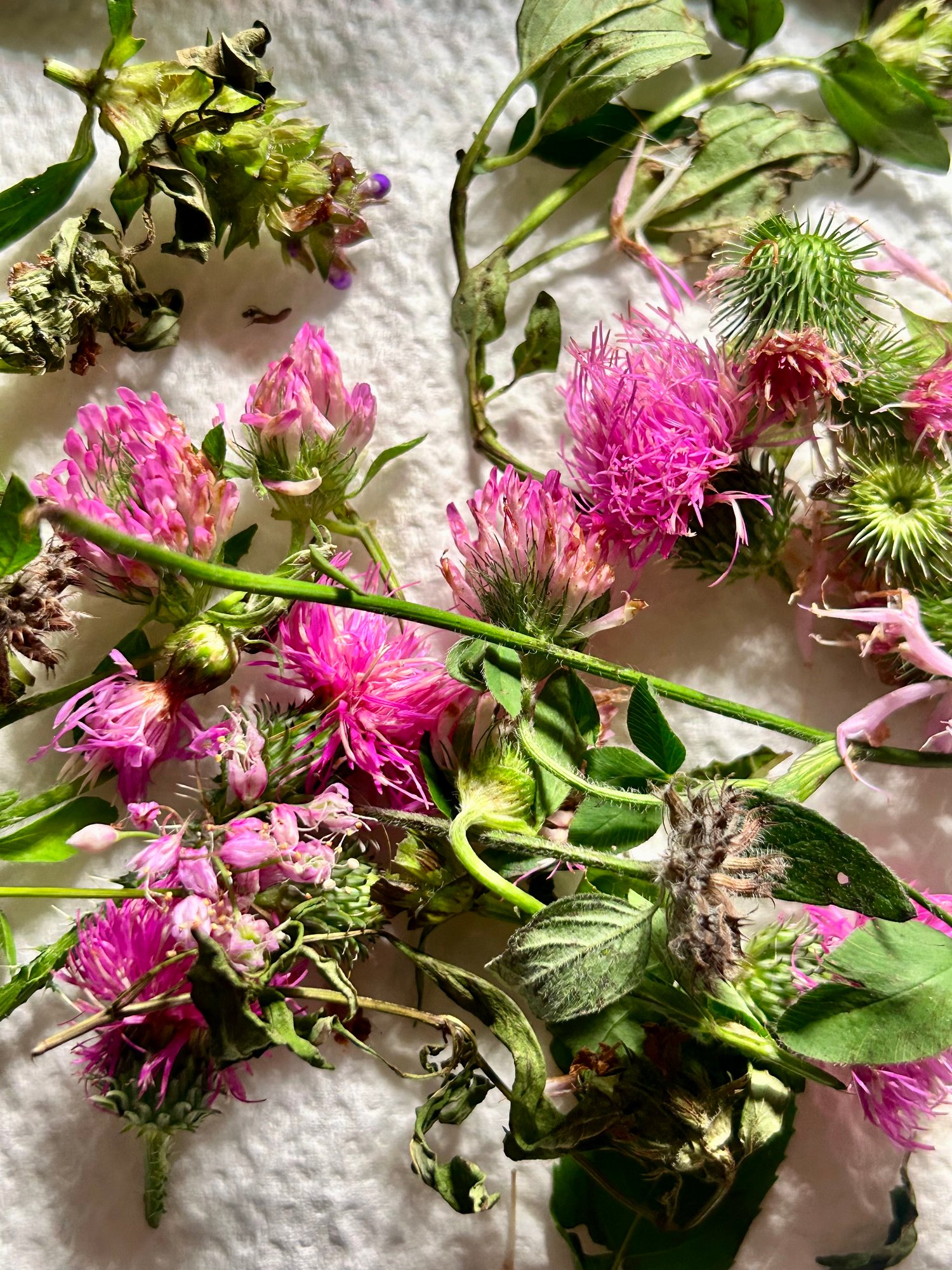
🌸 Red Clover (Trifolium pratense)
Those beautiful pinkish-purple blossoms are more than just pretty wildflowers.
Red clover has a long history as a nourishing herb and is particularly well known in herbalism for women’s wellness. It naturally contains compounds called isoflavones, a type of phytoestrogen that has structural similarities to estrogen produced by the human body.
Because of this, red clover has been studied for its potential role in supporting:
- Menopausal comfort, including hot flashes
- Bone health
- Cardiovascular health
- Healthy cholesterol levels
- Skin health
It has also traditionally been used for respiratory and lymphatic support.
For tea, the fresh flower heads and tender leaves can be infused. I always inspect wild blossoms carefully for insects and avoid flowers that are brown, damaged, or showing any signs of mold.
Because red clover contains phytoestrogens and may interact with certain medications, it isn't appropriate for everyone—particularly those with certain hormone-sensitive conditions or taking anticoagulant medications.
💜 Heal-All (Prunella vulgaris)
There is a reason this little purple-flowered herb earned names such as heal-all and self-heal.
Prunella vulgaris has been used in traditional herbal systems for centuries. It contains a variety of naturally occurring plant compounds, including flavonoids, tannins and phenolic compounds that continue to interest researchers.
Traditionally, heal-all has been associated with:
- Throat and respiratory comfort
- Immune support
- Wound and skin care
- Digestive wellness
- Supporting the body's normal inflammatory response
Fresh leaves, stems and flowering tops can all be used for an infusion.
Its mild herbal character also makes heal-all a nice companion to stronger aromatic herbs rather than completely dominating the flavor of the tea.
🌸 Wild Bergamot / Bee Balm (Monarda)
If you've ever crushed a bee balm leaf between your fingers, you probably understand immediately why I love adding it to tea.
That incredible fragrance comes from its aromatic volatile compounds. Depending on the Monarda species and chemotype, these can include compounds such as thymol and carvacrol.
Traditionally, Monarda has been used for:
- Digestive comfort
- Gas and occasional bloating
- Respiratory comfort
- Throat support
- General soothing herbal preparations
For fresh tea, I prefer the leaves and flowers. They're wonderfully aromatic and don't require drying before use.
Because many of the compounds responsible for bee balm's aroma are volatile, I like to cover the tea while it steeps rather than leaving the pot or mug uncovered.
That gorgeous aroma belongs in the cup—not floating away with the steam! 🌿
🌿 Wild Basil
Wild basil adds another aromatic dimension to the blend.
Plants commonly referred to as wild basil have traditionally been enjoyed as aromatic herbs, particularly in preparations intended to support digestion and general wellness.
Depending on the exact species, these plants can contain various aromatic and antioxidant plant compounds.
For an infusion, I prefer the fresh leaves and flowering portions rather than the tougher stems.
It pairs especially nicely with wild bergamot, giving the finished tea a much more fragrant character than you'd expect from looking at a handful of freshly gathered greenery.
🌿 Lesser Burdock (Arctium minus)
Burdock brings an entirely different personality to this blend.
Unlike the aromatic herbs above, burdock is traditionally valued primarily for its root.
In Western herbalism, burdock root has historically been used as a digestive and nutritive herb and is often associated with:
- Digestive support
- Healthy elimination
- Skin wellness
- Normal liver function
- Prebiotic support for the gut
Burdock root contains inulin, a type of prebiotic fiber that can serve as food for beneficial intestinal microorganisms.
However, preparation matters.
A delicate flower or leaf can surrender many of its constituents simply by sitting in hot water. A dense root needs more encouragement.
That's why I prefer preparing burdock root as a decoction rather than a simple infusion.
🍵 Infusion vs. Decoction: What's the Difference?
This is one of the most useful things to learn when beginning herbalism.
An infusion is essentially herbal tea: hot water is poured over delicate plant material such as leaves and flowers and allowed to steep.
A decoction is generally used for tougher materials such as roots and bark. The plant material is gently simmered in water for a longer period.
For this particular blend, I would prepare the burdock first.
Burdock root: Chop into small pieces and gently simmer in water for approximately 15–20 minutes.
Then remove the pot from the heat and add the fresh:
🌸 Red clover
💜 Heal-all
🌸 Wild bergamot
🌿 Wild basil
Cover and allow the herbs to steep for approximately 10–15 minutes, then strain.
The result is a combination of a burdock decoction and fresh-herb infusion in the same cup.
🌿 Do Fresh Herbs Need to Be Dried Before Making Tea?
No!
One of my favorite things about this particular blend is that most of these herbs can go practically from the forest to the teapot.
Drying herbs is incredibly useful because it removes moisture and allows properly dried herbs to be stored for future use. But drying isn't automatically required before making an herbal infusion.
Fresh herbs simply contain considerably more water than dried herbs, so you will generally need more fresh plant material to produce a similarly robust infusion.
Fresh wild bergamot in particular can make an incredibly aromatic cup.
🍵 What Does This Tea Ultimately Offer?
Rather than thinking of this concoction as a tea that "treats" a particular condition, I think it's much more useful to appreciate what each plant contributes.
Red clover brings nourishing phytoestrogen-containing plant compounds.
Heal-all contributes a long tradition of wellness use and antioxidant-rich phytochemistry.
Wild bergamot brings powerful aromatics and a history of digestive and respiratory use.
Wild basil contributes additional aromatic plant compounds and traditional digestive support.
And burdock root provides an earthy foundation along with its traditional digestive uses and naturally occurring prebiotic inulin.
Together, they create an herbal blend rooted in both traditional plant knowledge and the simple pleasure of interacting more intentionally with the natural world.
🍃 Foraging Has Changed the Way I See the Forest
Perhaps my favorite part of learning herbalism isn't any individual herb.
It's what happens when you begin recognizing them.
A patch of greenery stops simply being "weeds."
You notice the Monarda growing beside the trail.
You recognize the little purple flower of heal-all.
You spot red clover in an open field and know exactly what you're looking at.
The landscape becomes alive with individual plants, each with its own chemistry, ecology, history, traditional uses and relationship with the animals and people around it.
Foraging teaches you to actually see the forest instead of simply walking through it.
And sometimes, you get to bring a little bit of that experience home and put it in your teacup. 🌿🍵💚
⚠️ A Note About Wild Herbal Teas
Never consume a wild plant based solely on a common name, photograph, plant-identification app, or resemblance to another herb. Positive species identification is essential.
The medicinal traditions surrounding an herb also don't automatically establish that it is effective, appropriate, or safe for every person. Plant part, preparation, amount, medications, pregnancy or breastfeeding, allergies, and underlying health conditions can all affect safety.
When uncertain about the identity of a foraged plant, leave it out of the teapot.
This article is for educational purposes and is not intended to diagnose, treat, cure, or prevent disease.
Holistify Me, LLC | Holistic Health • Herbalism • Nutrition • Mind, Body & Soul
Comments ()