

There is something magical about walking through the forest and discovering an organism that looks as though it belongs in a fairy tale.
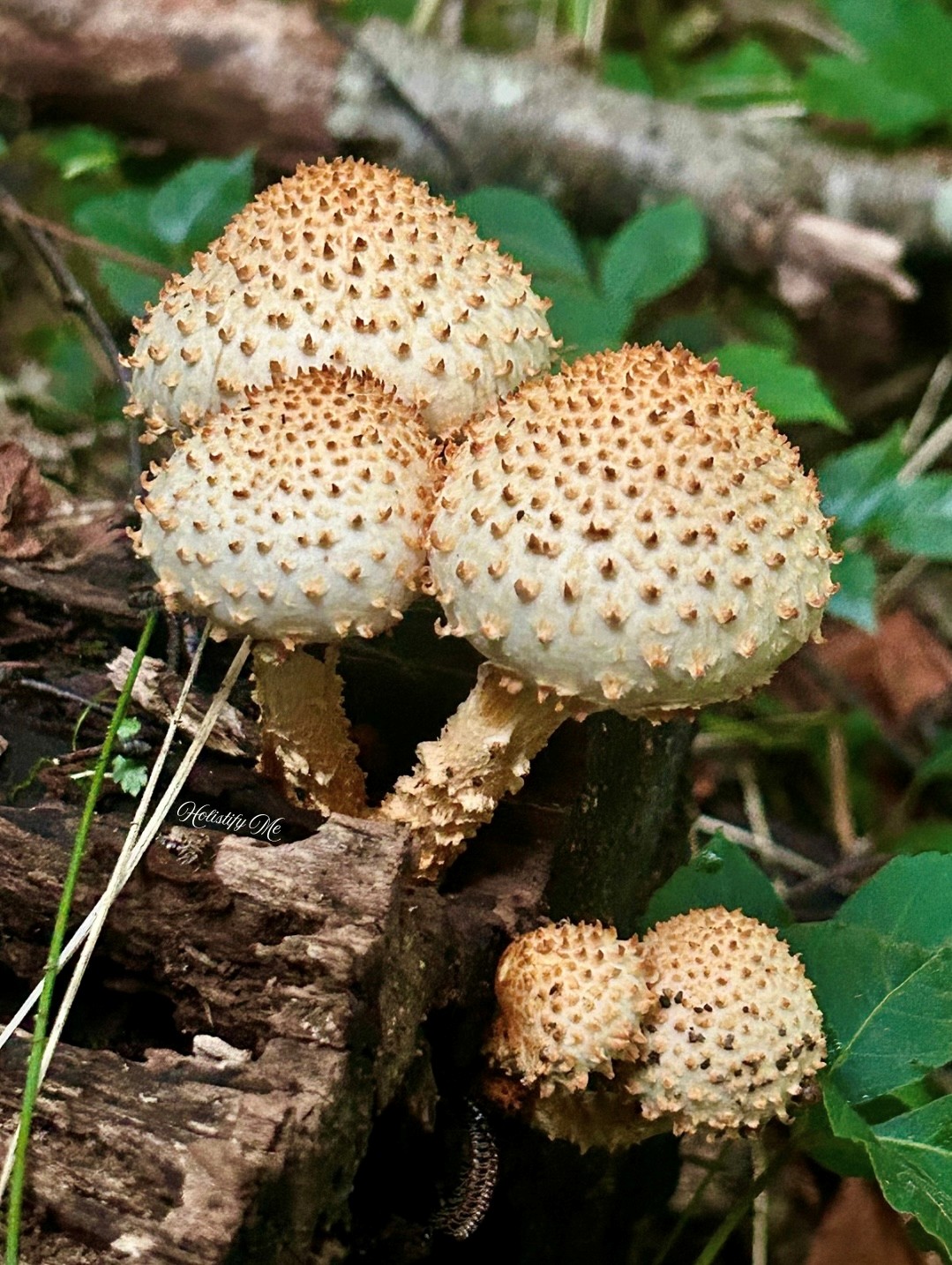
On a recent hike, I came across a beautiful cluster of mushrooms growing directly from a fallen log. Their creamy caps were covered in hundreds of tiny cinnamon-brown scales, giving them an almost jeweled or textured appearance.
I left them exactly where I found them—but, of course, I had to stop and photograph them.
Based on their appearance and their growth on decaying wood, these mushrooms appear consistent with a type of scalycap mushroom, quite possibly the sharp-scaly Pholiota (Pholiota squarrosoides). And while their appearance alone is fascinating, what they're doing for the forest is even more interesting.
Meet the Scalycaps
Pholiota is a genus of mushrooms containing numerous species that are frequently associated with wood.
Rather than popping up randomly from ordinary soil, many scalycaps grow from dead logs, stumps, buried wood, or weakened trees.
One of their most recognizable features is right in their name: scales.
The mushroom I encountered had pale cream-colored caps densely decorated with tiny, pointed, cinnamon-to-brown scales. Even the stems had a wonderfully rough, textured appearance.
Young mushrooms can appear almost round or dome-shaped. As the fruiting body matures, the cap expands and becomes broader.
Seeing several developmental stages growing together—as happened with this cluster—makes for a beautiful glimpse into the mushroom's life cycle.
What Is Pholiota squarrosoides?
The sharp-scaly Pholiota is a wood-inhabiting mushroom found in parts of North America and elsewhere.
It typically grows in clusters and is associated particularly with hardwood. Its fruiting bodies can emerge from decaying logs, stumps and other woody material.
One of its striking characteristics is the contrast between its relatively pale cap and darker pointed scales.
Those scales aren't merely decoration. They're remnants of fungal tissue associated with the mushroom's development, and they give mature specimens their extraordinary textured appearance.
Nature apparently decided a plain beige mushroom simply wasn't dramatic enough.
The Mushroom Is Only the Part We See
Here's one of my favorite things about mushrooms:
The mushroom isn't the whole organism.
Most of the fungus exists hidden within its food source as a network of microscopic filaments called hyphae. Collectively, these form the mycelium.
The mushrooms we see are reproductive structures—the fruiting bodies produced by the larger fungal organism.
So while I could see several beautiful mushrooms emerging from the log, much of the fungus itself was concealed inside the decaying wood.
It's an entire biological system operating beneath the surface.
Nature's Recycling Crew
Wood-decaying fungi perform one of the forest's most important jobs. Trees contain tough structural materials that don't simply disappear when a branch falls or a tree dies.
Fungi are among the organisms capable of breaking down components of woody plant material.
Over time, fungal decomposition helps transform fallen trees and branches into increasingly degraded organic matter.
That means the mushroom growing from an old log isn't destroying something that should remain untouched.
It's participating in the forest's recycling system.
The fallen tree nourishes fungi and other decomposers. The wood gradually breaks down. Nutrients cycle through the ecosystem. Other organisms make use of the deteriorating log.
Death in the forest becomes the foundation for new life.
And that's beautiful.
Why Leaving Wild Mushrooms Matters
Unless you're intentionally collecting mushrooms where harvesting is permitted—and you're absolutely certain of their identification—there's often no reason to pick them.
Leaving this cluster behind meant it could continue doing exactly what it was supposed to do.
Wild mushrooms can provide food or habitat for insects and other organisms, participate in decomposition, and ultimately produce and disperse enormous numbers of microscopic spores.
Sometimes the best form of foraging is simply:
Find it.
Study it.
Photograph it.
Appreciate it.
And leave it behind.
That's exactly what I chose to do with these.
⚠️ A Very Important Note About Identification
Although this mushroom's visible characteristics are consistent with sharp-scalaly Pholiota or a closely related Pholiota species, a photograph of the cap alone isn't enough to establish a definitive species identification.
Proper mushroom identification may require examining characteristics such as the:
- underside and gills
- entire stem
- presence and structure of a ring
- spore print
- substrate and tree species
- odor
- microscopic characteristics
And this is especially important when determining whether a mushroom is edible.
Never eat a wild mushroom based solely on an identification from a photograph, app, social-media post, or blog—including this one.
Some mushrooms have surprisingly convincing look-alikes.
🌿 A Little Forest Reminder
What struck me most about finding these mushrooms wasn't whether they were useful to humans.
It was simply how beautiful they were doing what fungi have been doing for millions of years.
No garden planted them.
No one arranged them on that log.
A fallen piece of wood, moisture, fungal mycelium and the changing seasons created this tiny scene in the forest.
That's one reason I love spending time outdoors. Once you start slowing down enough to notice fungi, herbs, berries, trees and the tiny ecosystems beneath your feet, a hike becomes much more than exercise.
The forest becomes a classroom.
And sometimes the lesson comes in the form of a little cream-colored mushroom covered in cinnamon scales. 🍄🌿
🌱 Holistify Me Nature Note
Likely identification: Sharp-scaly Pholiota
Scientific name: Pholiota squarrosoides
Group: Scalycap mushrooms
Habitat: Associated with wood, particularly hardwood
Ecological role: Wood decomposition and nutrient cycling
Edibility: Do not consume based on photographic identification
My choice: Photographed and left exactly where it was growing 💚
Holistify Me, LLC
Connecting wellness, nature & the wisdom growing all around us.
Comments ()