

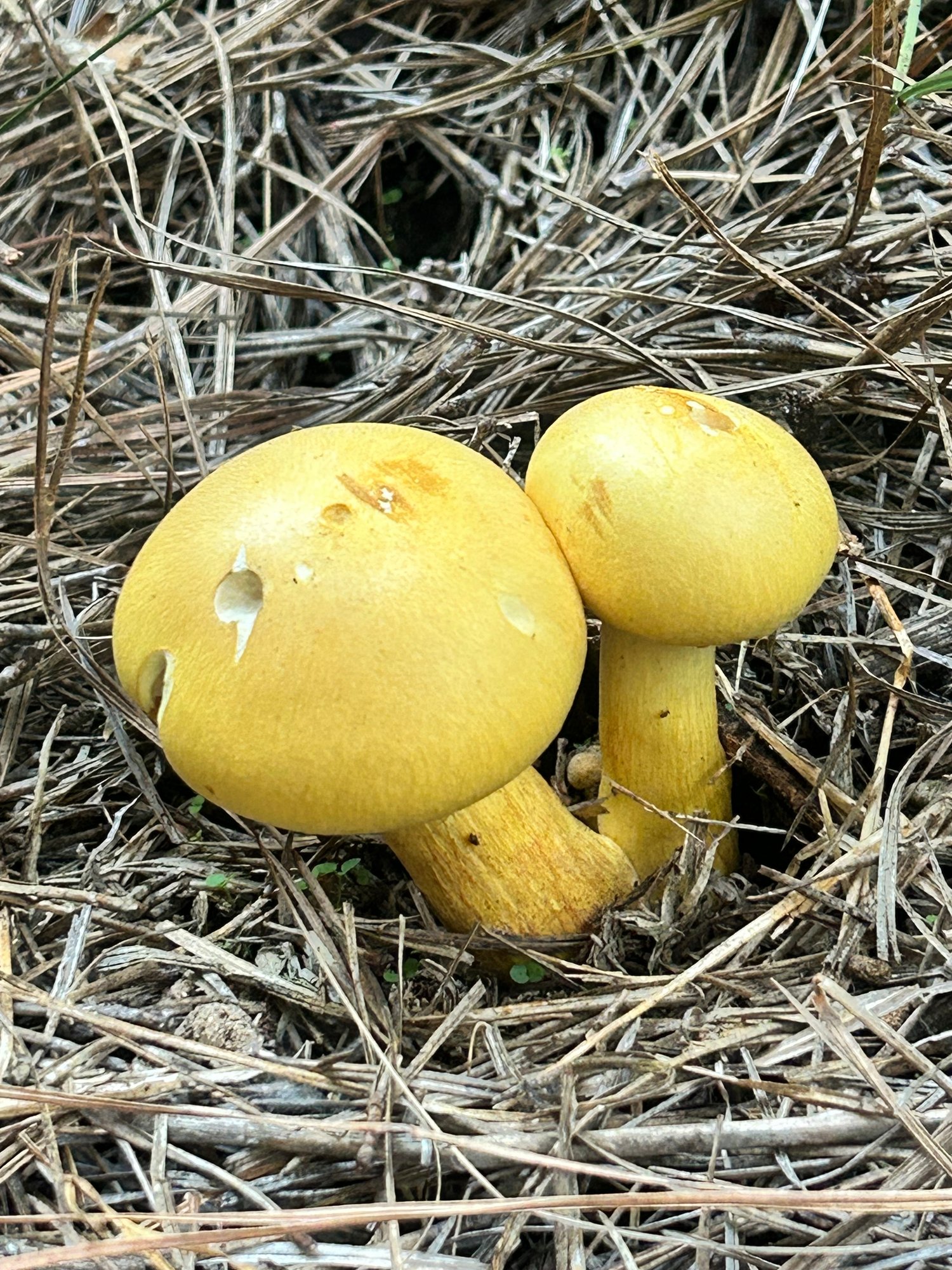
Discovering the biology, ecological importance, unusual chemistry, and mysterious reputation of the Golden Laughing Gym.
Nature has a remarkable way of hiding its most fascinating treasures in plain sight. Beneath towering pine trees, among fallen leaves, decaying wood, and layers of forest debris, an extraordinary world of fungi quietly supports the health of our ecosystems. Among these fascinating organisms is a group of golden-yellow to orange mushrooms commonly known as Laughing Gyms, belonging to the genus Gymnopilus. With their vibrant coloration, distinctive growth patterns, and intriguing chemical properties, these mushrooms have captured the attention of mycologists, naturalists, and mushroom enthusiasts alike.
But what exactly are Laughing Gyms?
Why are they called that?
And what roles do they play in the natural world?
Let's explore the science behind these remarkable fungi.
What Is a Laughing Gym Mushroom?
The name Laughing Gym is most commonly associated with Gymnopilus junonius, often called the Big Laughing Gym or Spectacular Rustgill. However, the term is also used informally for other members of the Gymnopilus genus, which contains numerous species distributed throughout the world. These mushrooms belong to the family Hymenogastraceae and are particularly recognized for their golden, yellow-orange, or rusty-colored fruiting bodies. Some species grow individually, while others emerge in impressive clusters from decomposing logs, stumps, or buried wood.
The name Gymnopilus comes from Greek roots meaning roughly "naked cap," referring to characteristics of the mushroom's cap surface. The nickname "Laughing Gym" reflects the historical association of certain species with psychoactive effects, including changes in mood, perception, and emotional experience. However, an important distinction must be made: not every Laughing Gym is psychoactive, and not every mushroom identified as Gymnopilus junonius contains psilocybin.
Identifying the Laughing Gym: Physical Characteristics
Laughing Gyms are often striking in appearance, particularly when growing in large groups against the muted browns and greens of the forest floor. Although characteristics vary among species, several features are commonly associated with larger Gymnopilus mushrooms.
1. Golden-Yellow to Orange Caps
The caps can range from bright golden-yellow to deep orange or rusty brown. Young mushrooms may have rounded, convex caps that gradually flatten as they mature. Some develop darker centers, subtle surface fibers, or irregular edges.
2. Closely Spaced Gills
Beneath the cap are numerous thin, blade-like structures called gills. These structures produce and release reproductive spores. In many Gymnopilus species, the gills begin yellowish or pale orange and gradually develop rusty coloration as the spores mature.
3. Thick, Fibrous Stems
Many larger species develop sturdy, fibrous stems that range from yellow to orange-brown. Some species, including members of the G. junonius complex, possess a partial veil that can leave a ring around the upper stem.
4. Rusty-Brown Spores
One of the genus's important identifying characteristics is its rusty orange-brown to brown spore print. A spore print is created when mature spores fall from the mushroom's gills onto a surface. Although useful for identification, spore color alone cannot establish a mushroom's species or safety.
Important: Several poisonous mushrooms resemble Laughing Gyms. Wild mushrooms should never be consumed based solely on photographs, coloration, or general appearance.
Where Do Laughing Gyms Grow?
Laughing Gyms are commonly associated with forests containing dead or decaying wood. Many species are saprotrophic, meaning they obtain nutrients by breaking down dead organic material.
They may grow on:
- Fallen trees and decaying logs
- Old stumps
- Buried roots
- Decomposing branches
- Wood concealed beneath soil, moss, or leaf litter
Certain species are associated with coniferous forests, while others grow on hardwoods. In eastern North America, various Gymnopilus species can be encountered during periods of favorable moisture and temperature, particularly in late summer and autumn. Interestingly, mushrooms that appear to be growing directly from soil may actually be connected to buried wood. This illustrates why observing a mushroom's surrounding environment is an important part of identification.
The Ecological Importance of Laughing Gyms
Beyond their unusual appearance, Gymnopilus mushrooms perform an essential ecological function. They are part of nature's decomposition and nutrient-recycling systems.
Breaking Down Dead Wood
Wood contains complex structural compounds, including cellulose, hemicellulose, and lignin. Certain wood-decaying fungi produce enzymes capable of breaking down these materials. Many Gymnopilus species are associated with white-rot decomposition, in which fungi help degrade lignin and other wood components.
Recycling Nutrients
As dead wood decomposes, nutrients become available to other organisms within the forest ecosystem. This process contributes to nutrient cycling, soil development, and the continued productivity of woodland habitats.
Supporting Forest Biodiversity
Decaying wood creates habitats for insects, microorganisms, and other fungi.
By participating in wood decomposition, Laughing Gyms contribute to the complex ecological relationships that sustain healthy forests.
A healthy forest depends not only on what is growing, but also on what is decomposing. Without decomposers, fallen trees and other organic materials would accumulate, and nutrients would cycle much more slowly through ecosystems.
Why Are They Called Laughing Gyms? The Connection to Psilocybin
Perhaps the most intriguing aspect of Laughing Gyms is their association with naturally occurring psychoactive compounds. Some Gymnopilus species have been found to produce psilocybin, a compound also present in certain mushrooms belonging to other genera.
Psilocybin is converted in the body into psilocin, which interacts with serotonin receptors in the brain, particularly the 5-HT2A receptor. This interaction can alter perception, mood, sensory processing, and patterns of thought. Depending on the individual, circumstances, and amount consumed, psilocybin may produce experiences ranging from altered visual perception and emotional intensity, to anxiety, confusion, or distress.
Are All Laughing Gyms Psychedelic?
No. This is one of the most important misconceptions surrounding these mushrooms. Psilocybin production varies among Gymnopilus species, and the presence of psychoactive compounds cannot reliably be determined through appearance alone. Additionally, the classification of mushrooms historically identified as Gymnopilus junonius has undergone taxonomic revision. Some North American populations previously assigned to that name are now recognized as distinct or closely related species. Consequently, reports about the psychoactivity of a mushroom called G. junonius may not apply to every mushroom carrying that name. The absence or presence of blue bruising is also not a dependable test for psilocybin.
Psilocybin and Modern Scientific Research
Psilocybin has attracted growing scientific interest because of its potential effects on brain function and psychological health. Researchers have investigated psilocybin-assisted therapy for conditions including depression, substance use disorders, and distress associated with serious illness.
Some controlled clinical trials have reported promising outcomes, particularly when psilocybin is administered in carefully monitored settings with structured psychological support. However, important limitations remain.
Research is still examining long-term outcomes, optimal treatment protocols, individual differences in response, and potential adverse effects.
Psilocybin can cause intense anxiety, panic, confusion, increased heart rate, and temporary increases in blood pressure. It may pose particular risks for individuals with certain psychiatric vulnerabilities. Clinical research involving a carefully measured pharmaceutical compound is fundamentally different from consuming an unidentified wild mushroom.
Psilocybin is not an established do-it-yourself treatment, and wild Laughing Gyms should never be used as substitutes for supervised medical care, nor should it be used by someone who is unskilled with the mushroom itself.
Are Laughing Gym Mushrooms Edible?
Laughing Gyms should not be treated as edible mushrooms. Some species are considered poisonous or otherwise unsuitable for consumption, and their chemical composition can vary. Their frequently reported bitter taste also makes many species undesirable as food. More importantly, potentially dangerous mushrooms can share their general appearance.
Misidentification can result in serious poisoning. Drying mushrooms does not reliably eliminate toxic compounds, nor does it make an unidentified mushroom safe to consume.
For anyone interested in wild mushroom identification, consultation with an experienced local mycologist is strongly recommended.
The Fascinating Life Cycle of a Laughing Gym
The visible mushroom is only one part of a much larger organism. Most of the fungus exists as an interconnected network of microscopic filaments called hyphae. Collectively, these filaments form the mycelium.
The mycelium grows through suitable material, such as decaying wood, where it absorbs nutrients.
When environmental conditions are favorable, the fungus may produce mushrooms, which serve as reproductive structures. The mushrooms release microscopic spores that can be carried by air currents. Under suitable conditions, spores may germinate and eventually contribute to the development of new fungal networks.
This cycle highlights an extraordinary biological reality: the mushroom we see is often only the temporary, visible expression of a much larger living system.
What Laughing Gyms Teach Us About Nature and Holistic Wellness
From a holistic perspective, studying fungi offers an opportunity to appreciate the interconnectedness of natural systems. Although Laughing Gyms themselves should not be promoted as medicinal or edible mushrooms, their ecological role illustrates several important principles.
Transformation is essential to renewal. Fungi help break down dead organic matter, allowing nutrients to reenter biological cycles.
Health depends on relationships. Forest ecosystems function through interactions among plants, fungi, microorganisms, animals, water, and soil.
Nature's chemistry is complex. Naturally occurring compounds can have significant biological effects, but natural origin does not automatically mean safety.
Observation encourages understanding. Learning about mushrooms through photography, habitat study, and responsible identification can deepen our appreciation for biodiversity.
Spending time in natural environments can also support relaxation, physical activity, and psychological well-being.
The benefits of a woodland walk do not require harvesting or consuming the organisms we encounter.
Sometimes, the greatest value of a mushroom is simply the opportunity to learn from it.
Final Thoughts: A Golden Treasure of the Forest
Laughing Gyms are fascinating examples of the diversity, chemistry, and ecological importance of fungi. Their golden caps and clustered growth make them visually memorable, while their role in decomposing wood helps sustain the natural environments in which they thrive. Their association with psilocybin adds another layer of scientific interest, but it also underscores the importance of accurate identification and responsible research.
Not every Gymnopilus species is psychoactive, and mushrooms that resemble Laughing Gyms may belong to entirely different genera.
For mushroom enthusiasts, the safest and most rewarding approach is to observe, photograph, document, and learn.
The forest is filled with extraordinary organisms whose value extends far beyond whether they can be eaten or used medicinally.
Sometimes, the most fascinating discoveries are waiting quietly beneath our feet.
Holistify Me | Exploring the connection between nature, science, and whole-body wellness.
Scientific References & Further Reading
- National Center for Biotechnology Information (NCBI) — Research on psilocybin pharmacology and clinical applications.
- Johns Hopkins Center for Psychedelic and Consciousness Research — Clinical research investigating psilocybin and mental health.
- Missouri Department of Conservation — Big Laughing Gym mushroom identification and ecology.
- MycoBank — Fungal taxonomy and scientific nomenclature.
- PubMed — Peer-reviewed studies on fungal chemistry, psilocybin, and wood-decaying fungi.
Disclaimer: This article is intended for educational purposes only. It does not provide mushroom identification certification, medical advice, or recommendations to consume wild fungi. Never ingest an unidentified wild mushroom.
Comments ()