

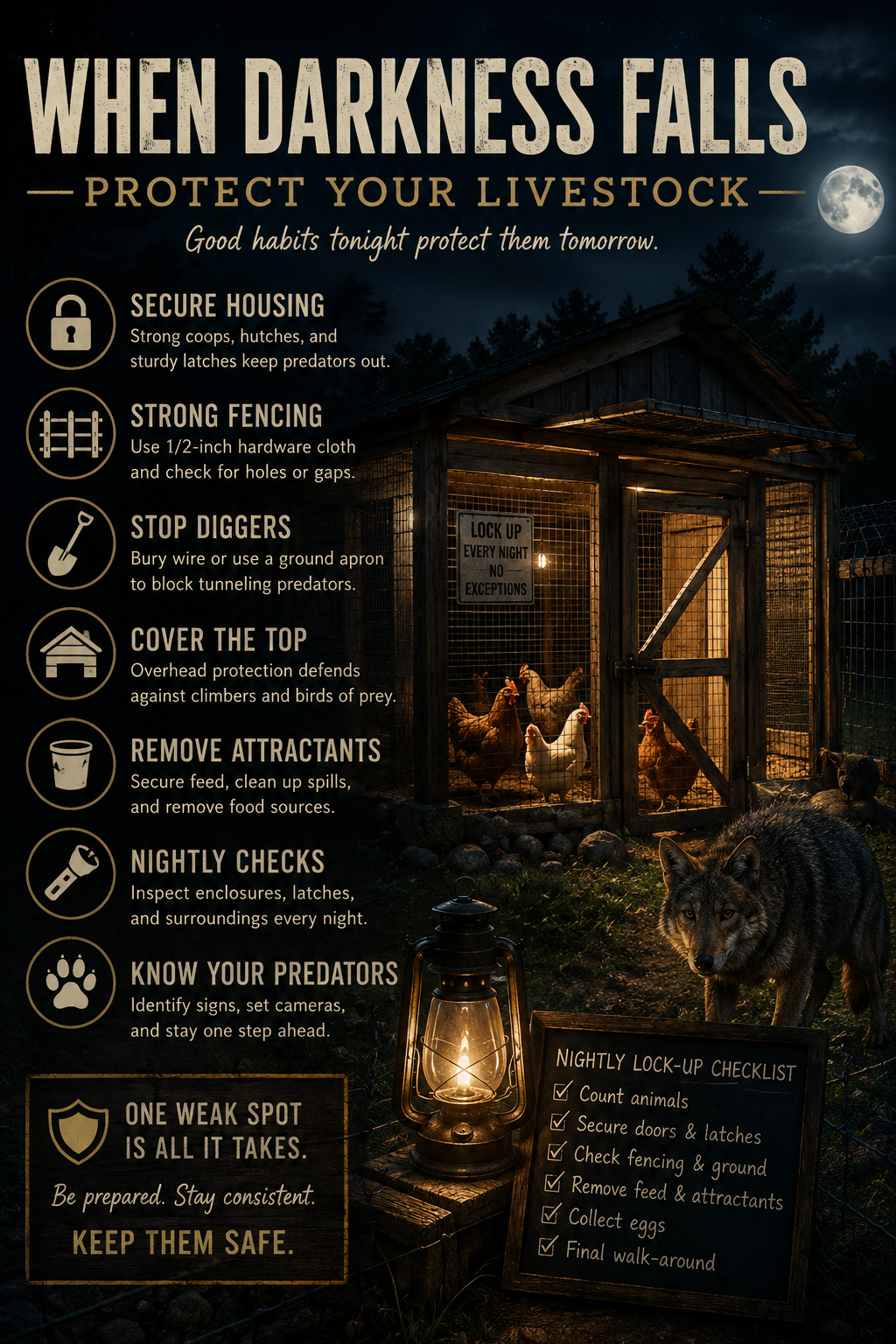
When the sun goes down on the homestead, a completely different world wakes up.
While we're inside settling down for the night, raccoons, coyotes, foxes, opossums, owls, bobcats, snakes, and other predators may be beginning their rounds. A chicken coop, rabbit hutch, quail pen, or brooder full of young animals can quickly become an easy target if we haven't prepared for nighttime visitors.
The goal isn't to eliminate wildlife. Predators have an important place in nature. Our job as homesteaders is to make our livestock difficult enough to reach that predators decide to look somewhere else for dinner.
Know What's Hunting at Night
Different predators leave different clues.
Raccoons are incredibly good with their paws. They can open simple latches, reach through wire, and pull poultry through surprisingly small openings.
Coyotes are powerful diggers and opportunistic hunters. Chickens, ducks, rabbits, goats, and other small livestock can attract them.
Foxes are quiet, quick, and excellent diggers. A small opening underneath a fence may be all they need.
Opossums will take eggs, chicks, and sometimes poultry when given the opportunity.
Owls and other birds of prey can become a threat to poultry and young animals when pens don't have secure overhead protection.
Bobcats are capable climbers and powerful enough to take poultry and other small livestock.
Snakes may enter surprisingly small openings looking for eggs, chicks, quail, or rodents.
Sometimes the predator isn't wildlife at all. Loose domestic dogs can cause devastating livestock losses, even when they aren't hunting for food.
Chicken Wire Isn't Predator Protection
One of the biggest mistakes new homesteaders make is assuming chicken wire will keep predators out.
Chicken wire is excellent for keeping chickens in, but it isn't designed to keep determined predators out.
For vulnerable areas, consider sturdy welded wire or 1/2-inch hardware cloth, particularly around openings, windows, ventilation areas, brooders, and smaller poultry such as quail.
Pay special attention to corners and attachment points. Strong wire doesn't help much if a predator can simply pull it away from the frame.
Stop Predators From Digging Under
A secure fence above ground is only half the battle.
Coyotes, foxes, dogs, raccoons, and other animals may investigate the bottom of an enclosure looking for somewhere to dig.
One option is creating a buried barrier. Another is installing a wire apron extending outward along the ground around the enclosure and securing it appropriately.
Walk around your pens occasionally and look for:
Fresh digging
Depressions underneath fencing
Bent or pulled wire
Loose staples or fasteners
Small tunnels
Tracks around the enclosure
A tiny weakness tonight can become an entrance tomorrow.
Don't Forget the Roof
Predator-proofing shouldn't stop at the fence.
Poultry runs and small-animal enclosures may need secure overhead protection. This helps defend against climbing predators as well as aerial predators.
Inspect where the roof meets the walls carefully. Those little gaps are exactly the places curious predators investigate.
Upgrade Your Latches
If a latch can easily be flipped with a paw, don't assume a raccoon can't figure it out.
Use secure closures that require more than one simple movement to open. Carabiners or other secondary locking methods can add another layer of protection where appropriate.
Every evening, physically check the doors rather than simply looking at them from across the yard.
That five-second habit could save an entire flock.
Remove the Midnight Buffet
Predators aren't necessarily coming to your property because they discovered your chickens.
They may have discovered food first.
Feed left outside, spilled grain, unsecured garbage, pet food, eggs, carcasses, and food scraps can attract wildlife. Rodents attracted to spilled feed can then attract snakes and other predators.
Keeping the livestock area clean helps break that chain.
Store feed in sturdy, secure containers and clean up major spills.
Use Layers of Protection
There usually isn't one magic predator deterrent.
A better approach is creating several obstacles:
Secure housing + strong fencing + hardware cloth + good latches + clean feed areas + regular inspections.
Some homesteads may also benefit from appropriately installed electric fencing, motion-activated lighting, alarms, cameras, or livestock guardian animals.
But technology shouldn't replace a secure enclosure.
A predator that discovers an easy meal often comes back.
Create a Nightly Lock-Up Routine
One of the simplest predator-prevention tools costs nothing: consistency.
Before going inside for the evening:
[ ] Count your animals.
[ ] Put poultry into secure nighttime housing.
[ ] Close and secure every door.
[ ] Check latches.
[ ] Look along the bottom of fencing for digging.
[ ] Check wire for new damage.
[ ] Remove exposed feed when appropriate.
[ ] Collect remaining eggs.
[ ] Check water and animal condition.
[ ] Take one last walk around the enclosure.
After a while, this becomes just another part of evening chores.
Learn From the Evidence
If something has been walking around your pens at night, don't ignore it simply because nothing has been killed yet.
Look for tracks, scat, hair, digging, scratches, damaged fencing, disturbed animals, missing eggs, or feathers.
A trail camera can be especially useful because it answers one of the most important questions:
What exactly are we defending against?
Once you know what's visiting, you can strengthen the enclosure accordingly.
Protect the Weakest Point
Predators don't have to defeat your entire setup.
They only have to find one weak spot.
Maybe it's the corner where the wire has started pulling loose. Maybe it's the little opening beside the door. Maybe it's the latch you keep meaning to replace.
Walk around your livestock enclosure and ask yourself:
If I were trying to get inside this pen tonight, where would I try first?
That's probably where you should start reinforcing.
The Homestead Changes After Dark
Daytime on a homestead is noisy—animals calling, people working, equipment running, and chores getting done.
At night, everything changes.
That's when good preparation takes over.
We can't stand beside our livestock until sunrise every night. But we can build systems that continue protecting them while we're sleeping.
Build strong. Lock up every night. Remove attractants. Inspect often. And never underestimate a hungry predator.
Because when darkness falls on the homestead, our animals are depending on the work we did before sunset.
Comments ()