
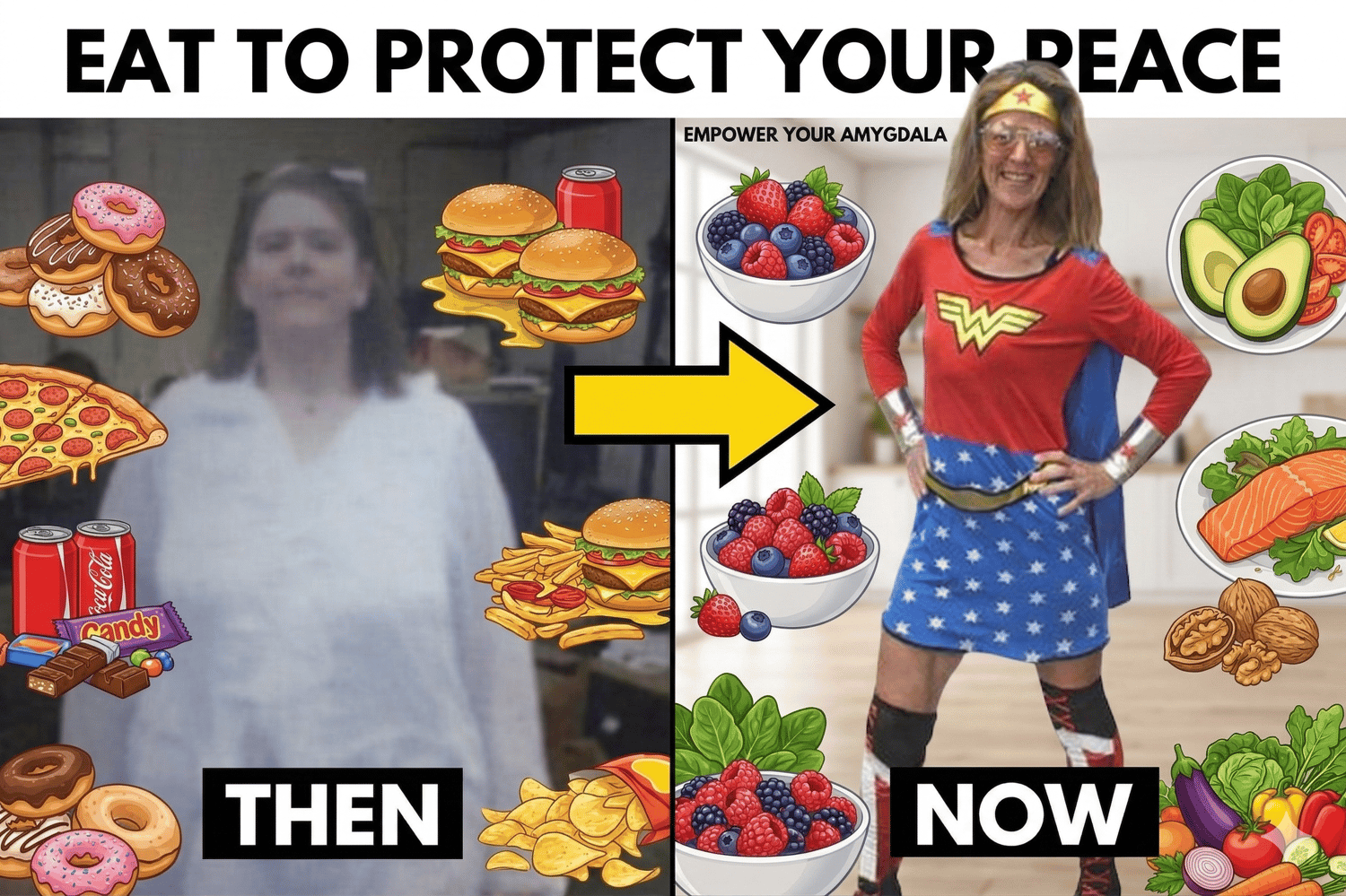
In my family, food was the one thing you could always depend on. When you’re dealing with physical pain, financial stress, or the weight of grieving, the fridge feels like the only friend that doesn’t ask for anything. But the truth is, the greasy, processed "sad foods" we were raised on—the ones covered in cheese, condiments, and sugar—were actually keeping me trapped in my trauma.
I used to think my reactions to people were just "who I was." If someone had an attitude, it ruined my day. If a situation was tense, I felt it in my bones. I wasn’t just being affected by people; I was being infected by them. Their bad energy became my bad energy.
The Amygdala Connection
What I didn't realize then is that my brain’s "social control center"—the amygdala—was being sabotaged by what I was eating.
The amygdala is the part of your brain that governs emotional memories and tells you when something is a "threat." When I was eating "trash" foods, my amygdala was in a state of constant, unregulated inflammation. It’s like having a smoke detector that goes off every time someone lights a candle.
The Science: A 2026 study from Ohio State University found that a highly processed diet lacking fiber can damage the amygdala in as little as three days. When we lack fiber, our gut stops producing butyrate, a key molecule that protects the brain from inflammation. Without it, your amygdala becomes hyper-reactive, making it nearly impossible to stay calm in social situations.
Source: Ohio State News: Emotional memory region sensitive to processed foods
Why "Sad Foods" Make You Sad
We often think of happiness as a "brain thing," but your gut is actually your "second brain."
The Science: According to Harvard Health, about 95% of your serotonin—the neurotransmitter that regulates your mood and sleep—is produced in your gastrointestinal tract. If your gut is inflamed by processed goods and high sugar, your "happy hormone" production shuts down, leaving you irritable and emotionally vulnerable.
Source: Harvard Health: How the gut-brain connection influences mood
The Sugar "Threat Response"
When you eat high-sugar or high-carb trash, your blood sugar spikes and then crashes. To your body, a sugar crash feels like a survival threat.
The Science: The Mayo Clinic explains that when your brain perceives a threat (like a blood sugar crash), it triggers a surge of cortisol and adrenaline. This is your "fight-or-flight" response. If you are already dealing with past trauma, this chemical storm makes you hyper-sensitive to every look or comment from the people around you.
Source: Mayo Clinic: Chronic stress puts your health at risk
One Happy Food at a Time
When I started replacing those "sad foods" with living, whole foods, my brain's alarm system finally calmed down. Now, when I deal with someone who has an attitude, I have the self-awareness to see it for what it is: their problem, not mine. I can feel the vibrations, but they don't get under my skin anymore.
You don’t have to change your entire life today. A refrigerator is meant for living foods that make you feel alive. Start by replacing just one "sad food" with a "happy food"—something from the earth, not a factory.
As you crowd out the trash, your emotional tolerance will go up. You’ll find that you are more focused, more productive, and most importantly, in control of your own peace.
Success isn't overnight, and neither is healing. But you are worth the effort!!!
Love, Liberty!
You can grab the full Natural GLP-1 Grocery List for free right here: https://payhip.com/b/p1ov5
I LOST over 250 lbs! No diets. No shame. Just love (and chocolate). → Join my class only $297 or 4 payments of $85! https://payhip.com/b/32pOh
This Blog is an expansion on things I said in my YouTube episode 4 years ago