
Introducing The ME Project
The ME Project is a developing InclusiveEd programme designed to help people understand themselves more clearly, build confidence, strengthen self-esteem and think more deliberately about the future they want to create.
Using visual reflection, mind maps and practical activities, the project will explore areas such as self-belief, thoughts and emotions, strengths, values, resilience, goal setting, future planning and personal growth. Rather than following one rigid route, the aim is to help each person identify what matters to them, recognise what may be holding them back and begin creating their own path forward.
The ME Project is currently in development. If you would like to hear more about it, register your interest or be notified as new resources become available, use the link below.
Want to know more about The ME Project?
Contact InclusiveEd → Contact InclusiveEd | Inclusive Ed
Please note: this link will take you to the Contact Us page on the InclusiveEd website, where you can send your details and let us know that you are interested in The ME Project.
Free Download at the bottom of the page:
Read More about building Confidence below.
When children are struggling emotionally, conversations often focus on anxiety, overwhelm, low mood and self-esteem. These difficulties deserve attention and support. However, emotional wellbeing is not only about reducing struggles. It is also about helping children recognise their strengths, build confidence, develop resilience and discover what they are capable of becoming. This matters because confidence and self-esteem influence far more than academic success. They affect how willing children are to try new things, recover from setbacks, manage challenges and approach opportunities throughout life.
Yet confidence is often misunderstood.
Many people view confidence as something we either have or do not have. Some children appear naturally confident whilst others seem hesitant, anxious or unsure of themselves. The reality is more hopeful than that. Research suggests that confidence is not a fixed personality trait. It can be developed, strengthened and maintained throughout life. Understanding how confidence works may be one of the most valuable gifts we can offer both ourselves and our children.
What Is Confidence? What Is Self-Esteem? And Why Does The Difference Matter?
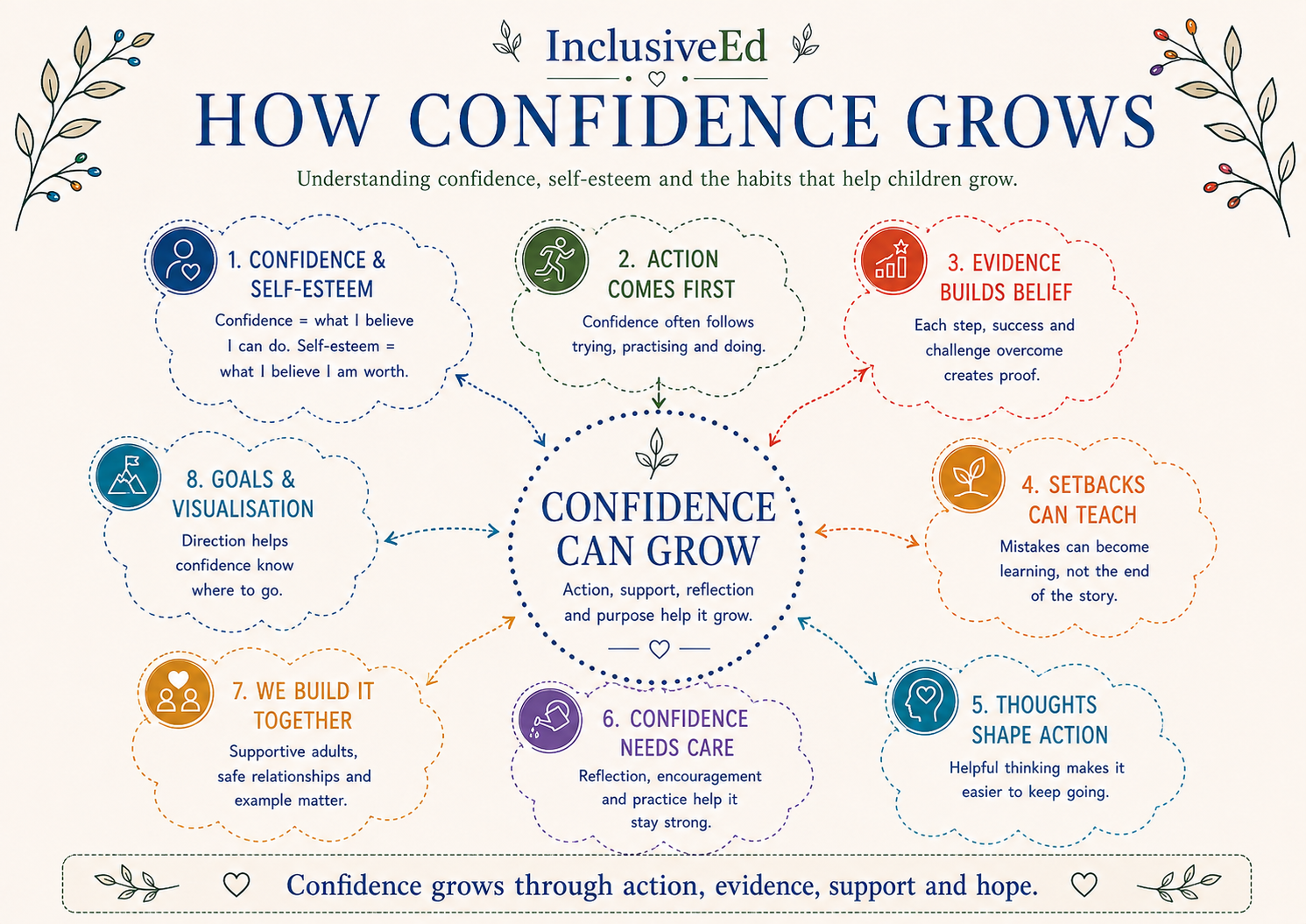
Although confidence and self-esteem are often discussed together, psychologists generally view them as related but distinct concepts. Confidence refers to our belief in our ability to do something. A child may feel confident riding a bicycle, swimming, drawing or speaking to friends, yet lack confidence in other areas of life.
Self-esteem is broader. It relates to how we value ourselves as a person. It reflects our overall sense of worth, self-respect and the beliefs we hold about ourselves.
Put simply:
• Confidence is often about what we believe we can do.
• Self-esteem is often about what we believe we are worth.
The distinction matters because children can experience one without the other. A child may be highly capable in certain areas yet still struggle with low self-esteem. Equally, a child with healthy self-esteem may still feel nervous when facing something new. When children experience anxiety, overwhelm or repeated setbacks, they can sometimes begin to see themselves through the lens of those difficulties.
They may start to believe that they are the problem rather than recognising that they are experiencing a problem.
This is why supporting emotional wellbeing should never focus solely on reducing difficulties.
It should also help children recognise:
• their strengths
• their achievements
• their interests
• their values
• their hopes
• their possibilities
There is always more to a child than their current struggle. Research consistently suggests that confidence and self-esteem are influenced by experience, relationships, opportunities for success, supportive environments and the meaning we attach to those experiences. They are not fixed traits.
They can grow, change and develop throughout life. This leads to a much more hopeful question:
If confidence and self-esteem can be developed, how do we build them?
The Confidence Myth: Why Confidence Usually Comes After Action
One of the most common misconceptions about confidence is the belief that we need to feel confident before we take action.
Adults often tell themselves:
"I'll do it when I feel more confident."
Children often think:
"I'll put my hand up when I feel confident."
"I'll join in when I feel confident."
"I'll try when I feel confident."
The problem is that confidence rarely works this way. Research into learning, performance and human behaviour suggests that confidence is often the result of experience rather than the starting point.
In many areas of life, action comes first and confidence follows.
Consider how children learn to walk.
They do not begin with confidence.
They begin with uncertainty, wobbling, falling and trying again.
The confidence develops because of the experience, not before it.
The same principle can be seen in sport, performance, education and rehabilitation.
Athletes do not become confident before they train. They train repeatedly, develop skills, overcome setbacks and gradually build confidence through mastery. Psychologist Albert Bandura identified mastery experiences as one of the most powerful sources of confidence. In simple terms, people develop belief in their abilities by experiencing themselves successfully doing difficult things.
Confidence grows when we gather evidence.
Each small success becomes evidence.
Each challenge overcome becomes evidence.
Each setback survived becomes evidence.
Over time, these experiences begin to influence what we believe is possible.
This does not mean pushing children beyond their limits. Confidence is not built through overwhelming pressure. It is built through achievable challenges, encouragement, practice and support. Sometimes an achievement may appear small to somebody else.
To the individual, it can be enormous.
A child attending school for one lesson after a difficult period.
A teenager speaking up for the first time.
A parent making a phone call they have been avoiding.
Each provides evidence that growth is possible.
Confidence often grows quietly.
Not through dramatic breakthroughs.
But through hundreds of small moments that gradually teach us:
• I can learn.
• I can improve.
• I can cope.
• I can recover.
• I am capable of more than I thought.
Confidence Is Built Through Positive Thinking, Action and Evidence
Confidence is often discussed as though it is simply a matter of positive thinking or positive affirmations.
Whilst positive thinking has an important role to play, confidence rarely develops through positive thoughts alone. If somebody repeatedly tells themselves they can do something but never takes action, confidence is unlikely to grow.
Equally, if somebody repeatedly faces challenges without encouragement, hope or belief that improvement is possible, setbacks can begin to erode confidence over time. Real confidence sits somewhere between the two. Positive thinking helps us take the first step. Action provides experience.
Experience creates evidence.Evidence strengthens belief.
This is one reason many athletes, performers and successful people spend time developing both their mindset and their skills. They do not simply practise. They also work on the way they think about challenges, setbacks and success. The thoughts we repeat matter. The stories we tell ourselves matter.
The way we interpret our experiences matters. Over time, repeated thoughts and experiences can become familiar pathways.
A child who repeatedly thinks:
"I can't do this."
may begin to avoid challenges altogether.
A child who learns to think:
"This is difficult, but I can improve."
is far more likely to keep trying.
Neither approach guarantees success. However, one creates possibility whilst the other often closes it down. Importantly, confidence is not built by succeeding all the time. Confidence is built by learning that setbacks do not have to be permanent. Failure, disappointment and mistakes are not signs that confidence has failed. They are often part of the process through which confidence develops.
Every athlete loses.
Every performer has difficult days.
Every successful person encounters obstacles.
The difference is often how those experiences are interpreted. A setback can become evidence that we should stop. Or it can become information that helps us adjust our approach. This distinction matters.
There is a significant difference between saying:
"This approach didn't work," and "I can't do this." One identifies a problem. The other becomes a judgement about ourselves. Children benefit enormously from seeing adults model this difference.
When parents say:
• "I got that wrong."
• "That didn't work."
• "I'm disappointed."
• "I'm going to try again."
they demonstrate one of the most powerful confidence-building lessons of all. They show that mistakes are not the end of the story. They show that failure is information. They show that setbacks can lead to learning.
Many of history's greatest achievements emerged through repeated trial and error. Inventors, scientists, athletes and explorers rarely succeeded on their first attempt. The first four-minute mile was not achieved because somebody avoided failure. It was achieved because people continued striving towards a goal despite repeated setbacks. Confidence is not the belief that we will always succeed. Confidence is the belief that we can learn, adapt and keep moving forwards when things do not go according to plan.
Positive thinking helps us see possibility.
Action helps us test that possibility.
Reflection helps us learn from the results.
Together, they create the foundation upon which confidence grows.
Why Confidence Requires Maintenance
One of the biggest myths about confidence is that once we have built it, it remains with us forever.
In reality, confidence is much more like physical fitness. It can be strengthened. It can be neglected. It can grow. It can weaken and it often requires regular attention throughout our lives.
Many people assume that confident individuals simply remain confident regardless of circumstances. Yet athletes, performers, business leaders, teachers, parents and public speakers frequently describe periods of self-doubt, uncertainty and loss of confidence. New challenges can make even highly capable people feel vulnerable which is perfectly normal because confidence is not a permanent state. It is an ongoing relationship between our beliefs, experiences and actions. Like any important relationship, it benefits from attention and care.
One reason confidence can fade is that our brains naturally pay more attention to threats, problems and potential risks than successes. Psychologists often refer to this tendency as a negativity bias. From an evolutionary perspective, this makes sense. Our ancestors survived because they paid attention to danger. The challenge is that modern life often means we pay far more attention to what is going wrong than to what is going right. Without realising it, we can begin to overlook evidence of our strengths, achievements and progress.
- We remember the criticism.
- We forget the compliment.
- We focus on the mistake.
- We overlook the success.
- We notice the obstacle.
- We ignore how far we have already travelled.
This is why confidence benefits from deliberate maintenance. Not because we are pretending everything is perfect but because we are choosing to see the whole picture.
Maintaining confidence may involve:
• Reflecting on achievements and progress.
• Recognising challenges we have overcome.
• Celebrating effort, not just outcomes.
• Continuing to set meaningful goals.
• Taking manageable risks.
• Learning new skills.
• Revisiting strengths and positive qualities.
• Practising gratitude and self-compassion.
These habits help prevent confidence from becoming overshadowed by setbacks and difficulties.
Importantly, maintaining confidence does not mean denying reality. Healthy confidence acknowledges reality. It recognises disappointment. It accepts mistakes and it learns from setbacks, however, it refuses to allow those experiences to become the entire story.
There is always more to us than our most recent mistake or latest struggle. There is always more to a family than the difficult season they may currently be experiencing which is why activities that encourage reflection on strengths, achievements, positive memories, goals and future possibilities can be so valuable. They help balance the picture and remind us of evidence that can easily be forgotten. They remind us that growth has already happened before and if growth has happened before, it can happen again.
Perhaps this is one of the most important lessons we can teach children. Confidence is not something we build once and then forget about. It is something we continue to nurture throughout life because growth, challenge and change are lifelong experiences. The goal is not to become permanently confident.
The goal is to develop the habits, mindset and resilience that allow confidence to be rebuilt whenever life tests it.
Parents and Children Build Confidence Together
When a child is struggling emotionally, it is natural for parents to focus on reducing anxiety, avoiding distress and protecting them from further difficulties. These instincts come from a place of love. Children need support. They need understanding. They need to feel safe, however, confidence is rarely built through protection alone.
Confidence often develops when children are supported to face manageable challenges, overcome obstacles and discover that they are capable of more than they first believed. This is why building confidence should never be viewed as something we do to children.
It is something we do with them.
It is something we model.
It is something we practise together.
Children learn about confidence long before they can define it. They watch the adults around them.
They notice how we respond to setbacks. They notice how we speak about ourselves. They notice whether mistakes are treated as evidence of failure or opportunities to learn. They notice whether we give up when things become difficult or whether we adapt and try again. In many ways, confidence is modelled long before it is taught. When a parent says:
• "I found that difficult."
• "I got that wrong."
• "That didn't go to plan."
• "I'm disappointed."
• "I'm going to try again."
they are teaching confidence in action. They are showing that confidence does not mean always succeeding. It means continuing to move forwards despite uncertainty.
This is one reason supporting children emotionally should never focus solely on problems, worries and difficulties. Those conversations are important. Children need to feel heard. They need support and understanding, however, they also need opportunities to discover their strengths, interests, achievements, hopes and possibilities. If all of our attention is directed towards what is wrong, we can unintentionally overlook what is strong.
A child is never just their anxiety.
Never just their overwhelm.
Never just their behaviour.
Never just their current struggle.
Every child also has strengths waiting to be recognised.
Interests waiting to be explored.
Talents waiting to be developed.
And goals waiting to be pursued.
Parents can help nurture confidence by creating opportunities to notice these things. Noticing effort. Recognising progress. Celebrating achievements. Talking about strengths. Setting goals together. Trying new experiences. Encouraging curiosity. Reflecting on challenges that have already been overcome.
Over time, these moments create evidence. Evidence that growth is possible, challenges can be overcome and difficult feelings do not have to define who we are.
Perhaps most importantly, children benefit enormously when they see adults continuing to grow too.
Learning new skills, setting new goals, facing new challenges and recovering from setbacks. Trying again after disappointment. Confidence is not something that belongs only to childhood. It is something we build, maintain and strengthen throughout life. When parents and children embrace that journey together, confidence becomes more than an individual skill. It becomes part of a family culture.
A culture that says:
We can learn.
We can grow.
We can adapt.
We can recover.
And we are capable of more than we sometimes realise.
Goals, Visualisation and Giving Confidence Somewhere To Go
Confidence grows most effectively when it has a direction. Without direction, confidence can become difficult to maintain. We may recognise our strengths and achievements, yet still feel uncertain about what comes next.
Goals provide confidence with somewhere meaningful to travel. Many people assume that goals need to be ambitious to be worthwhile. In reality, the most powerful goals are often deeply personal. For one person, a goal may be speaking in front of a group, for another, it may be returning to school after a difficult period. For somebody else, it may be making a phone call, attending a social event, joining a club, applying for a job or simply completing a task they have been avoiding.
The significance of a goal is not determined by how impressive it appears to other people. It is determined by the amount of growth it represents for the individual pursuing it. This is why confidence is often built through small goals long before larger goals become possible. Each step creates evidence, each achievement creates evidence and each challenge overcome creates evidence.
Over time, those experiences begin to influence what we believe we can accomplish next. Psychologists have long recognised the importance of goal setting in motivation, learning and achievement. Goals help focus attention, direct effort and provide opportunities to recognise progress. Perhaps most importantly, goals transform vague hopes into practical actions.
A goal turns:
"I wish things were different."
into:
"This is the next step I am going to take."
Alongside goal setting, many athletes, performers and successful individuals use visualisation as a form of mental rehearsal. Before an important competition, elite athletes often imagine themselves performing successfully. They mentally rehearse movements, challenges and desired outcomes. This process does not guarantee success, nor does it replace effort, practice or persistence, however, it can help strengthen focus, preparation and belief in what may be possible. Importantly, visualisation can also challenge the negative inner voice that often accompanies anxiety, low confidence and self-doubt.
Instead of repeatedly imagining what might go wrong, we begin to explore what might go right. Children and adults can both benefit from practising this skill. Try a simple exercise.
Close your eyes and imagine a day in the future when things are going well.
Where are you?
What can you see?
What can you hear?
What can you smell?
What are you wearing?
Who is with you?
How do you feel?
What are you doing?
Most people discover something surprising when they attempt this exercise. Their mind wanders.
Within moments, attention drifts towards worries, distractions, responsibilities or unrelated thoughts.
This is entirely normal. Holding attention on a single image or idea is difficult. Like confidence itself, it is a skill that develops through practice.
The goal is not to create a fantasy world or ignore reality. The goal is to create direction. To develop a clearer picture of what we are working towards. To identify possibilities rather than focusing exclusively on problems. To remind ourselves that our current situation is not necessarily our permanent destination.
For children and adults experiencing anxiety, overwhelm or low confidence, this can be particularly important.
Difficult emotions naturally narrow our focus. We become absorbed by what is wrong, what might go wrong or what feels impossible. Goals and visualisation gently encourage us to widen the picture. They remind us that there can be a future beyond the current challenge. A future containing new experiences, opportunities, achievements and possibilities.
Confidence is not built by wishing for that future, it is built by taking steps towards it, however, before we can move towards something, it often helps to imagine where we would like to go. Confidence grows most powerfully when it is connected to purpose and purpose gives confidence a reason to keep moving forwards.
There Is More To Us Than Our Current Struggle
When we are struggling emotionally, it is easy for life to become dominated by the problem. Conversations begin to revolve around anxiety, overwhelm, behaviour, panic, worries, setbacks or low mood. These difficulties deserve attention. Children need support, understanding and compassion. Parents need support, understanding and compassion too, however, difficulties are only one part of the story.
A child experiencing anxiety is not simply an anxious child.
A child who is overwhelmed is not simply overwhelmed.
A child who lacks confidence today is not destined to lack confidence forever.
The same is true for adults.
We are not defined by our most recent mistake.
We are not defined by our worst day.
We are not defined by the challenges we happen to be facing right now.
Human beings are remarkably adaptable. History is filled with examples of people overcoming challenges that once appeared impossible. Athletes have returned to competition after career-threatening injuries.
Individuals have learned to walk again following life-changing accidents. Scientists, inventors, performers and entrepreneurs have experienced repeated setbacks before achieving success. Progress rarely follows a straight line.
What these stories often have in common is not the absence of difficulty. It is the refusal to allow difficulty to become the entire story. Confidence does not grow because life becomes easy. Confidence grows because we discover that we can learn, adapt, recover and keep moving forwards despite challenges.
This is why confidence and self-esteem deserve as much attention as the difficulties we face.
Supporting emotional wellbeing should not only involve helping children manage worries and overcome obstacles. It should also involve helping them discover:
• their strengths
• their interests
• their achievements
• their values
• their goals
• their hopes
• their possibilities
The same is true for parents. Perhaps one of the most powerful messages we can give our children is not:
"Don't be afraid."
or
"Everything will be fine."
Instead, it may be:
"You can learn."
"You can grow."
"You can recover."
"You can try again."
"You are capable of more than you realise."
Confidence is not something we find.
It is not something reserved for a lucky few.
It is something we build.
Through thought.
Through action.
Through practice.
Through setbacks.
Through reflection.
Through experience.
And through the evidence we gather that growth is possible. So wherever you or your child happen to be right now, perhaps the question is not: "How do I become confident?" Perhaps the question is:
"What is the next small step I can take?" Because confidence rarely arrives all at once. It grows one challenge, one lesson, one achievement and one brave step at a time, and every time we take that step, we gather evidence that change is possible.
There is more to us than our current struggle.
There is more to our children than their current struggle.
There is more to our future than our current circumstances.
And confidence grows every time we choose to move towards that possibility.
Research, Evidence and Quotations
Albert Bandura – Self-Efficacy and Confidence
Psychologist Albert Bandura's work on self-efficacy transformed our understanding of confidence. He argued that one of the most powerful ways people develop belief in their abilities is through experiencing themselves successfully doing difficult things.
"Successes build a robust belief in one's personal efficacy." — Albert Bandura
This idea sits at the heart of confidence building. Confidence grows when children and adults gather evidence that they can learn, improve, adapt and overcome challenges.
Carol Dweck – Growth Mindset
Carol Dweck's research demonstrated that people who view abilities as developable rather than fixed are more likely to persevere through challenges and setbacks.
"Becoming is better than being." — Carol Dweck
Confidence is not about proving we are already good enough. It is about recognising that growth, learning and improvement remain possible.
Michael Jordan – Learning Through Failure
Few people are associated with success more than Michael Jordan. Yet his most famous reflection focuses not on his achievements, but on his failures.
"I've missed more than 9,000 shots in my career. I've lost almost 300 games. Twenty-six
Ready to Start Building Confidence?
Confidence rarely arrives all at once. It is built through small steps, small successes and the evidence we gather along the way. Whether you are supporting a child, rebuilding your own confidence, or working on both together, sometimes it helps to pause and reflect on where you are, where you would like to go and the steps that might help you get there. To support this process, I have created a free worksheet:
Journey Back to Confidence
This reflective worksheet helps children, teenagers and adults explore:
• Where they are now
• What confidence would look like for them
• Strengths and achievements they may have forgotten
• Small, manageable next steps
• Hopes, goals and possibilities for the future
Because confidence is not something we find.
It is something we build.
And every journey starts with a single step.
Download your free Journey Back to Confidence worksheet here:
Download your Free Confidence Can Grow Through Emotional Struggles Wall Poster here: Confidence Can Grow Through Emotional Struggles - Payhip
If you find it helpful, feel free to share it with a friend, family member, colleague, teacher or anyone who might benefit from a gentle reminder that growth is possible.