
The ME Project: A Visual Approach to Confidence, Self-Esteem, Growth and Future Thinking
There are times in life when we know something needs to change, but we are not quite sure where to begin.
We may feel stuck, overwhelmed, under-stimulated, frustrated, disappointed or simply aware that life is not quite moving in the direction we want. Sometimes the difficulty is confidence. Sometimes it is anxiety. Sometimes it is motivation, self-doubt, low self-esteem or the feeling that other people somehow know what they are doing while we are still trying to work ourselves out.
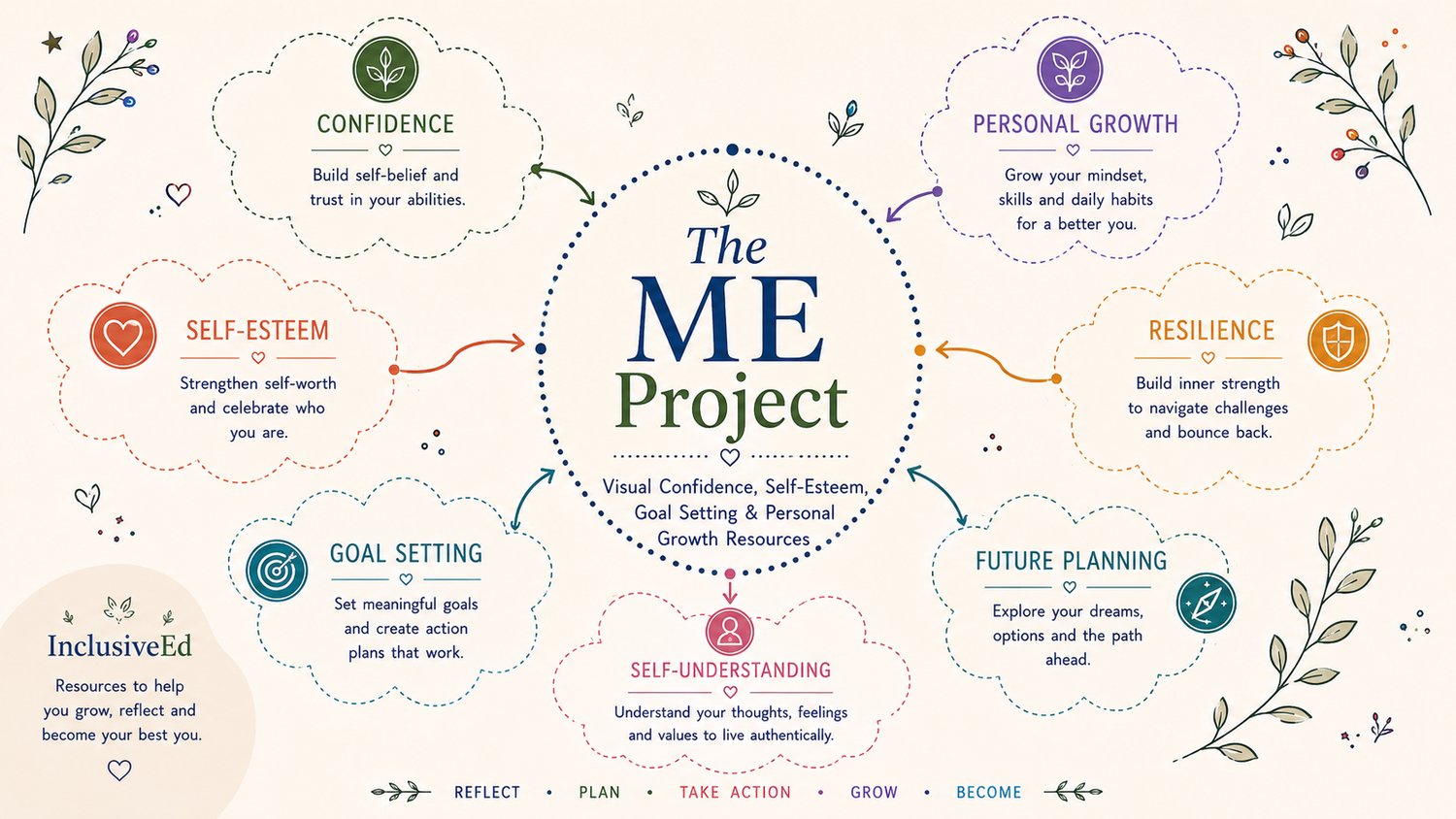
The ME Project is being developed by InclusiveEd as a visual, reflective approach to helping people understand themselves more clearly, recognise what may be holding them back and think with greater purpose about what they want from the future.
It is not about becoming somebody else.
It is about understanding yourself well enough to decide what you want to change, what you want to keep, where you want to go and how you might begin moving towards it.
What Is The ME Project?
The ME Project is a developing collection of visual tools, mind maps, reflective activities and guided resources focused on personal growth.
It brings together areas that are often treated separately:
- confidence
- self-esteem
- anxiety and overthinking
- emotional awareness
- resilience
- values
- strengths
- self-belief
- motivation
- goal setting
- future planning
- reflection
- personal development
The idea is simple.
When people are given space to see their thoughts, strengths, worries, values, goals and possibilities visually, it can become easier to make sense of what is happening and decide what matters next.
For some people, writing pages of a journal feels natural.
For others, a visual map can make everything suddenly feel clearer.
The ME Project has been designed with that second group very much in mind.
Why Start With “Me”?
Personal development often begins with advice.
Set goals.
Think positively.
Build better habits.
Believe in yourself.
But those messages can miss an important step.
Before deciding what to do next, it helps to understand the person who is making the decision.
What matters to me?
What do I value?
What am I good at?
What do I struggle with?
What do I keep avoiding?
What have I already overcome?
What kind of life would actually feel right for me?
What am I trying to prove, and to whom?
What do I want more of?
What am I ready to leave behind?
The ME Project starts from the belief that meaningful change becomes easier when it is personal.
Confidence Is Not the Starting Point
One of the ideas running through The ME Project is that people do not necessarily need to feel confident before they begin.
Confidence often grows through experience.
We try something.
We learn.
We adjust.
We gather evidence.
We begin to realise that perhaps we are more capable than we thought.
That is very different from being told simply to “believe in yourself”.
For someone who genuinely does not believe in themselves, that instruction can feel hollow.
The ME Project takes a more grounded approach.
Instead of asking people to manufacture confidence, it encourages them to notice the evidence already present in their lives and gradually create more.
Understanding Self-Doubt
Almost everybody experiences self-doubt.
People who appear confident can still question themselves.
People who are successful can still worry that they are not good enough.
People who have achieved a great deal can still feel like an imposter.
The problem is not necessarily having those thoughts.
The problem is when we start treating every thought as a fact.
The ME Project includes space for recognising the voice of self-doubt, noticing when it appears and exploring the evidence it conveniently forgets.
Not every thought deserves control of the steering wheel.
Looking at the Things We Carry
Personal growth is not only about looking forward.
Sometimes we also need to look at what we have been carrying with us.
Mistakes.
Regrets.
Habits.
Embarrassment.
Comparisons.
Things we wish we had done differently.
Things we have avoided.
Things we have been ashamed of.
Most people have some version of these.
The ME Project approaches them as information rather than identity.
A mistake can become a lesson.
A weakness can become something we understand and work around.
A regret can influence a better future decision.
A difficult period can become evidence that we survived something we once thought we could not.
Recognising what has happened does not mean allowing it to define what happens next.
Discovering Strengths We Have Forgotten
People are often remarkably good at remembering what they got wrong and remarkably poor at remembering what they got right.
We remember the embarrassing moment.
We forget the courage it took to show up.
We remember the failure.
We forget everything we learned.
We remember the criticism.
We forget the compliment.
We compare ourselves with somebody else's visible success while knowing every detail of our own uncertainty.
The ME Project creates deliberate space for the other side of the story.
The skills already developed.
The difficulties already overcome.
The qualities other people value.
The things we have learned.
The times we kept going.
The evidence that progress has already happened.
Exploring Values and What Really Matters
Goals are useful.
Values go deeper.
A goal might be to change career.
The value behind it might be independence, creativity, security or contribution.
A goal might be to improve a relationship.
The value underneath it might be loyalty, honesty, connection or respect.
A goal might be to improve confidence.
The deeper desire may be freedom.
The ME Project encourages people to think about the qualities, principles and ideas that matter to them.
The people they admire.
The qualities they respect.
The books, sayings, ideas or experiences that have stayed with them.
The kind of person they want to be when nobody is watching.
Understanding these things can give future decisions a stronger foundation.
What Does Success Look Like to Me?
Success is personal.
For one person, success might mean building a business.
For another, it might mean walking to the shops independently.
It might mean applying for a job.
Leaving a relationship.
Starting one.
Returning to education.
Learning to manage money.
Stopping drinking.
Giving up smoking.
Keeping the house organised.
Going outside every day.
Making a friend.
Speaking in front of a room.
Changing career.
Writing a book.
Running a marathon.
Becoming calmer.
Becoming braver.
Becoming more like the person we know we could be.
The ME Project does not decide what success should look like.
The person using it does.
Future Thinking Without Pretending Everything Will Be Perfect
Future thinking is a major part of personal development.
But there is an important difference between fantasy and direction.
Visualising the future is not about pretending everything will magically work out.
It is about asking:
What am I actually working towards?
What would an ordinary day look like if things had changed?
Where would I be?
Who would be around me?
How would I spend my time?
What would I feel proud of?
What would I have stopped doing?
What would I have started doing?
What would be different because I decided to act?
A clearer picture can help give effort somewhere to go.
Moving From Thinking to Doing
Reflection matters.
But eventually something has to happen.
The ME Project therefore connects thinking with action.
That might involve:
- defining a goal
- identifying important steps
- planning what needs to happen first
- preparing properly
- setting aside time
- recognising obstacles
- deciding who might help
- changing systems or routines
- reviewing what is working
- adapting when circumstances change
The aim is not rigid perfection.
Plans evolve.
Priorities change.
Obstacles appear.
Unexpected things happen.
Progress is often less like following a perfectly straight road and more like continually adjusting direction while keeping sight of where we are trying to go.
Procrastination, Excuses and the Voice That Says “Later”
Most people procrastinate.
Sometimes because something is boring.
Sometimes because it feels too difficult.
Sometimes because we are frightened of getting it wrong.
Sometimes because we are frightened of getting it right.
Sometimes because beginning forces us to confront whether we really want the thing we say we want.
The ME Project explores procrastination without turning it into a character flaw.
Instead, it asks what systems might make action easier.
Could the task be scheduled?
Could it become the first thing done that day?
Could a specific time be protected?
Could preparation happen beforehand?
Could an excuse be recognised before it takes over?
Could an unhelpful thought be replaced with a more useful action?
The point is not simply to become “more motivated”.
It is to create circumstances that make action more likely.
Learning From Setbacks
A plan that changes is not necessarily a failed plan.
A setback can provide information.
Something did not work.
Something was harder than expected.
Something took longer.
An obstacle appeared.
A person changed their mind.
Circumstances shifted.
The question then becomes:
What have I learned?
What needs adapting?
What remains important?
What can I do differently?
Resilience is not pretending setbacks do not hurt.
It is developing the ability to respond to them without allowing them to become the end of the story.
The Role of Evidence
One of the strongest ideas within The ME Project is evidence.
People often make sweeping claims about themselves.
“I always give up.”
“I never finish anything.”
“I am terrible at everything.”
“I am not confident.”
“I am not the kind of person who succeeds.”
But when we slow down and actually look at the evidence, those statements are often much less accurate than they feel.
What have I completed?
What have I survived?
What have I learned?
When did I keep going?
Who believes in me?
What skills have I developed?
What difficult things have I already done?
What is different now compared with a year ago?
Evidence gives self-belief something solid to stand on.
Why Visual Mind Maps?
The ME Project makes extensive use of visual thinking.
Mind maps allow different parts of an idea to exist on the same page.
Thoughts.
Feelings.
Strengths.
Obstacles.
Plans.
People.
Values.
Future possibilities.
For someone whose thoughts feel scattered, seeing them organised visually can reduce the sense of chaos.
For someone who struggles with long passages of text, a visual map can make reflection feel more approachable.
For someone who needs to return to an idea repeatedly, the completed page can become a visual reminder.
It can sit in a folder.
On a wall.
On a desk.
In a calm space.
Or simply somewhere private.
There Is No Single Correct Route Through The ME Project
Personal development is personal.
Someone may currently be thinking about confidence.
Someone else may need to explore anxiety.
Another person may be ready to plan a major career change.
Someone else may simply want to understand themselves better.
The ME Project is therefore being designed so that people can engage with the areas that feel most relevant to them.
A person may return to the same idea more than once.
What matters at 15 may be different at 25.
What matters after a setback may be different from what matters during a period of confidence.
The project is intended to grow with the person using it.
How Children Can Use The ME Project
For children, The ME Project can provide visual ways to explore:
- strengths
- feelings
- confidence
- worries
- goals
- interests
- relationships
- things they are proud of
- things they would like to learn
- what helps them when life feels difficult
The aim is not to turn childhood into a self-improvement exercise.
It is to help children understand that they are more than the difficult emotion or problem they may currently be experiencing.
How Teenagers and Young Adults Can Use The ME Project
Teenage years and early adulthood can involve enormous change.
Identity.
Friendships.
Education.
Relationships.
Body image.
Future choices.
Confidence.
Independence.
Expectations.
Comparison.
The ME Project can give young people space to think about who they are becoming without telling them who they should be.
It can support reflection around self-belief, values, goals, future planning, setbacks, emotional regulation and the pressures that often accompany growing independence.
How Adults Can Use The ME Project
Personal development does not stop when school finishes.
Adults continue to change throughout life.
Careers change.
Relationships change.
Responsibilities change.
Priorities change.
Confidence changes.
Sometimes we simply reach a point where we realise that the version of life we have built is no longer the version we want.
The ME Project can provide a structured but visual way to pause, reassess and think about what comes next.
How Parents and Carers Can Use The ME Project
Parents and carers may use individual resources alongside a child or young person.
Sometimes a visual prompt can make a conversation easier than a direct question.
A completed mind map can help a young person explain something that is difficult to say aloud.
It can also provide a useful reminder that emotional support should not focus only on problems.
Strengths, goals, achievements, interests and future possibilities matter too.
How Schools Can Use The ME Project
The ME Project is being developed with educational settings in mind.
Visual activities can support conversations around confidence, emotional wellbeing, resilience, goal setting, self-reflection and future planning.
They may be useful within pastoral support, PSHE, tutor time, mentoring, calm spaces, individual intervention and wider personal development work.
The aim is to provide resources that feel engaging and accessible to diverse learners rather than relying entirely on traditional written worksheets.
How Therapists, Counsellors and Practitioners Can Use The ME Project
Visual prompts can also provide a useful starting point for discussion.
Different individuals may connect with different themes.
A person may want to explore self-doubt one week and future goals the next.
Another may find it easier to discuss a completed visual page than answer a long series of direct questions.
The ME Project is intended to provide flexible visual tools that can support reflection rather than prescribe a single route.
The Interactive ME Project
The longer-term vision also includes interactive visual experiences.
Rather than simply completing a static worksheet, users may be able to build personalised visual maps around areas such as confidence, self-understanding, future thinking and emotional wellbeing.
The intention is to make reflection feel engaging, personal and increasingly responsive to the individual.
This part of The ME Project is still being developed, and more information will be shared as the concept evolves.
Is The ME Project Therapy?
No.
The ME Project is a reflective educational and personal-development resource.
It is not intended to diagnose, treat or replace professional mental-health care.
Some people may use the resources independently.
Others may choose to use them with a parent, teacher, coach, counsellor, therapist or other practitioner.
Where someone is experiencing significant emotional distress or mental-health difficulties, appropriate professional support remains important.
Why InclusiveEd Is Developing The ME Project
InclusiveEd has always been interested in making complicated thoughts easier to see.
Many emotional and personal-development resources rely heavily on text.
But people do not all process information in the same way.
Some of us understand ourselves more clearly when we can see ideas spread across a page.
When we can connect them.
Colour-code them.
Circle them.
Add to them.
Return to them.
The ME Project grows from that idea.
Personal development does not need to look like pages and pages of writing.
It can be visual.
Reflective.
Practical.
Honest.
And personal.
What The ME Project Is Not
It is not about becoming perfect.
It is not about pretending difficult emotions do not exist.
It is not about forcing positive thinking.
It is not about comparing yourself with other people.
It is not about somebody else deciding what success should look like.
And it is not about changing everything overnight.
It is about understanding yourself well enough to make more deliberate choices about what comes next.
What The ME Project Is Really About
At its heart, The ME Project asks some deceptively simple questions.
Who am I?
What matters to me?
What have I already learned?
What am I capable of?
What might be holding me back?
What do I want to change?
What do I want to keep?
Where would I like to go?
And what am I prepared to do to move towards it?
The answers will be different for everybody.
That is the point.
Want to Know More About The ME Project?
The ME Project is currently being developed as part of the growing InclusiveEd collection of visual wellbeing, confidence and personal-development resources.
If you would like to hear more about the project, register your interest, ask about using it within a school or other setting, or be notified as new resources and interactive tools become available, please get in touch.
Want to know more? Contact InclusiveEd → Contact InclusiveEd | Inclusive Ed
Please note: this link takes you to the Contact Us page on the InclusiveEd website. Simply mention “The ME Project” in your message and let us know whether you are interested as an individual, parent or carer, school, practitioner or organisation.
Take a look around InclusiveEd's Etsy Shop InclusiveEdTraining - Etsy
Take a look around InclusiveEd's Website InclusiveEd | Calm visual resources for confidence and growth
Explore free resources Free Resources | Inclusive Ed