
What to Do When Your Child Refuses School Day After Day
There’s a moment many parents never expect to face, the morning your child looks at you with a fear you can’t explain away anymore. Not the usual reluctance, not the “five more minutes” we all tried as kids. Something deeper. Something that sits in their chest and yours.
If you’re reading this, you already know the difference. You’ve seen the panic in their eyes when school is mentioned. You’ve felt their body tense when you try to recreate schoolwork at home. You’ve watched the tears, the shutdowns, the anger that isn’t really anger at all, it’s fear wearing a louder mask.
And you’ve felt it too.
That knot in your stomach.
That dread in your chest.
That sense that something is very wrong, even if you can’t name it yet.
This isn’t a “sicky.”
This is distress.
And you’re not imagining it.
Across the UK — and increasingly in the US — school-based anxiety, emotional overwhelm and school avoidance are rising sharply. In the UK, persistent absence has reached over 1 in 5 pupils, while mental-health-related school avoidance and EBSA (Emotionally Based School Avoidance) are now among the most common concerns raised by parents. NHS data shows that 1 in 5 children aged 8–16 now meet the criteria for a probable mental health disorder.
In the United States, rising levels of youth anxiety, school stress, emotional dysregulation and chronic absenteeism are also causing growing concern among parents, schools and mental health professionals. Many families are searching for support around school refusal, burnout, panic, sensory overwhelm and emotionally driven school avoidance — even if different terminology is sometimes used.
This isn’t rare.
This isn’t fringe.
This isn’t “bad parenting.”
This is a quiet crisis happening in thousands of homes, and most families are dealing with it silently.
The truth no one tells parents
Our school systems were designed during the Industrial Revolution, a time when society needed compliant workers, predictable routines, and standardised outcomes. We are not living in that world anymore, and our children are not built for it.
The number of children who find school overwhelming, emotionally unsafe, or incompatible with their nervous systems is rising every year. Sensitive children. Neurodivergent children. Deep‑thinking children. Children who mask until they break.
Your child is not the problem.
Their distress is not defiance.
Their refusal is not a behaviour to correct.
It’s communication.

When everything in you wants to protect them
Every parent I’ve ever spoken to who has lived through school refusal describes the same internal conflict:
You want to protect them. You want to do the “right” thing. You want to follow the rules. You want to keep your job. You want to keep life functioning. But you also want to scoop them up and run.
If you’re seriously considering home education, or you’ve already stepped into it, it’s because you’ve reached the point where your child’s wellbeing outweighs everything else.
So pause. Just for a moment. Breathe.
If school is harming your child’s mental health, if they are overwhelmed, anxious, panicky, depressed, or shutting down, then stopping, even temporarily, is not failure. It’s care. It’s protection. It’s parenting.
When my daughter was 13, everything stopped
I remember the conversation that changed everything. She was thirteen, and the words she spoke weren’t accusations, but they felt like them. They felt like “you failed me,” even though she never said that. They felt like “why didn’t you see?” even though she didn’t blame me.
I blamed myself. I thought it was hormones. I thought it was teenage moodiness. I thought she’d grow out of it. But she was drowning quietly, and I didn’t see it until she couldn’t hide it anymore. So we stopped.
Everything stopped. And I did what so many parents are terrified to do:
I stepped out of the system with her.

Fifteen years later, I can tell you this: it was the right choice
She never went back to school.
At sixteen she went to college, sat her exams, and started selling jewellery she made by hand. She took commissions painting people’s pets, painting had become her therapy, her expression, her strength.
At eighteen she moved into a shared house, found her people, found her rhythm, found her independence.
Two years ago, she went to university. She is thriving. Not because we forced her through school.
But because we stopped when she needed us to. This, she tells us.
What actually helped, the things she remembers
When I ask her now what made the difference, she never mentions academics. She never mentions worksheets or timetables or “keeping up.”
She talks about the simple things.
We walked. We rode our bikes. We visited family. We cooked. We talked, I mean really talked. We watched videos about mental health and neurodivergence. We read books. We cleaned the house together. We just lived life.
She tells me the most important things I taught her were these:
Nothing stays the same.
People change.
Everyone has hard times and good times.
Those thriving now will struggle later.
Those struggling now will thrive.
She says those conversations were the turning point, not the “education,” but the connection.
If you’re new to home education, or considering it, here’s what I want you to know
You don’t need to recreate school (unless your child wants this and it works for you).
You don’t need a timetable (although if it works, superb).
You don’t need a curriculum if it causes stress.
You don’t need to have everything figured out, just take one day at a time. Rest is good for everyone when stress is in the home.
You need calm.
You need connection.
You need a way to rebuild your child’s sense of safety and curiosity, gently, slowly, without pressure.
And you need support that doesn’t overwhelm you.
I am still involved with various forums and parent groups. I feel the pain every time I read a HELP ME message from a distressed parent. I wrote A Gentle Introduction to Home Education - not as a manifesto, not as a plan, but as the guide I wish I’d had when everything felt impossible. A place where everything is in one place: reassurance, clarity, gentle ideas, trauma‑informed approaches, digital safety, optional planners, and a way to breathe again.
It’s not about doing more.
It’s about doing less...with intention.
If this resonated with you, please consider sharing this blog.
There are so many parents silently struggling with school refusal, school anxiety, and EBSA, often feeling like they’re the only ones. They’re not. And sometimes a single shared post is the lifeline that helps a family breathe again.
And if you’re looking for a calm, practical, reassuring starting point, something that brings everything together in one place, you can find my guide A Gentle Introduction to Home Education here:
Helping children in the moment - Child Anxiety Toolkit Printable, Calm Down Worksheets Workbook Ages 7-11, Coping Skills, Emotional Regulation - Etsy UK
Helping children work with thoughts - Child Anxiety Toolkit | Worry & Thoughts Workbook for Kids (printable PDF) - Etsy UK
Helping children grow in resilience and confidence - Confidence & Emotional Regulation Workbook for Kids | Anxiety Support Printable Growth Mindset Activities | SEL Worksheets - Etsy UK
All of the above in one bundle Child Anxiety Toolkit, Worry & Overthinking Support, Emotional Regulation Activities (digital Download) - Etsy UK
Teen Anxiety Workbook | Emotional Regulation & Panic Support for Overwhelmed Teens | Calm Code Printable
You’re not alone.
You’re not failing.
And you’ve got this — even if today feels impossible. 
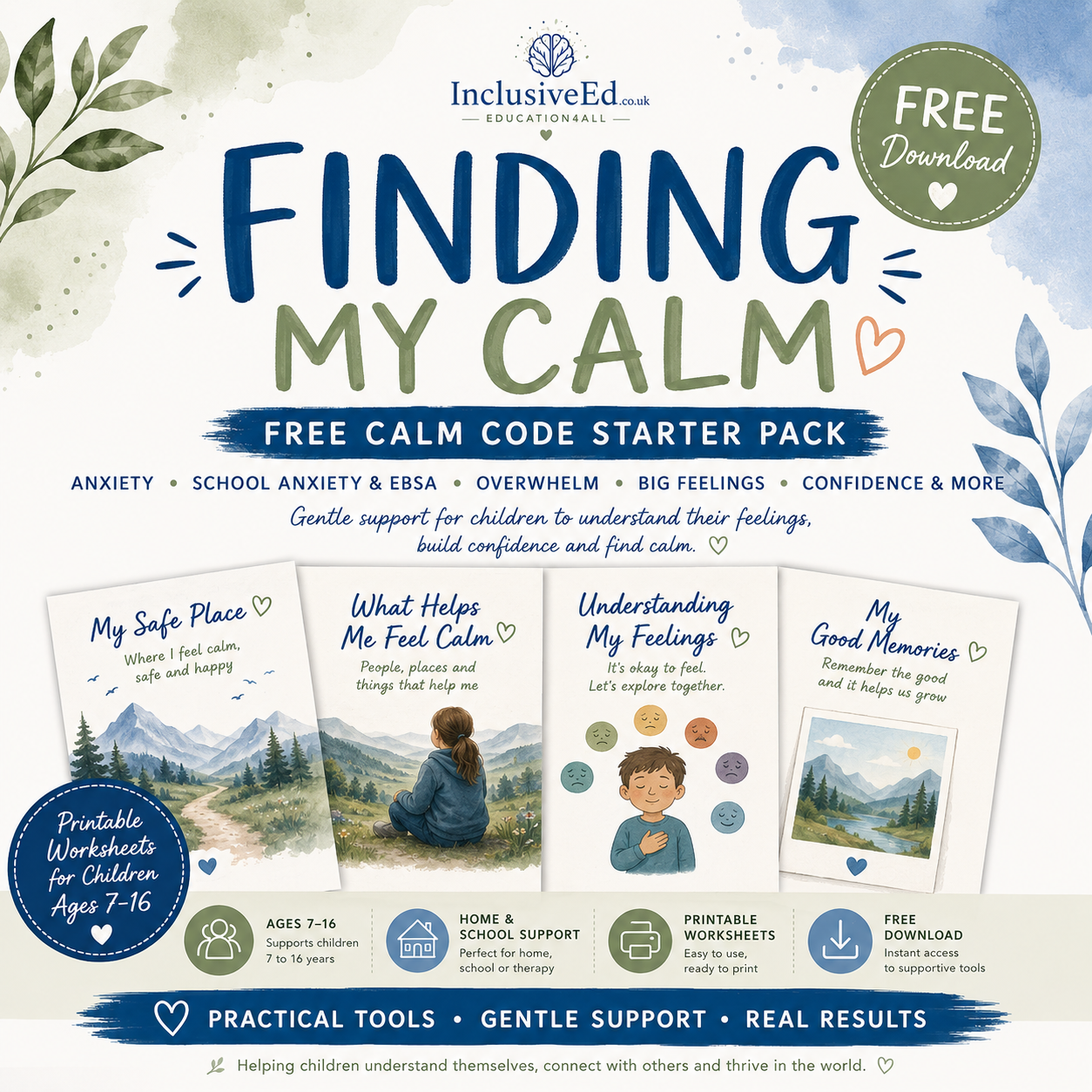
Free Anxiety & EBSA Support Pack
If you're supporting a child with anxiety, school avoidance, EBSA, overwhelm or big feelings, I've created a free printable starter pack to help children understand their emotions and begin important conversations at home or school.
Inside you'll find gentle worksheets on overwhelm, sadness, anger, calm strategies and emotional wellbeing, plus practical support from the InclusiveEd Calm Code series.
Comments ()