

Why PSHE Is Getting Harder to Teach And What Teachers Can Do When “Manosphere” Talking Points Enter the Classroom
If like me, you are engaging in certain platforms and forums where teachers share their fears you'll know that the Manosphere has a great deal to answer for. Have you noticed a shift happening in your classroom? Little comments, remarks or ideas filtering into conversations? Maybe you are a parent and you are hearing things at home that bother you. It doesn’t always arrive loudly. It often starts with small comments.
“High-value men.”
“Real women behave like this.”
“Dominance is natural.”
“Weak men don’t lead.”
At first glance, these might sound like immature repetition of things students have seen online.
But in the classroom, they create something much more serious:
A sudden tension that changes the entire tone of a PSHE lesson.
For many teachers, it’s becoming the most difficult part of the job.
The Problem Isn’t the Topic, It’s the Pressure that the topic creates in the room.
PSHE teachers are not struggling because they lack knowledge.
They are struggling because they are now expected to respond to fast-moving online ideology in real time, often without training, scripts, or support. Let's be honest, the classroom is often where these issues come to light, before understanding and mitigating strategies are in place. Teachers are on the frontline of these issues and are expected to know exactly how to tackle them.
When these ideas appear in discussion, teachers report:
- Freezing or feeling unsure how to respond
- Worrying about escalating conflict
- Fear of parental complaints
- Concern about saying the “wrong thing”
- Students dominating discussion with confident but harmful narratives that create discomfort, conflict and uncertainty.
Underneath all of this is a bigger issue: Most PSHE frameworks were not designed for today’s digital influence landscape. It's difficult to keep up with global trends, in worlds that 'we' are not a part of.
Most PSHE frameworks were not designed for TikTok-driven identity narratives or influencer-style relationship hierarchies entering classroom conversations.
So when it happens, teachers are often left improvising in real time.
And that’s where risk increases.
Why These Moments Feel So Difficult in PSHE Lessons
When students repeat manosphere-style talking points, the danger is not just disagreement.
It’s structure.
Because these ideas often arrive as:
- Confident statements, not questions
- Moral judgements, not opinions
- “Rules about people,” not discussion points
That means if a lesson is unstructured, it can quickly turn into:
- Debate spirals
- Student-to-student confrontation
- Emotional shutdowns
- Or complete silence from other students
In other words: The lesson stops being educational and becomes reactive. And reactive PSHE is where most schools feel exposed.
What Teachers Actually Need (But often are not Being Given)
The solution is not to avoid these topics, and it is not to shut down discussion completely. The real need is this:
- A safe structure that controls the format of the conversation, not just the content.
- Because when the structure is safe, the discussion becomes safe.
- And when the structure is inconsistent, even well-meaning lessons can become unpredictable.
Teachers need:
- Clear opening language
- Predictable classroom routines
- Scripts for difficult moments
- A way to reset unsafe conversations without confrontation
- A shared language across staff
- And a lesson flow that reduces emotional escalation
This is not about limiting discussion. It’s about making discussion safe enough to actually happen.
A Simple Shift That Changes Everything
One of the most effective approaches schools are beginning to adopt is a human-first structure.
Instead of reacting to content directly, teachers guide students through a sequence like:
- Needs
- Rights
- Value
- Power
- Relationships
This quietly shifts the focus away from ideology and back toward human experience.
Not by arguing.
Not by debating.
But by changing the frame of reference.
Students move from:
“This is how the world works”
to
“What does this mean for people in real life?”
That shift is subtle, but very powerful. It reduces confrontation and increases reflection.
The Missing Piece: Teacher Confidence
Even with good PSHE curriculum content, many teachers still say the same thing: “I don’t feel confident handling it when it actually comes up.” And that is the real gap.
Not content.
Not resources.
But in-the-moment confidence under pressure. Because once a comment lands in a classroom, there is no time to open a policy document or search for guidance.
You need something immediate.
Something structured.
Something safe.
What Safe PSHE Actually Looks Like in Practice
Safe PSHE lessons tend to share a few consistent features:
- A clear opening script that sets boundaries early
- Agreed classroom expectations for discussion
- Structured turn-taking (not open debate)
- A reset method when conversation becomes unsafe
- Reflective rather than confrontational questioning
- Exit tasks that bring emotional closure
When these elements are in place, something important happens:
The teacher stays in control of the format, even when the topic is challenging.
And that reduces both behavioural risk and safeguarding stress.
Why This Matters for Schools Right Now
Schools are under increasing pressure to demonstrate:
- Safeguarding awareness
- Consistent PSHE delivery
- Behaviour management in discussion-based lessons
- Ofsted-ready evidence of student understanding
At the same time, students are being shaped by fast-moving online spaces that often present:
- Simplified gender narratives
- Hierarchies of value
- Relationship “rules” framed as facts
This creates a mismatch between:
what students bring in
and
what traditional lesson structures were designed to handle
That gap is where most of the difficulty sits.
A Practical Way Forward
What schools are increasingly looking for is not another scheme of work.
It is a practical framework that teachers can actually use in real time.
Something that includes:
- Ready-to-use scripts
- Safe classroom structures
- Clear red-flag language indicators
- Reset techniques for difficult moments
- And lesson formats that reduce escalation
This is what allows PSHE to remain safe, structured, and meaningful — even when difficult topics appear unexpectedly.
Final Thought
PSHE has always dealt with sensitive topics. But today’s challenge is different. It is not just what is being discussed.
It is where those ideas come from, how confidently they are delivered, and how quickly they can destabilise a room.
Teachers don’t need more pressure.
They need structure.
And when structure is in place, something changes:
The classroom becomes calm again.
Discussion becomes possible again.
And learning becomes real again.
If this reflects what you’re seeing in your classroom…
There is a practical, ready-to-use framework designed specifically for these situations:
👉 The Human-First Anti-Manosphere Playbook
A teacher-ready system with scripts, lesson flow, safety structure, and classroom tools for handling manosphere-influenced discussions confidently and safely.
Tackling the Manosphere Safely & Without Debate, CPD PowerPoint for Schools
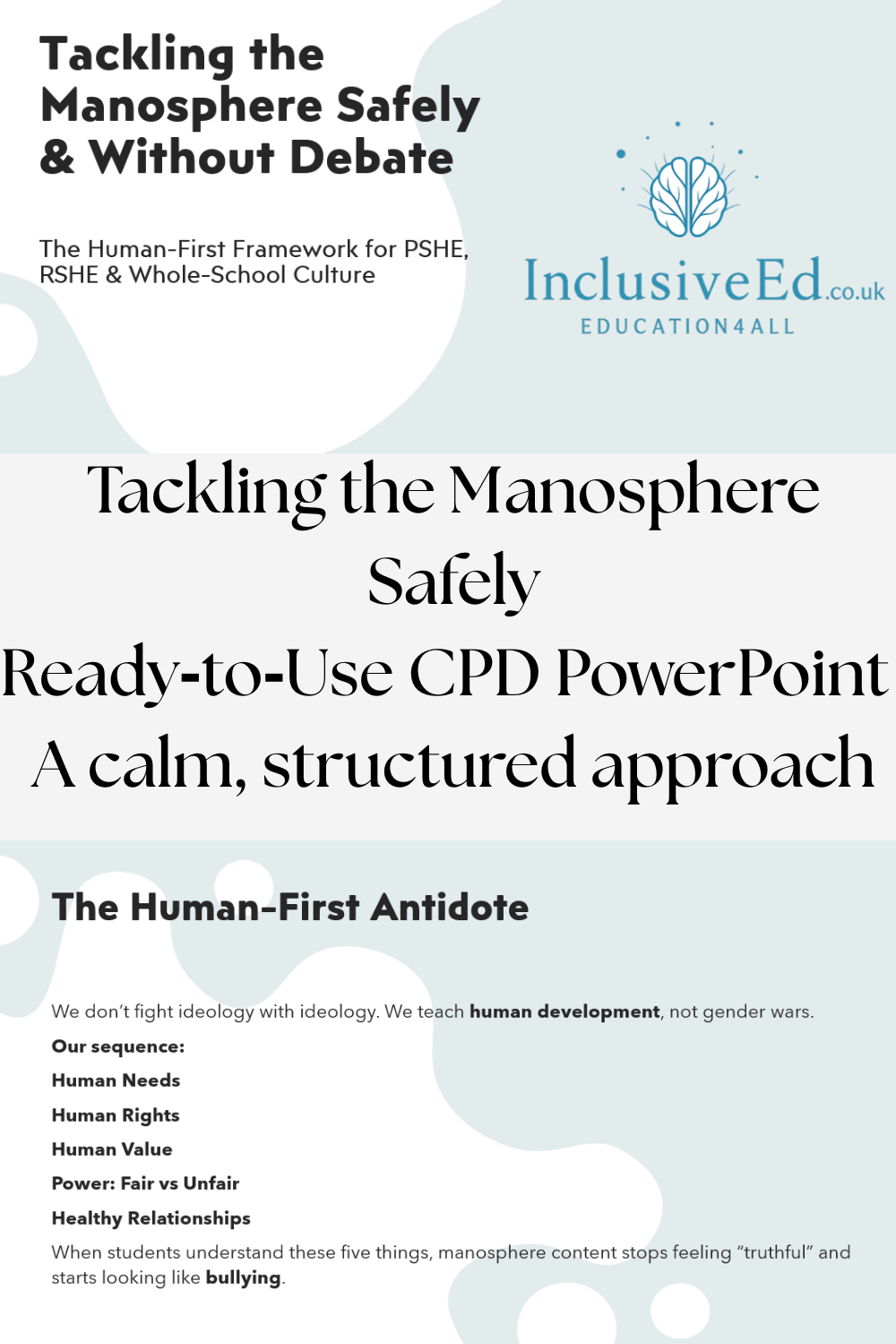
Tackling the Manosphere Safely & Without Debate, CPD PowerPoint for Schools
Comments ()