

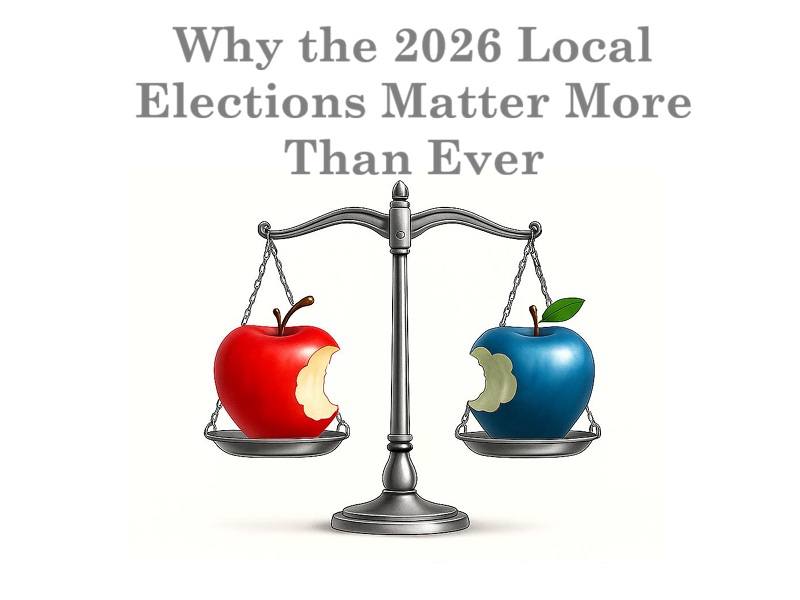
Why the 2026 Local Elections Matter More Than Ever
And why understanding left and right ideas helps you make sense of it all
Local elections rarely dominate the news cycle, yet they shape daily life in ways most people only notice when something stops working. A bus route disappears. A planning decision changes a neighbourhood. Social care delays spill into NHS waiting times. In 2026, with the UK facing economic pressure, stretched public services and shifting political priorities, these elections carry unusual weight. They determine who makes decisions about housing, transport, social care, youth services, local safety and long‑term community planning. They also reveal what voters want political parties to pay attention to next.

“Local elections don’t choose the Prime Minister — they choose the people who shape your everyday life.”
What Local Elections Tell Parties About Public Priorities
Local elections act as a national pulse check. When voters shift towards or away from certain parties, it often reflects deeper concerns about fairness, public services, economic pressure and trust. Because turnout is lower than in general elections, even small changes can send a strong message.
These results help parties understand which issues people feel are being handled well and where they believe change is needed. They also highlight which ideas are gaining traction — whether that’s calls for stronger environmental action, more investment in public services, or tighter control over spending.
“When voters change direction locally, parties listen — because it shows what people want more of, and what they’re losing patience with.”
How Political Direction Responds to Voter Behaviour
Political debate often shifts in response to what voters reward. In recent years, national politics has focused heavily on economic caution, border policy and cultural debates. At the same time, increased support for parties with strong environmental or social‑equity platforms has highlighted concerns about climate resilience, public investment and the distribution of wealth.
When these groups gain ground locally, it can encourage larger parties to revisit their own positions on taxation, public services and long‑term planning. Local results don’t decide national leadership, but they do influence how parties shape their future commitments.
The Pressures Making 2026 Especially Significant
The UK is facing a combination of challenges that make local decision‑making more important than usual:
Cost of living pressures
Councils influence council tax, local welfare schemes and economic development — all of which affect household budgets.
Housing shortages
Local planning decisions determine how much is built, where it’s built and how affordable it is.
NHS pressures
Social care, managed by councils, affects hospital capacity, discharge delays and community health.
Climate adaptation
Flood planning, energy efficiency schemes and sustainable transport are increasingly local responsibilities.
Transport and infrastructure
Road repairs, bus routes and cycling networks are decided locally and shape daily life.
Community safety
Youth services, prevention programmes and local partnerships influence safety and cohesion.
Migration and integration
Councils manage support schemes, community cohesion work and local services.
Council finances
Budget pressures force difficult choices between raising council tax or reducing services.
“The people elected locally will be the ones navigating the pressures that affect every household.”
Why the Message Sent by Voters Matters
Local election results help parties understand what matters most to communities. When voters support groups focused on environmental action, public investment or wealth taxation, it highlights concerns about inequality, climate resilience and long‑term planning. When voters move towards parties focused on fiscal restraint or local autonomy, it signals concerns about spending, governance or rapid change.
These shifts influence how parties shape their national strategies, from spending plans to policy priorities.
Why Clear Political Understanding Matters Now
With so many pressures converging, voters are trying to make sense of competing claims, shifting priorities and complex trade‑offs. Understanding how political ideas differ — and how they shape real‑world decisions — helps people vote with confidence rather than confusion.
This is where a calm, balanced guide becomes valuable.
“When you understand the ideas behind the arguments, politics becomes clearer, calmer and far less overwhelming.”
A Helpful Resource for Voters in 2026
Left vs Right: Understanding Politics in Simple Terms was written to make political ideas accessible without telling readers what to think. It explains:
- why people see issues differently
- how left and right ideas shape decisions
- how everyday concerns — housing, the NHS, the economy, climate, migration — connect to wider political beliefs
- how to question claims, spot oversimplifications and understand trade‑offs
For anyone trying to make sense of the choices facing their community in 2026, it offers a clear, straightforward starting point.
“If you want politics explained without noise, pressure or jargon, this book is for you.”
Understanding politics doesn’t require taking sides — just curiosity. And with local elections approaching, there has never been a better time to build that understanding.
PDF copy available here - GCSE Citizenship - Left vs Right, Understanding Politics in Simple Terms - Payhip
Amazon Copy available here - Left vs Right: Understanding Politics in Simple Terms eBook : Darch, Jennifer: Amazon.co.uk: Books
Comments ()