
When children are struggling with anxiety, emotional overwhelm or emotionally based school avoidance (EBSA), adults often feel pressure to make things better quickly.
We want to calm things down.
We want to help.
We want to understand what is happening.
But anxiety and overwhelm are not always easy for children to explain, especially when they are already overloaded emotionally. Some children become angry, some withdraw, some stop talking.
Some complain of stomach aches or headaches and some avoid school completely.
Some appear “fine” one day and completely overwhelmed the next.
This can leave parents, carers and schools feeling confused, worried and unsure what to do next.
Calm Code was created to help slow things down.
Not to “fix” children.
Not to force difficult conversations.
Not to create pressure.
But to help adults and children better understand what may be happening underneath the behaviour, and to build calmer communication, clearer patterns and safer ways forward together.
Understanding What Anxiety & Overwhelm Can Look Like
One of the hardest things about childhood anxiety is that it does not always look how people expect.
Children do not always say:
“I feel anxious.”
Instead, anxiety may appear as:
- anger
- avoidance
- silence
- emotional shutdown
- reassurance seeking
- physical complaints
- panic
- exhaustion
- difficulty concentrating
The early pages in Calm Code help adults recognise some of the ways overwhelm can appear in everyday life. Understanding this matters because children are often reacting to stress and overwhelm long before they can clearly explain it. When adults understand this, situations can start to feel less confusing and less personal.
Understanding Patterns, Triggers & Recovery
Children often cannot explain patterns while they are overwhelmed.
This is why Calm Code includes tools such as:
- anxiety trackers
- pattern calendars
- sensory overload checklists
- recovery reflections
These tools are not about “monitoring” children.
They are about helping adults notice:
- what increases pressure
- what environments feel harder
- what helps children recover
- when overwhelm tends to build
- and what support may reduce stress rather than increase it
Sometimes small patterns become clearer over time:
- difficult transitions
- sensory overload
- exhaustion after school
- social pressure
- uncertainty
- noise
- rushing
- too many demands at once
When patterns become clearer, support can become calmer and more consistent.
Supporting Communication Without Increasing Pressure
One of the most important parts of Calm Code focuses on communication during overwhelm.
Because overwhelmed children are not always able to talk clearly in the moment.
Some children:
- freeze
- shut down
- struggle to process questions
- become irritable
- avoid eye contact
- or say very little at all
This does not usually mean they are being difficult or manipulative.
Often, it means their brain and body are overloaded.
Pages such as:
- When A Child Cannot Talk
- Safe Communication Prompts
- and What Adults Need To Know About Me
help adults reduce pressure and create calmer ways to communicate.
Sometimes children communicate more easily:
- while walking
- in the car
- while drawing
- side-by-side rather than face-to-face
- or after they have had time to recover emotionally
Many children need emotional safety before they can fully explain how they feel.
Many do not want conversation for a while but may still need your presence or reassurance. Let them tell you what helps them and what doesn't. This will make it easier to support them when they need you most.
Helping Children Recover From Overwhelm
When children are overwhelmed, adults often feel pressure to solve the situation immediately.
But calm usually comes from reducing pressure rather than increasing it.
Calm Code includes practical low-pressure support ideas designed to help children regulate and recover.
This includes:
- calming environments
- reassurance
- sensory support
- recovery time
- quieter communication
- movement
- rest
- and helping children identify what personally helps them feel safer
Every child is different.
What calms one child may not help another.
The goal is not perfection.
The goal is understanding.
Supporting Home & School Together
Anxiety and school overwhelm often affect the whole family.
Parents may feel exhausted. Schools may feel unsure how to help consistently, especially given that a teachers time is divided between many children with multiple and often complex needs.
Children may feel misunderstood or pressured from multiple directions.
This is why Calm Code also includes:
- school anxiety planners
- home-school communication sheets
- reintegration support tools
- and practical reflection pages
These pages are designed to help adults work together more calmly and consistently.
Sometimes small adjustments can make a significant difference:
- reducing unnecessary pressure
- improving communication
- creating predictable routines
- identifying safe adults
- allowing recovery time
- and building confidence gradually
Small Steps Matter
Children do not usually recover from overwhelm overnight. Progress is often uneven. There may be good days, difficult days and setbacks along the way, and importantly, there isn't always a singular logical reason. The triggers children experience may be cumulative, a combination of many different things that build up.
That is normal.
Calm Code was created to support:
- understanding
- calmer communication
- emotional safety
- reflection
- and small practical steps forward
Not every tool will suit every child.
But sometimes simply helping a child feel:
- understood
- listened to
- safer
- and less alone
can begin to reduce some of the pressure they are carrying.
And sometimes families grow through difficult periods together, one conversation, one adjustment and one small step at a time.
If these tools sound like they will help you and a child that you are caring for here is a break down of what the different tools focus on.
Helping children in the moment - Child Anxiety Toolkit Printable, Calm Down Worksheets Workbook Ages 7-11, Coping Skills, Emotional Regulation - Etsy UK
20-page printable PDF
• Breathing tools
• Grounding techniques (5-4-3-2-1)
• Calm plan & coping strategies
• Worry and thought support pages
• Confidence-building activities
Helping children work with worry and thoughts - Child Anxiety Toolkit | Worry & Thoughts Workbook for Kids (printable PDF) - Etsy UK
• Understanding worry and anxiety
• How thoughts affect feelings
• “What if” thinking explained simply
• Calm-down strategies and grounding tools
• Worry tracker and reflection pages
• Thought-challenging activities (“Thoughts are not facts”)
• Confidence-building exercises
Helping children grow in resilience and confidence - Confidence & Emotional Regulation Workbook for Kids | Anxiety Support Printable Growth Mindset Activities | SEL Worksheets - Etsy UK
Understanding confidence (what it really means)
Small steps approach to building bravery and resilience
“What helps me feel safe” emotional awareness page
Brave Ladder activity (gradual exposure in child-friendly format)
Strengths and reflection exercises to build self-belief
Growth mindset pages (learning, progress, and persistence)
Weekly calm plan + habit tracker for daily routines
All of the above in one bundle Child Anxiety Toolkit, Worry & Overthinking Support, Emotional Regulation Activities (digital Download) - Etsy UK
Teen Anxiety Workbook | Emotional Regulation & Panic Support for Overwhelmed Teens | Calm Code Printable
✔ Understanding anxiety & overwhelm
✔ Recognising triggers & patterns
✔ Panic & emotional regulation support
✔ Reflection & calming strategies
✔ Daily check-ins & reset tools
✔ Confidence & self-awareness building
✔ Calm planning pages
✔ Gentle emotional support prompts
✔ Space for honest reflection without pressure
School Anxiety EBSA Support Toolkit | Emotional Regulation Printables (Digital Download) - School Anxiety EBSA Support Toolkit | Emotional Regulation Printables (digital Download) - Etsy
✔ Anxiety & Panic Tracker
✔ Anxiety Pattern Calendar
✔ Recovery Time Tracker
✔ Sensory Overload Checklist
✔ School Anxiety Support Planner
✔ Home ↔ School Communication Sheet
✔ Safe Communication Prompts
✔ Low-Pressure Support Ideas
✔ Reintegration Planner
✔ Calm Options Support Page
✔ Observation & Reflection Pages
✔ Understanding Overwhelm Visual Support
✔ Early Warning Signs Support Sheet
✔ Practical Home & School Tools
Free Anxiety & EBSA Support Pack
If you're supporting a child with anxiety, school avoidance, EBSA, overwhelm or big feelings, I've created a free printable starter pack to help children understand their emotions and begin important conversations at home or school.
Inside you'll find gentle worksheets on overwhelm, sadness, anger, calm strategies and emotional wellbeing, plus practical support from the InclusiveEd Calm Code series.
📥 Download the FREE Calm Code Starter Pack here: FREE Calm Code Starter Pack Anxiety, EBSA & Emotional Wellbeing Worksheets for Children - Payhip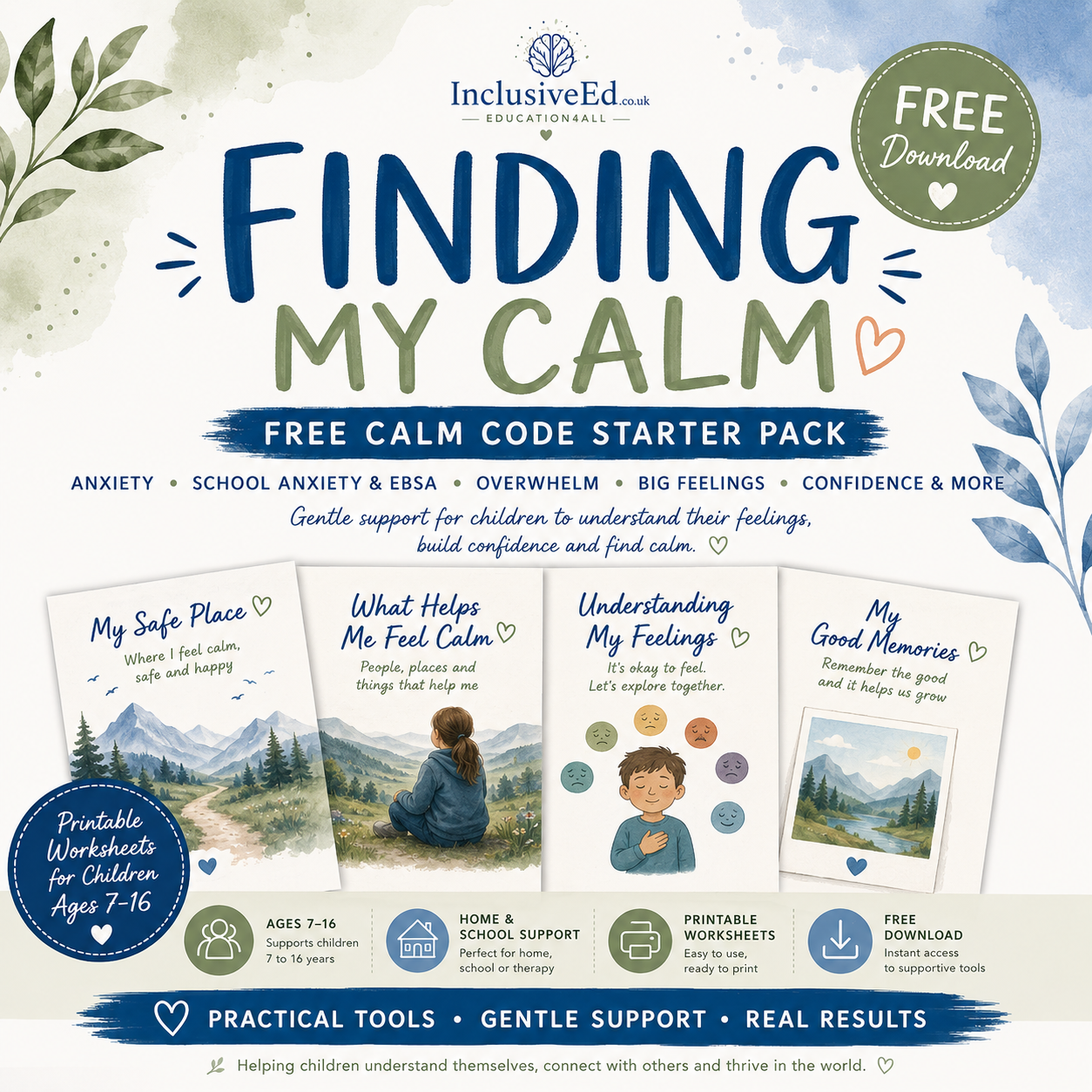
Comments ()