
Something has shifted in schools.
Across primary and secondary education, increasing numbers of children and young people are struggling with anxiety, emotional overwhelm, attendance difficulties and emotionally based school avoidance (EBSA). Persistent absence rates remain significantly above pre-pandemic levels, and many schools are reporting growing concerns around emotional wellbeing, disengagement and mental health pressures.
Teachers are often the first people to notice it.
The child who no longer speaks in class.
The student whose attendance slowly begins to fall.
The pupil who appears constantly exhausted or emotionally overwhelmed.
The young person who says they are “fine” while clearly struggling underneath.
Increasingly, schools are supporting children who are not simply finding learning difficult, but who are finding the emotional experience of school difficult.
And this is why PSHE, wellbeing and emotional safety are far more interconnected than we sometimes realise.
Children Experience School Emotionally Before They Experience It Academically
Adults often separate things into categories: behaviour, attendance, safeguarding, mental health, wellbeing, PSHE, SEND. But children do not experience school in separate boxes. For them, everything is connected.
A friendship issue can affect concentration. Fear of embarrassment can affect attendance. Feeling socially unsafe can affect participation. Online comparison can affect confidence and identity. Emotional overload can make learning feel impossible. Sometimes what appears to be disengagement is actually overwhelm.
Many children and teenagers are trying to navigate:
• friendship instability
• identity pressure
• social comparison
• online conflict
• emotional misunderstanding
• fear of judgement
• uncertainty
• sensory overwhelm
• academic pressure
• changing social expectations
— often all at the same time.
For some young people, school can begin to feel emotionally exhausting long before adults fully recognise what is happening.
The Growing Overlap Between Attendance and Emotional Wellbeing
Schools across the UK are increasingly discussing the relationship between attendance, anxiety and emotional wellbeing. Emotionally based school avoidance (EBSA) is now widely recognised as a complex issue often linked to anxiety, emotional distress, unmet needs, social pressures and feelings of unsafety rather than simple “non-compliance” or disengagement.
This does not mean expectations disappear. It does not mean schools should remove all challenge.
But it does mean we may need to think more carefully about what some behaviours and attendance patterns are communicating. Sometimes a refusal to enter the classroom is not defiance. Sometimes it is distress. Sometimes the student who appears disruptive is emotionally overwhelmed. Sometimes the child who withdraws completely is carrying far more anxiety than adults realise. And increasingly, teachers are balancing academic expectations alongside significant emotional and pastoral needs within the classroom itself.
Why PSHE Matters More Than Ever
Good PSHE is not simply about delivering information.
At its best, PSHE helps create emotionally safer environments where children can:
• explore ideas safely
• reflect on emotions and relationships
• develop empathy
• build communication skills
• understand differences
• practise respectful discussion
• develop emotional literacy
• feel less alone in their experiences
These things are not “extras.” They are protective necessities. They help children understand themselves and other people more clearly, which can positively affect confidence, behaviour, relationships and engagement with learning over time. In many ways, PSHE provides opportunities for children to develop the emotional understanding that supports learning across the wider school experience.
Emotional Safety Comes Before Emotional Regulation
Children and teenagers are far more likely to regulate emotions when they feel:
safe
heard
understood
accepted
connected
and emotionally secure. Teachers know this, whilst they are juggling everything else that the role demands. PSHE and RSHE teachers are no doubt the advocates of the fact that Emotional safety is not about removing boundaries, challenge or accountability. It is about creating environments where children feel safe enough to:
participate
communicate
reflect
recover from mistakes
ask for help
and remain engaged even when things feel difficult.
This is particularly important for children experiencing anxiety, SEND-related overwhelm, social difficulties or emotional dysregulation. Predictability, calm communication, structured discussion and emotionally safe relationships can make an enormous difference to how secure children feel in school environments.
And it is a lot for teachers. That said, with the ever growing demands on the profession it's really easy to lose sight of educational priorities.
Why Emotional Literacy Matters
Many children struggle to explain what they are feeling. Stress does not always look like sadness or tears.
Sometimes it appears as:
anger
withdrawal
shutdown
avoidance
masking
snapping
perfectionism
silence
or “difficult behaviour”.
Sometimes a child’s emotional “stress bucket” has been overflowing for weeks before anybody notices.
Helping children recognise thoughts, emotions, triggers and coping strategies can reduce emotional overwhelm and improve self-awareness over time. This is where wellbeing approaches and PSHE can work together incredibly powerfully. Not as separate initiatives, but as interconnected parts of helping children feel calmer, safer and more able to learn.
Supporting the Whole Child
Children do not need perfect schools, perfect adults or perfect emotional regulation, they need environments that help them:
feel emotionally safe
develop confidence
understand themselves
navigate relationships
build coping strategies
recover from setbacks
and feel able to participate in learning again.
Perhaps one of the most important things schools can offer children is not simply academic instruction, but emotionally safe environments where learning, wellbeing and human relationships are understood as deeply connected.
PSHE, wellbeing and emotional literacy are not competing priorities.
For many children, they are part of the foundation that makes learning possible in the first place.
What are your thoughts?
Are you seeing increasing links between wellbeing, attendance, emotional regulation and engagement in your own setting?
Do you think schools are now supporting emotional needs that extend far beyond traditional academic teaching?
I’d genuinely love to hear the perspectives of teachers, pastoral staff, SENCOs, parents and those working with children and young people.
If you would like to explore more of my resources, you can find them on TES and Teachers Pay Teachers.
My work focuses on creating structured, reflective and emotionally safe resources that support wellbeing, communication, critical thinking, personal growth and emotional literacy across education.
Many of the resources are designed around a more holistic approach to learning — recognising that confidence, relationships, resilience, self-understanding and emotional safety are deeply connected to how children engage with school, learning and the wider world around them.
The aim is not simply to deliver information, but to help children and young people develop the tools, understanding and confidence that support them socially, emotionally, academically and throughout later life.
• TES Store: [insert link]
• Teachers Pay Teachers: [insert link]
• TES Store: InclusiveEd Shop - Teaching Resources - TES
• Teachers Pay Teachers: InclusiveEd | Teachers Pay Teachers
I'm always interested to here your comments and feedback.
Free Anxiety & EBSA Support Pack
If you're supporting a child with anxiety, school avoidance, EBSA, overwhelm or big feelings, I've created a free printable starter pack to help children understand their emotions and begin important conversations at home or school.
Inside you'll find gentle worksheets on overwhelm, sadness, anger, calm strategies and emotional wellbeing, plus practical support from the InclusiveEd Calm Code series.
📥 Download the FREE Calm Code Starter Pack here: FREE Calm Code Starter Pack Anxiety, EBSA & Emotional Wellbeing Worksheets for Children - Payhip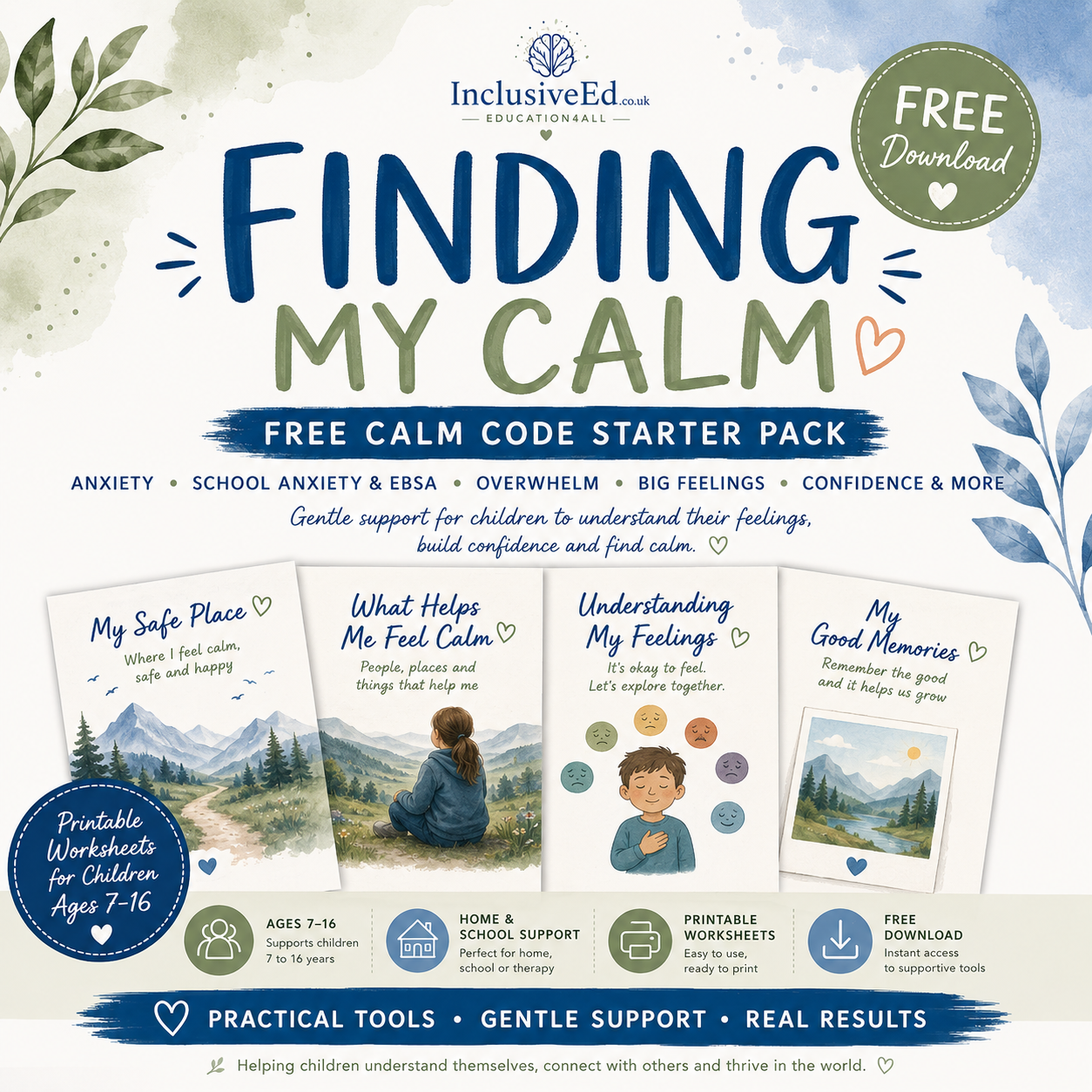
Comments ()