

When people imagine school anxiety, they often picture a child crying at the school gates.
And sometimes that does happen.
But school anxiety is often far quieter, more complicated and more misunderstood than people realise.
Some children become distressed.
Some become angry.
Some go silent.
Some seem “fine” at school and completely fall apart at home.
Others become exhausted simply trying to hold everything together.
School anxiety does not always look like fear.
Sometimes it looks like survival.
It Can Look Like Stomach Aches And Illness
Many anxious children experience physical symptoms.
They may regularly complain of:
- stomach aches
- headaches
- nausea
- dizziness
- shaking
- feeling sick
- exhaustion
- panic symptoms
These symptoms are real.
Anxiety affects the nervous system and body.
It is not “just in their head.”
Often these symptoms appear:
- before school
- on Sunday evenings
- before certain lessons
- during periods of pressure or change
Some children genuinely want to attend school but physically cannot cope with the overwhelm their body is experiencing.
It Can Look Like Anger
This is one of the most misunderstood signs of overwhelm.
Some anxious children:
- shout
- slam doors
- argue
- refuse
- become irritable
- appear defiant
But underneath that behaviour is often:
- panic
- stress
- fear
- overload
- emotional exhaustion
When children feel trapped, overwhelmed or unsafe, their nervous system can move into survival mode.
That can look like fight responses.
Not all anxious children cry.
Some explode instead.
It Can Look Like Silence
Some children become very quiet when overwhelmed.
They may:
- stop talking
- avoid eye contact
- shrug constantly
- say “I don’t know”
- freeze when asked questions
- struggle to explain what’s wrong
Others may appear calm externally while internally feeling overwhelmed.
Silence is not always refusal.
Sometimes it is shutdown.
When the nervous system is overloaded, communication can become extremely difficult.
It Can Look Like Exhaustion
Many anxious children are exhausted.
Not because they are lazy.
But because anxiety is tiring.
Some children spend the entire school day:
- masking
- monitoring themselves
- trying to stay regulated
- worrying about getting things wrong
- coping with sensory overload
- managing social pressure
By the time they get home, they may completely collapse emotionally.
This is why some parents hear:
“But they seemed fine at school.”
Many children use all their energy surviving the school day.
Home becomes the place where the overwhelm finally comes out.
It Can Look Like Avoidance
Avoidance is one of anxiety’s strongest coping strategies.
Children may:
- refuse school
- avoid certain classrooms
- struggle entering the building
- ask to come home
- avoid homework
- avoid social situations
- become distressed on Sunday evenings
- delay getting ready
- hide in toilets or safe spaces
This is often misunderstood as:
- laziness
- manipulation
- bad behaviour
- lack of resilience
But anxious avoidance usually develops because something feels too overwhelming for the child’s current coping capacity.
Avoidance is often about protection, not control.
Emotional Overwhelm Is Often The Missing Piece
Some children are not refusing learning.
They are struggling with overwhelm.
That overwhelm may involve:
- noise
- pressure
- transitions
- social expectations
- uncertainty
- sensory overload
- fear of failure
- fear of embarrassment
- constant emotional masking
When overwhelm builds for too long without recovery, children can reach shutdown, panic or burnout.
Sometimes what looks like “not coping with school” is actually:
“a nervous system under too much stress for too long.”
What Helps More Than Pressure
Children experiencing school anxiety usually need:
- safety
- understanding
- predictability
- emotional regulation support
- reduced shame
- calm communication
- manageable steps
- trusted relationships
Pressure, punishment and constant confrontation often increase fear and overwhelm.
Support does not mean removing all boundaries or expectations.
It means understanding what the child’s behaviour may be communicating underneath.
A Very Important Reminder For Parents
Many parents blame themselves.
They wonder if they:
- caused it
- missed signs
- handled something wrongly
- made their child too anxious
But anxiety can happen to children from all kinds of families and backgrounds.
Often there is no single cause.
Sometimes children themselves cannot explain why school suddenly feels impossible.
Progress is rarely linear.
Good weeks and difficult weeks often come in waves.
Small steps still matter.
School Anxiety Is Real
Children do not usually choose panic, shutdown or overwhelm.
And most do not want to struggle.
Many desperately want things to feel easier — but do not yet have the tools, support or nervous system capacity to manage what they are experiencing.
Understanding what school anxiety REALLY looks like is often the first step towards helping children feel safer, calmer and more supported again.
Helpful Resources For School Anxiety & Emotional Overwhelm
These gentle printable support tools may help children, parents and schools better understand anxiety, panic, shutdown and emotional overwhelm:
Helpful Calm Support Tools
If your child struggles with panic, overwhelm or school anxiety, these gentle printable tools may help support calm communication and recovery at home or school:
- Understanding Anxiety & EBSA - School Anxiety EBSA Support Toolkit | Emotional Regulation Printables (digital Download) - Etsy
- Calm Code for Children — Understanding Anxiety & Finding Calm - Child Anxiety Toolkit Printable, Calm Down Worksheets Workbook Ages 7-11, Coping Skills, Emotional Regulation - Etsy
- Calm Code for Teens & Young People Teen Anxiety Workbook | Emotional Regulation & Panic Support for Overwhelmed Teens | Calm Code Printable Journal - Etsy
FREE LINK TO QUICK CALM AND SUPPORT TOOLS PRINT, CUT, LAMINATE ADD TO KEY RING - for those moments when the child needs reasurence with them. Copy and paste below -
- https://acrobat.adobe.com/id/urn:aaid:sc:EU:a0db173a-35ff-4ee5-9948-51ed52fec75a?x_api_client_id=edge_extension_viewer&x_api_client_location=share
Free Anxiety & EBSA Support Pack
If you're supporting a child with anxiety, school avoidance, EBSA, overwhelm or big feelings, I've created a free printable starter pack to help children understand their emotions and begin important conversations at home or school.
Inside you'll find gentle worksheets on overwhelm, sadness, anger, calm strategies and emotional wellbeing, plus practical support from the InclusiveEd Calm Code series.
📥 Download the FREE Calm Code Starter Pack here: FREE Calm Code Starter Pack Anxiety, EBSA & Emotional Wellbeing Worksheets for Children - Payhip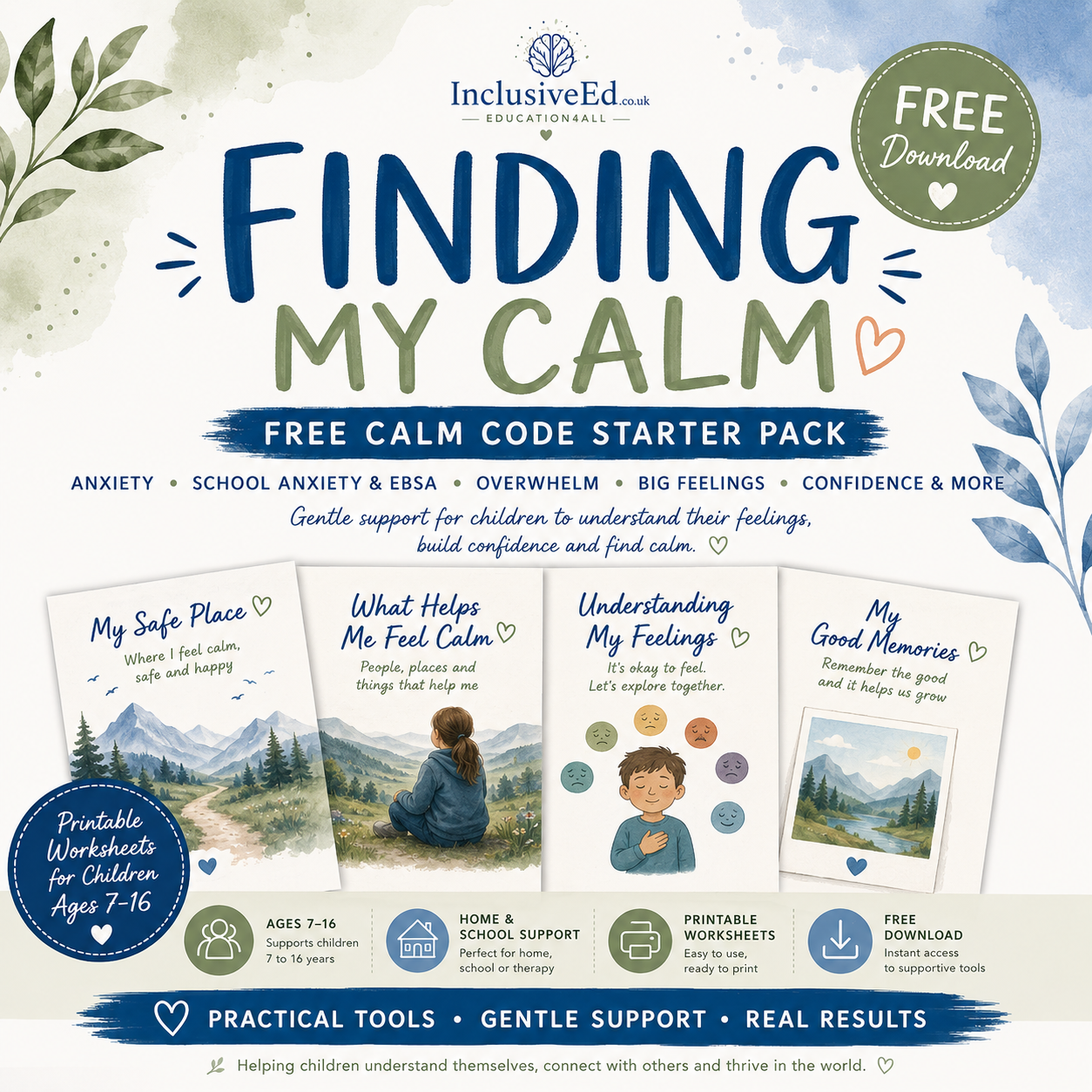
Comments ()