

There is a particular kind of fear that comes when you realise your child may be struggling emotionally.
Something feels different.
Maybe your child suddenly doesn’t want to go to school anymore. Maybe they cry more easily, seem constantly worried or emotionally overwhelmed. Maybe they complain of tummy aches every morning. Maybe they panic over small things that never used to bother them.
And suddenly, as a parent, your own thoughts become overwhelming too.
What’s happening to my child?
Why are they feeling like this?
Have I done something wrong?
Did I miss signs?
Am I helping properly?
What am I supposed to do now?
For many parents, anxiety in children comes with a huge amount of guilt and self-blame.
I know it did for me. Even though I understood logically that anxiety can affect anybody, part of me still felt shame somehow. I replayed moments in my head. I questioned decisions. I worried I had failed to protect my child from something. And if I’m honest, I also felt quite alone with it at times.
Because although lots of people talk about children’s mental health online now, very few people talk honestly about what it actually feels like when you are living it as a parent.
The exhaustion.
The second-guessing.
The fear.
The feeling that I should somehow instinctively know how to fix everything.
Despite my work with children, when anxiety hit my daughter, I felt powerless for a while. I thought I must have failed her somehow.
No parent is perfect — and life isn’t perfect either
Let’s be honest — no parent is perfect and no home life is perfect.
As parents we juggle work, stress, finances, relationships, other children, responsibilities and our own emotional struggles too. Sometimes we argue. Sometimes family life becomes loud, rushed or emotionally stretched.
I remember wondering:
Is it something we’ve done?
Something we haven’t done?
Life just is not perfect.
In hindsight, maybe I could have noticed earlier that my daughter wanted her bedroom painted in darker colours, or that some of the pictures she was drawing felt quite dark emotionally. But she was thirteen, and honestly, I had simply put some of it down to “being a teenager”.
Children experience friendship difficulties, pressure, change, loss, overstimulation, uncertainty and emotional overwhelm just as adults do — often without the vocabulary or emotional understanding to explain what is happening inside them.
And sometimes there is no single obvious reason at all.
This blog is written from one parent to another
This blog is written from one parent to another, with the value of hindsight.
It is also written by somebody who has worked professionally with children who were struggling emotionally in different ways.
It is not designed to offer miracle solutions or pretend anxiety can be fixed overnight. It is simply a calm, honest collection of thoughts, reassurance and practical ideas for parents who may be feeling overwhelmed themselves.
Because when our children are struggling, even obvious things can become difficult to see clearly.
That was certainly my experience.
And if that is where you are right now, I hope some of this helps you feel a little less alone.
Things can get better
My daughter is now 26.
Even though she left school at 13, she is now thriving at university and has been genuinely enjoying life since around the age of 16.
Does she still experience anxiety sometimes? Yes — but not on the level she did when she was younger.
More importantly, she understands herself now.
She understands:
- her triggers
- her needs
- the environments that overwhelm her
- the coping strategies that help her
- when she needs space
- when she needs support
Over the years my daughter has been able to tell me:
- the things that helped
- the things that didn’t
- the things we could probably have done better
That hindsight has taught me a great deal.
Anxiety can look very different in every child
One of the hardest things about childhood anxiety is that it does not always look how people expect it to.
Some children become quiet and withdrawn. Others become angry, emotional or overwhelmed very quickly. Some children seem completely fine all day at school and then emotionally collapse at home because home is the place they finally feel safe enough to let everything out.
Some become clingier.
Some avoid things they once enjoyed.
Some constantly seek reassurance.
Some overthink everything.
Some complain about feeling ill all the time.
And anxiety can often look physical before it looks emotional.
Children may complain about:
- tummy aches
- headaches
- feeling sick
- racing heart
- shakiness
- exhaustion
- difficulty sleeping
- feeling “funny” or “not right”
Some children also experience panic attacks or panic-like moments where anxiety suddenly feels physically overwhelming.
This can sometimes look like:
- crying uncontrollably
- struggling to breathe calmly
- freezing completely
- saying “I can’t do this”
- needing to escape situations quickly
These moments can feel frightening for both children and adults.
At the same time, it is important not to panic about every behaviour.
Lots of children enjoy quiet time after school because they are mentally exhausted from the day. Some children are naturally sensitive, thoughtful or introverted. Not every emotional child is anxious, and not every difficult week means something serious is wrong.
Children are individuals, not checklists.
“What’s wrong?” — and why children often don’t know
One of the hardest moments as a parent can be asking:
“What’s wrong?”
…and hearing:
“I don’t know.”
Children often genuinely do not know.
Anxiety can feel physical before it feels understandable. Children may feel overwhelmed, panicked or emotionally uncomfortable without having the words to explain what is happening inside them.
Sometimes children worry they are being silly or dramatic because they cannot explain themselves properly.
I remember the first time my daughter became so overwhelmed that her vision blurred and she felt so dizzy she could barely move.
I didn’t know what to do.
Should I hold her?
Talk to her?
Move her?
What I wanted to do was cry.
Afterwards, I asked her what actually helped in those moments.
That was probably one of the most useful things I did.
My daughter told me:
- she didn’t want to be stared at
- she didn’t want to be touched
- she didn’t want people panicking around her
- she certainly didn’t want to feel responsible for worrying me too
That told me something incredibly important.
What she needed most was for me to stay calm — even when inside I was falling apart.
What children may need in the moment
I remember searching desperately back then for the “right” answer.
The truth is:
there is no perfect script for helping anxiety.
But many children benefit from:
- calm adults
- reassurance
- patience
- predictable routines
- emotional safety
- feeling listened to
- opportunities to talk without pressure
- quiet recovery time after overwhelming situations
- small confidence-building steps
Sometimes children need space.
Sometimes they need closeness.
Sometimes they need movement, distraction or humour.
Sometimes they simply need somebody to sit quietly beside them without demanding explanations or trying to solve everything immediately.
Very often, children need adults who can stay calm when they cannot.
What children often do NOT want
When adults are worried, we naturally want to fix things quickly.
But anxiety rarely disappears because somebody says:
“Don’t worry.”
Children who are overwhelmed often do not want:
- pressure to explain everything immediately
- too many questions all at once
- criticism
- comparisons to other children
- to feel rushed
- to feel like a problem that needs “fixing”
Many children respond better when adults slow things down and help them feel safe first.
Is their environment calm and peaceful?
This might sound obvious, especially given my professional background where calm rooms and quiet spaces were common.
But home life is real life.
We had other children. Busy schedules. Stress. Noise. Arguments sometimes.
Our home was not silent or perfect. Far from it.
And my daughter’s bedroom certainly did not look particularly calm or peaceful at the time.
Eventually we redecorated it, but in reality her “calm spaces” turned out to be:
- sitting quietly drawing or creating things
- walking through the countryside with me or her dad
- spending time at her auntie’s quieter house
- being outdoors
- having space away from pressure
She stopped wanting televisions, noise and constant stimulation around her.
Modern life can feel incredibly busy and overwhelming for anxious children.
Children who feel emotionally overwhelmed are often highly sensitive to:
- chaos
- shouting
- constant pressure
- unpredictability
- overstimulation
- rushing from one thing to the next
- tension around them
In hindsight, my husband and I did argue and bicker at times. Back then I thought it was just normal family life.
Years later my daughter told me how difficult she had found that emotionally.
Hindsight again.
But we did slowly start making changes:
- calmer evenings
- quieter routines
- less rushing
- more emotional warmth
- more predictable expectations
- safer spaces to decompress
- less unnecessary pressure
And those small things genuinely mattered.
Getting help can feel painfully slow
One of the hardest parts for many parents is that support can take time.
Waiting lists can feel endless. Schools may not always fully understand immediately. Children themselves may struggle to engage with support at first. And sometimes progress is so gradual that you barely notice it happening.
But small things matter.
A child talking slightly more.
One calmer morning.
One school day managed successfully.
One less panic moment.
One difficult situation handled differently.
These things count.
Even when it feels like nothing is changing, children are often slowly building emotional safety, confidence and coping skills underneath the surface.
What children need to know
Children often need reminding:
- that they are loved
- that they are safe
- that these feelings can pass
- that many people struggle with anxiety at some point in their lives
- that anxiety does not define who they are
- that life changes and difficult periods do not last forever
Children also benefit from understanding:
- what anxiety actually is
- why it happens
- what triggers it
- what calming strategies help them personally, because calming methods are very individual.
Some children respond well to breathing exercises. Others prefer movement, drawing, music, routines, humour, walking, creating things or simply riding overwhelming moments out quietly.
There is often a lot of trial and error involved and what does not help today might help six months from now.
I remember after around nine months away from hockey, my daughter quietly saying:
“I miss hockey.”
I had stopped asking if she wanted to go because I thought I was reducing pressure.
What she had heard instead was:
“I’m never going back.”
That taught me how differently children sometimes interpret silence.
You do not need to do this perfectly
Supporting an anxious child can feel emotionally exhausting.
There will be moments where you feel worried, frustrated, overwhelmed or unsure of yourself.
That does not make you a bad parent. Children do not need perfect adults.
They need adults who are trying to understand them and help them understand themselves.
Sometimes support looks less like “therapy” and more like:
- quiet chats
- car journeys
- walking together
- cooking together
- sitting together without pressure
- gently checking in
- letting children lead conversations when they are ready
My daughter tells me now that feeling heard mattered enormously to her.
At the time, both me and her dad often felt like we were getting nowhere.
But with hindsight, I can see that slowly and quietly:
- we were learning what she needed
- and she was learning about herself too
Sometimes the smallest things become the biggest things:
- feeling safe
- feeling heard
- feeling accepted
- feeling loved even on difficult days
And although you may not always realise it at the time, every small thing you do to help your child feel calmer, safer and more supported matters.
What parents need to know
You are not alone.
Many children struggle with anxiety, and sometimes the exact reason may never be fully understood.
You are more capable of helping your child than you probably realise — even when it feels like nothing is working.
There are other parents who understand exactly what this feels like.
And over time, many children do learn:
- how to understand themselves
- how to recognise triggers
- how to cope more effectively
- how to feel calmer and more confident again
This journey can take time.
But sometimes it also becomes a journey that brings families closer together in ways they never expected.
Final thoughts
Anxiety can feel frightening for children and emotionally draining for the adults trying to help them.
But many children do gradually learn to understand their feelings, manage anxiety and build confidence over time.
There is no perfect child.
No perfect parent.
And no single “correct” way through anxiety.
What matters most is creating spaces where children feel safe, understood and supported as they grow.
Calm Code for Children™
After years of both personal and professional experience, I eventually created the Calm Code for Children™ resources to support some of the things I wish I had understood earlier.
The series gently explores:
- understanding anxiety
- recognising feelings and triggers
- calming strategies
- confidence building
- emotional resilience
- coping tools for real-life moments
The resources are designed to feel calm, practical and emotionally safe for children and the adults supporting them — not overwhelming, clinical or full of theory.
Because sometimes children do not need perfection.
They simply need support that helps them feel understood.
Helping children in the moment - Child Anxiety Toolkit Printable, Calm Down Worksheets Workbook Ages 7-11, Coping Skills, Emotional Regulation - Etsy UK
Helping children work with thoughts - Child Anxiety Toolkit | Worry & Thoughts Workbook for Kids (printable PDF) - Etsy UK
Helping children grow in resilience and confidence - Confidence & Emotional Regulation Workbook for Kids | Anxiety Support Printable Growth Mindset Activities | SEL Worksheets - Etsy UK
All of the above in one bundle Child Anxiety Toolkit, Worry & Overthinking Support, Emotional Regulation Activities (digital Download) - Etsy UK
Teen Anxiety Workbook | Emotional Regulation & Panic Support for Overwhelmed Teens | Calm Code Printable
Free Anxiety & EBSA Support Pack
If you're supporting a child with anxiety, school avoidance, EBSA, overwhelm or big feelings, I've created a free printable starter pack to help children understand their emotions and begin important conversations at home or school.
Inside you'll find gentle worksheets on overwhelm, sadness, anger, calm strategies and emotional wellbeing, plus practical support from the InclusiveEd Calm Code series.
📥 Download the FREE Calm Code Starter Pack here: FREE Calm Code Starter Pack Anxiety, EBSA & Emotional Wellbeing Worksheets for Children - Payhip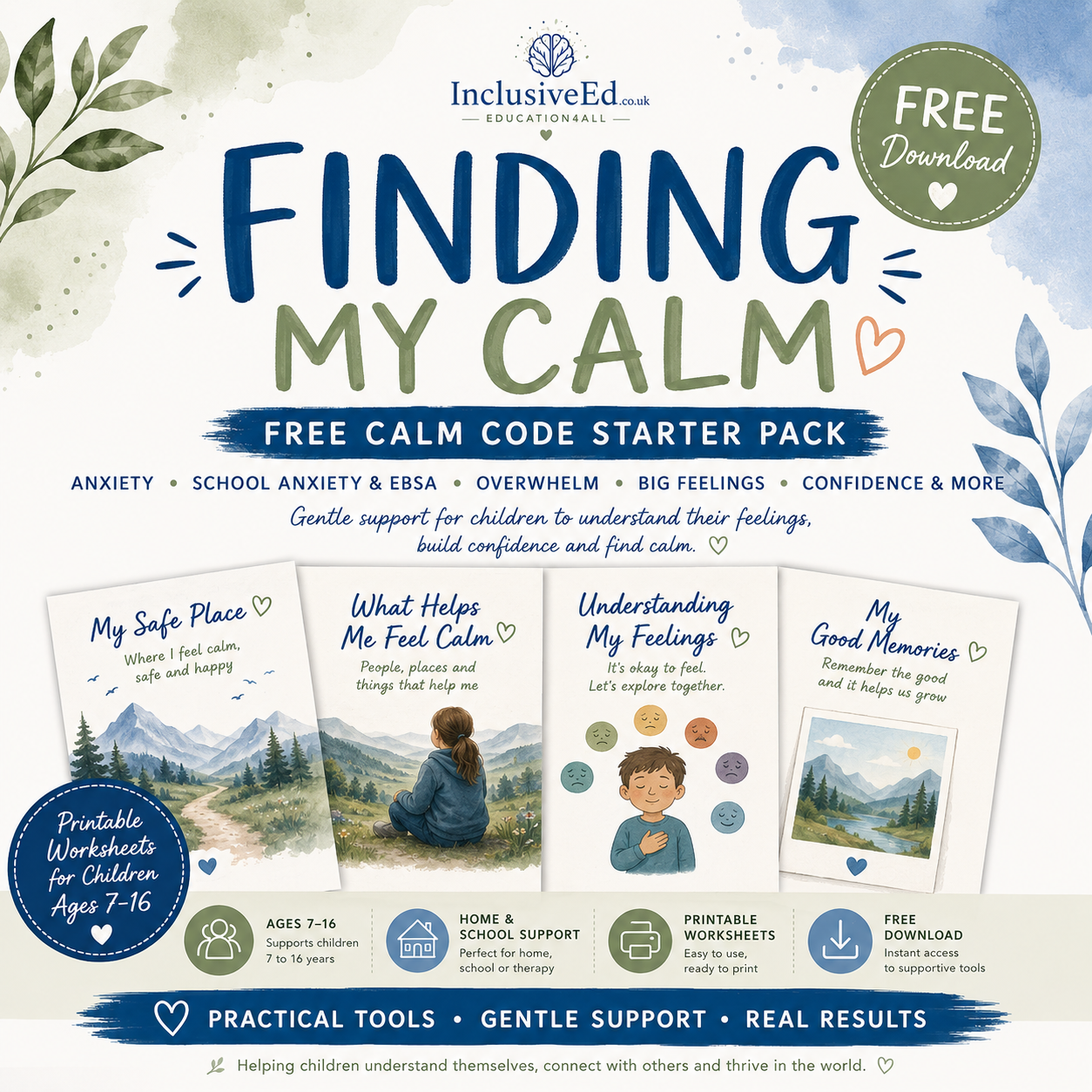
Comments ()