
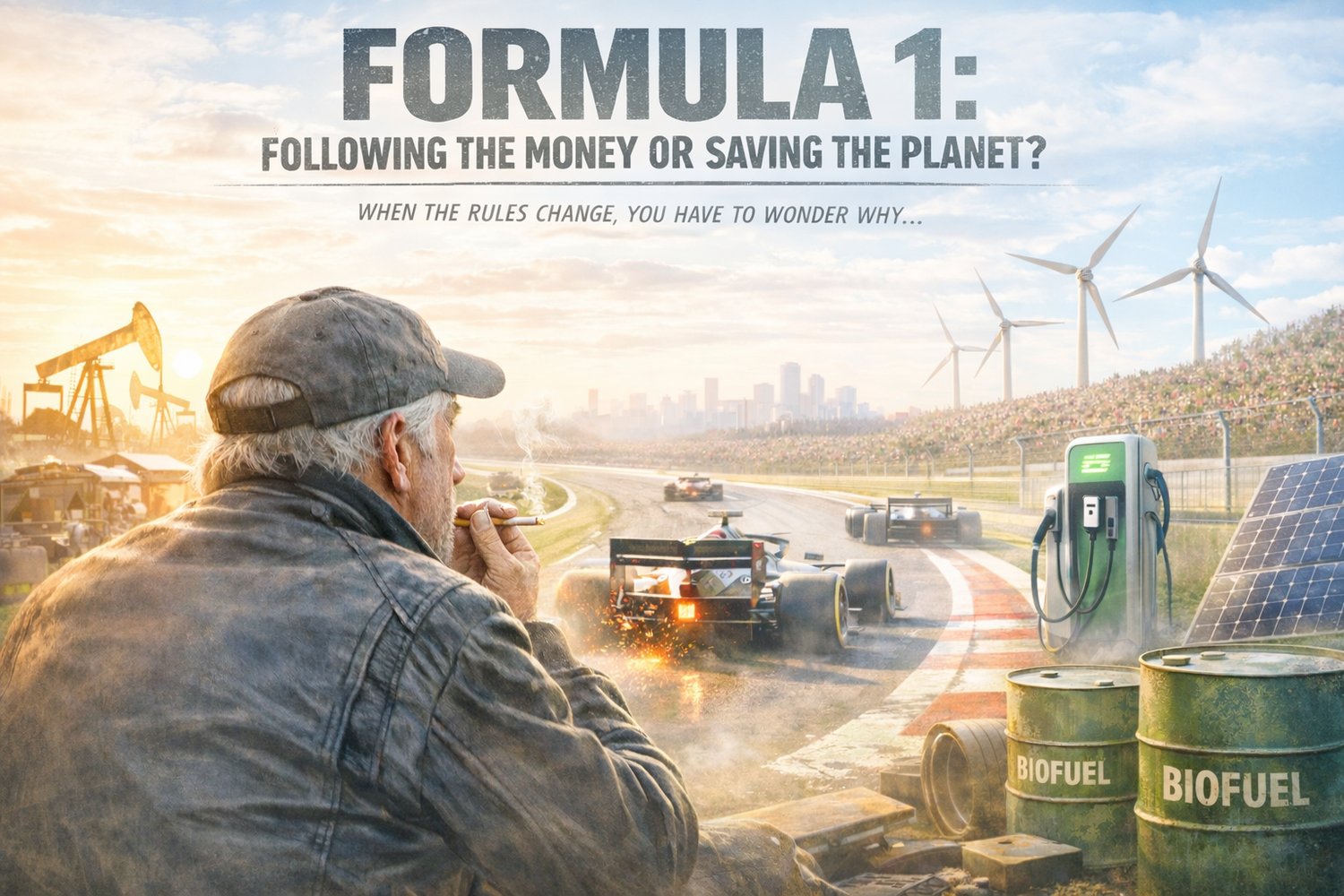
Now, first things first. I am not a conspiracy theory type of person, really not. But with age, you start noticing patterns, and if you are anything like me, you begin to ask one simple question: why?
Formula 1 used to lead. That’s how it felt, anyway. Engineers would push the limits of what was possible, and the road car industry would follow. New ideas, better performance, smarter engineering, it all trickled down from the track to everyday cars.
These days, in the 21st century, it feels like that has flipped. The road car industry now seems to be setting the direction, and Formula 1 is reacting. Almost as if the message is, “Go green,” and Formula 1 simply answers, “Yes, sir.”
That shift is what makes me pause.
Biofuels are not new. They have been around since the early days of motoring. Yet for decades, they sat in the background while fossil fuels took center stage. I understand why traditional fuels are powerful, consistent, and efficient. Engines respond better, performance is sharper, and the entire system was built around them. There were also real concerns about farming, fuel crops competing with food production.
All of that makes sense.
But now, suddenly, there is a strong push toward electric and biofuel technologies. Not slowly, not cautiously, but aggressively. And that raises the question again: why now?
The official answer is clear: environmental concerns, climate change, and the need to reduce emissions. Science points to faster changes than in the past, and industries respond. That is the explanation we are given.
Still, I cannot shake the feeling that there is more to it.
The Fédération Internationale de l'Automobile includes figures from all over the world, including regions built on oil wealth. That alone does not prove anything, but it does make the sudden enthusiasm for green technology feel… unusual.
At the same time, Formula 1 itself no longer feels like the raw sport it once was.
I have been watching since the late 80s, and something has changed. There was a time when high-octane fuel, mechanical grip, and driver instinct defined the race. Drivers wrestled the car. Mistakes were human. Skill was visible.
Now, the cars feel different. Energy systems, battery deployment, complex electronics, it all plays a role. Overtakes are sometimes less about daring moves and more about who has energy left to deploy. The car slows, the battery fades, and positions change again.
Yes, it is still racing. Yes, the engineers will improve things. But for the first time, it leaves a bad taste in my mouth.
It no longer feels like man versus machine. It feels like a man with a machine, guided by systems most people will never fully understand.
Perhaps that is progress.
Or perhaps it is something else.
I am not saying there is a grand conspiracy. Most of those theories fall apart under scrutiny. But I have learned this much over the years: when large, powerful systems shift direction quickly, it is rarely for a single reason.
There is always a mix of money, influence, pressure, and opportunity.
So yes, maybe this push is about the environment. Maybe it is necessary. Maybe it is even the right thing to do.
But it is also fair to ask questions.
After all, twenty-four cars on a track are not going to change the planet. Formula 1 was never the problem.
Yet it is changing anyway.
And maybe that is the real point.
Formula 1 is no longer leading the future.
It is adapting to it.
The question is whether that future is being shaped for the right reasons, or simply by the strongest forces behind it.