
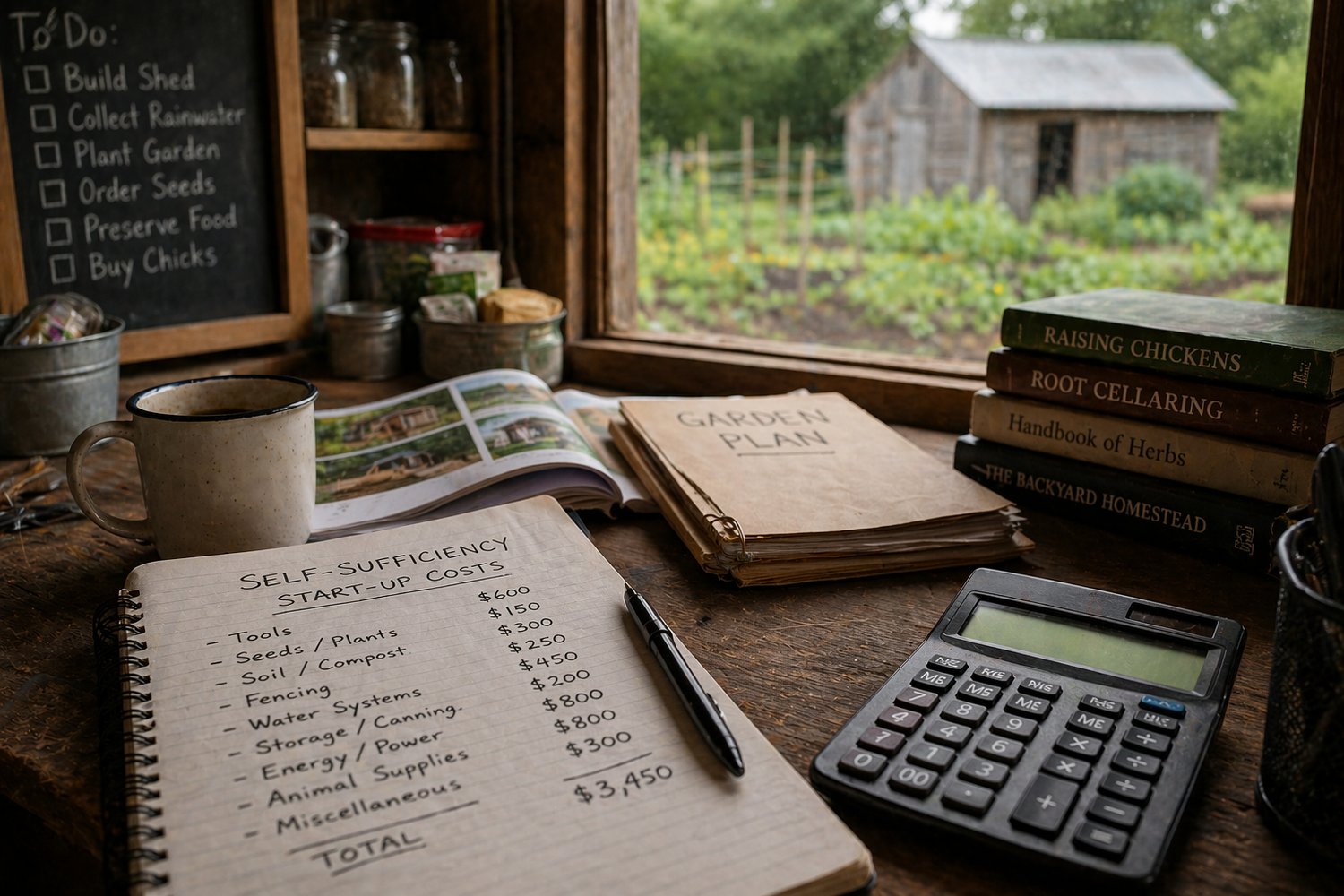
At the beginning, the idea of self-sufficiency often feels surprisingly within reach. You sketch out a plan in your head, maybe jot down a list of what you’ll need, and it all seems manageable. Grow your own food, store some water, reduce your reliance on outside systems, it sounds practical, even efficient. There’s a quiet sense that you’ve discovered a more sensible way of living, something more stable than what most people rely on.
That feeling doesn’t last unchanged for very long.
Once you move from the idea into the early stages of doing, the first cost begins to show itself, and it isn’t financial. It’s the amount of time and attention required just to understand what you’re getting into. You start researching soil, climate, planting cycles, water systems, and preservation methods, and very quickly you realise that most of the information available is either incomplete or contradictory. What works perfectly in one environment fails completely in another, and the gap between theory and practice becomes difficult to ignore.
This stage doesn’t look expensive on paper, but it carries a real cost. Time spent learning is time not spent building, and mistakes made early tend to echo into later stages. There’s no way to shortcut this part entirely, and most people underestimate how long it takes to develop even a basic level of confidence in what they’re doing.
The financial side follows closely behind, and while it’s more visible, it tends to grow in ways that are easy to underestimate. A simple garden is rarely just a packet of seeds and a patch of soil. If the ground isn’t suitable, you’ll need to improve it. That might mean compost, fertilisers, or building raised beds. Tools become necessary very quickly, and the difference between something that lasts and something that fails after a few uses is often the difference between buying once and replacing it repeatedly.
Water introduces another layer of cost that people often overlook. As long as you’re connected to a reliable system, it’s easy to treat water as a constant.
The moment you try to manage it yourself, it becomes something that requires planning, storage, and sometimes filtration. Each of those steps adds complexity and expense, and none of them are optional if you’re aiming for any level of independence.
What makes these costs more challenging is that they don’t arrive all at once. They build gradually, spreading across different parts of your setup. A hose here, a tool there, a repair you didn’t expect, a system that needs adjusting. Over time, these additions form a steady upward pressure on both your budget and your time, and it’s only when you look back that you realise how much has been invested.
There is also a pattern that tends to repeat itself, especially in the early stages. In an effort to save money, it’s tempting to start with the simplest or cheapest version of everything. Sometimes that works, particularly for smaller experiments, but often it leads to doing the same job more than once. Tools break, setups fail, or systems prove inadequate under real conditions. When that happens, you either repair, replace, or rebuild, and the initial saving turns into a delayed cost. Over time, most people learn that certain parts of the system benefit from being done the first time properly, even if it feels like a larger commitment up front.
Beyond money and time, there is a physical element that becomes more noticeable as the system grows. Maintaining even a modest level of self-sufficiency requires consistent effort. Tasks don’t disappear because the weather is inconvenient or because you’re tired. Plants need attention, structures need maintenance, and small issues have a tendency to become larger ones if they’re ignored. The work itself is not necessarily overwhelming, but it is steady, and it accumulates in ways that demand regular involvement.
Alongside the physical effort comes a shift in how you think. Planning becomes a constant background process. You start looking ahead to the next season, the next harvest, the next potential failure point. Decisions are no longer isolated; they connect to each other in ways that affect how well the entire system holds together. This ongoing awareness is part of what makes self-sufficiency effective, but it also adds a layer of responsibility that doesn’t switch off at the end of the day.
None of this means the pursuit itself is misguided. It simply means that the cost is broader than it first appears. If the expectation is that self-sufficiency will quickly reduce expenses or simplify life, the reality can feel frustrating. The return on investment takes time, and in some cases, it takes longer than expected to see tangible benefits.
However, if the goal is to build resilience, the perspective changes. What you’re developing is not just a collection of tools or systems, but a set of skills and an understanding of how to operate without relying entirely on external support. That knowledge compounds over time, and its value becomes clearer in situations where adaptability matters more than convenience.
The real cost of starting a self-sufficient lifestyle is not just measured in money. It includes the time spent learning, the effort required to maintain what you build, and the willingness to absorb mistakes along the way. For those who continue, the cost becomes part of the process rather than a barrier to it.
What matters most is entering it with a clear understanding of what that process involves. Not the simplified version, but the one that includes the setbacks, the adjustments, and the steady work required to make it sustainable.