
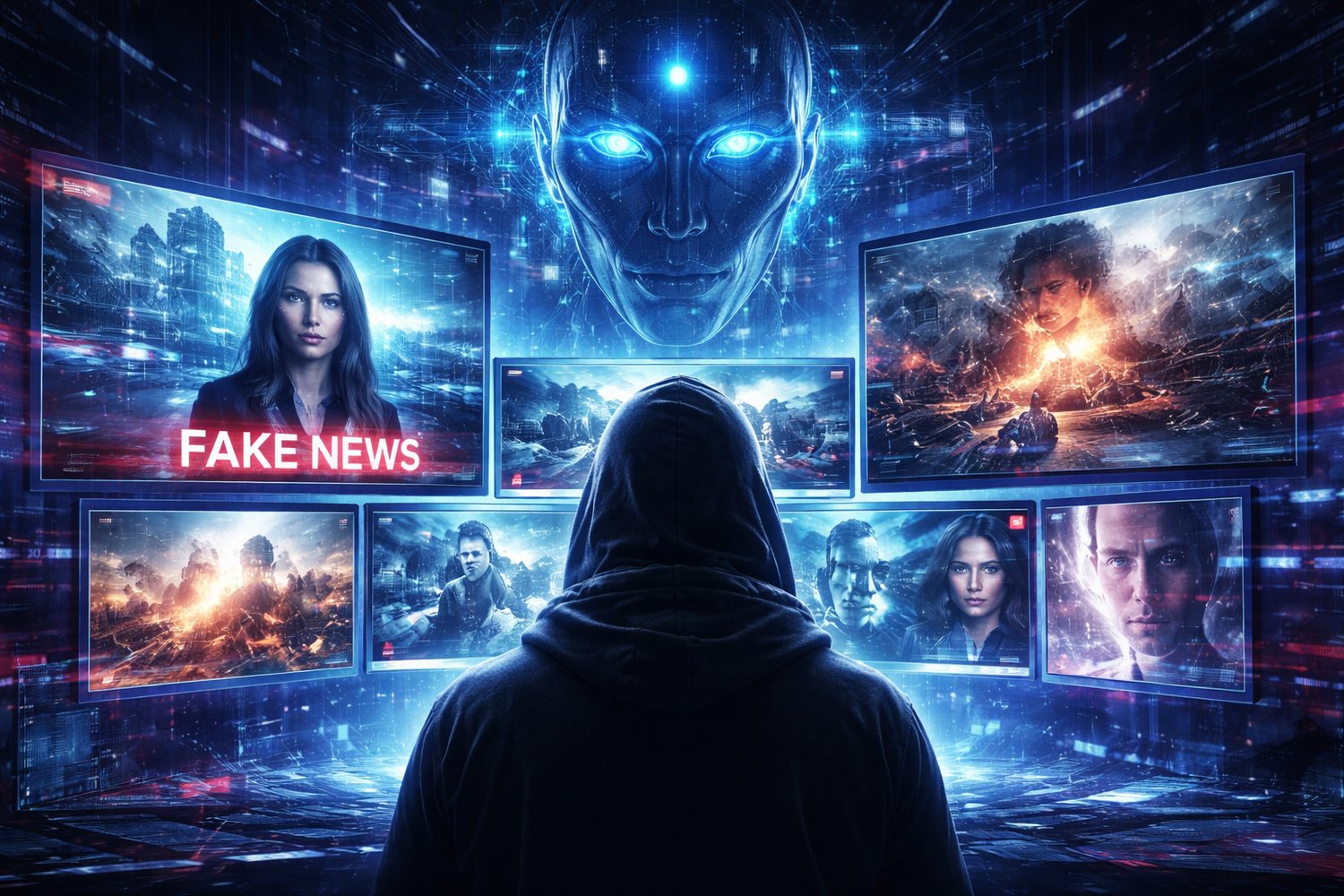
There was a time, not so long ago, when seeing meant believing. A photograph carries weight. A video felt like proof. If something unfolded before your eyes on a screen, it was assumed to be real, or at least anchored in reality. But that quiet agreement between truth and image has begun to unravel, thread by thread, until now we find ourselves staring at a world that looks convincing… but often isn’t.
Welcome to the age of the almost-real.
AI-generated videos, synthetic voices, deepfakes, fabricated headlines, staged “events”, they are no longer rare curiosities or experimental tricks. They are everywhere. They slip into our feeds, whisper through our speakers, and present themselves with an unsettling confidence. A politician says something they never said. A disaster appears in a place it never happened. A war seems to erupt overnight, complete with footage, commentary, and emotional reactions, only for it to dissolve later into nothing more than a digital illusion.
And the most dangerous part?
It looks real.
Not clumsy. Not obviously fake. Not something you can laugh off and scroll past. It looks polished, urgent, and immediate. It feels like the truth, dressed in high definition.
We are entering a strange new territory where reality is no longer defined by what we see, but by what we can verify, and verification, as it turns out, is a much harder task than simply watching a video.
Imagine this: you wake up, check your phone, and see footage of a city in chaos. Smoke rising, people running, sirens blaring. Clips spread rapidly, shared by thousands. Comments pour in, fear, anger, outrage. It feels immediate. It feels important. It feels like something you must react to.
But hours later, doubt creeps in. A detail seems off. A building that doesn’t belong to that city. A shadow that moves unnaturally. A voice that sounds human, but not quite. Then the truth emerges: the entire thing was generated. Not filmed. Not witnessed. Created. The event never happened.
But the reaction did.
That’s the shift. That’s the fracture line in our reality. The consequences of something fake can be entirely real. People panic. Markets move. Opinions harden. Trust erodes, and once that trust is shaken, it doesn’t easily return.
We used to worry about misinformation, incorrect facts, biased reporting, and manipulated narratives. Now we are facing something deeper: manufactured evidence. It’s no longer just about telling a false story. It’s about showing you something that never existed and making you believe you saw it yourself.
It’s a subtle but powerful transformation. Before, you could question a claim. Now, you have to question your own perception. Did that really happen? Did I really see that? Can I trust this?
Those questions linger longer than they used to, and the more often we ask them, the more uncertain everything becomes. There’s another layer to this problem, one that doesn’t shout but quietly reshapes how we think: confusion. Not dramatic, headline-grabbing confusion, but a slow, steady fog that settles over our understanding of the world.
When everything could be fake, everything becomes slightly suspect. A real video of a real event? Maybe it’s edited. A genuine speech? Could be synthesized. An authentic photograph? Possibly altered. This doesn’t just make us more cautious; it makes us more uncertain. And prolonged uncertainty has a strange effect on people. Some become hyper-skeptical, doubting even verified truths. Others give up trying to distinguish fact from fiction altogether, accepting whatever aligns with their existing beliefs.
In both cases, the result is the same: a fractured reality where shared understanding begins to crumble, and without shared understanding, communication itself starts to weaken. Think about it, how do you have a meaningful conversation about the world if you and someone else can’t even agree on what actually happened? It becomes less about truth and more about perception.
Less about evidence and more about belief. That’s where the danger truly lies. Because once truth becomes optional, manipulation becomes easy. AI-generated content doesn’t just confuse; it can be used deliberately. To influence. To mislead. To provoke emotional reactions that drive behavior. A fake crisis can incite real panic. A fabricated conflict can fuel real anger. A synthetic voice can spread a message that feels personal, persuasive, and immediate.
And it can all be done at scale.
That’s what makes this different from anything we’ve faced before. It’s not just that false content exists; it’s that it can be produced rapidly, convincingly, and endlessly. There’s no natural limit. No physical barrier. Just code, data, and intent.
An entire world can be constructed in minutes. A believable lie can circle the globe before the truth even has a chance to put on its shoes. And when the truth finally arrives, it often feels quieter. Less dramatic. Less engaging. It doesn’t carry the same emotional punch as the fabricated version. So people remember the lie. Even after they know it’s false.
That lingering impression, the emotional residue of something that never happened, is one of the most difficult things to undo. But this isn’t just about technology. It’s about us. Our attention. Our instincts. Our desire for stories that feel immediate and impactful. AI didn’t create those tendencies; it amplified them.
We are drawn to what feels urgent, what sparks emotion, what demands a reaction. And fake content is often designed with that in mind. It doesn’t aim to inform, it aims to engage. To hook you in the first few seconds. To make you feel something strong enough that you don’t stop to question it.
And in a fast-moving digital world, pausing to question something is becoming a rare habit. Scroll. React. Share. Repeat. The cycle moves quickly, and within it, the line between real and fake becomes increasingly blurred. So what happens next?
Do we retreat into skepticism, questioning everything until nothing feels certain? Do we accept the blur and move forward, even if it means occasionally believing something untrue? Or do we adapt?
Because adaptation might be the only real path forward.Not by rejecting technology, but by changing how we engage with it. Learning to pause before reacting. To look for sources, not just visuals. To question not just what we see, but how it’s presented. To accept that in this new landscape, seeing is no longer enough. It’s not an easy shift. It requires effort, attention, and a willingness to sit with uncertainty a little longer than we’re used to. But it also opens up a new kind of awareness, a more deliberate way of understanding the world.
One where truth isn’t assumed, but discovered.
And perhaps that’s the strange paradox of this fake world: it forces us to become more thoughtful, more curious, more cautious. It challenges the shortcuts we’ve relied on and asks us to engage more deeply with the information we consume.
Still, the risks remain. Because not everyone will adapt at the same pace, and some will continue to trust what they see. Others will trust nothing at all. And in that gap, confusion grows. So we stand at an unusual crossroads, not between truth and falsehood, but between clarity and uncertainty. The tools we’ve created are powerful, creative, and, in many ways, extraordinary. But like all powerful tools, they come with consequences that ripple far beyond their original purpose.
We wanted to create. We succeeded. Now we must learn how to live with what we’ve made. Because this fake world isn’t somewhere else. It isn’t a distant possibility or a future concern. It’s here. It’s in our feeds, our conversations, our perceptions. It’s shaping how we see the world, quietly, persistently, and sometimes invisibly. And the challenge before us isn’t just to identify what’s fake.
It’s to hold on to what’s real.
Even when it’s harder to see.
All over the world, free speech is under attack, yet the devil in the story, AI, is hailed.